Christopher Peters Ranks Highly

According to Libertarian Party News, the official newspaper of the Libertarian National Committee, the performance of Iowa City surgeon and Libertarian Party candidate Christopher Peters in the November election ranked high among all Libertarian candidates nationwide.  In races for state legislature with either no Republican or no Democrat in the race, Dr. Peters finished sixth in the country.

Peters ran for State Senate District 15 in the heavily Democratic Johnson County.  No Republican volunteered to be a sacrificial lamb in this Democratic Party stronghold.  Peters received 25.22% of the vote, a new record for an Iowa Libertarian candidate.

Here’s the 2010 results as listed by LP News:

Top ten percentages for state legislature (either no Republican or no Democrat in the race)

  1. Sean T. O’Toole         MO State Rep., Dist. 40              33.42%
  2. Brad Hyatt                 IN State Rep., Dist.56                 31.57%
  3. Scott A. Kohlhaas      AK State Rep., Dist. 20               30.10%
  4. Jonathan Loya            MA State Rep., Middlesex 8        28.74%
  5. Ron Cenkush              IN State Rep., Dist. 5                 27.97%
  6. Christopher Peters   IA State Senator, Dist. 15        25.22%
  7. Fred Fogel                 HI State Rep., Dist. 5                  24.39%
  8. Bob Ludlow               MO State Senator, Dist. 10          23.65%
  9. Richard W. Shuey      TX  State Rep., Dist. 43               22.44%
  10. Don Crossley             IN State Senator, Dist. 27            21.72%

Way to go, Doc!

SKUNKED!

As a known third-party supporter, after an election I’m sometimes asked by friends and coworkers if any of my “weird people” won.  This year, like every year before, I can answer that all of my “weird people” were soundly handed their asses yet again.  If you just want to be on the team with the highest score you can’t vote third party.

One major disappointment came in the governor’s race however.  Regular readers will recall that Libertarian candidate Eric Cooper sought to win 2% of the vote, thereby securing “major party” status for the Libertarian Party under Iowa law.  If ever we could achieve this status, I thought 2010 would be the year.

In Cooper we had a passionate and articulate candidate who was willing to do the necessary leg work.  He garnered the most media coverage of any Iowa L.P. candidate that I’d ever seen.  There was a palpable anti-establishment buzz in the air this election season.  All the political tumblers seemed to be aligning for the L.P. to capture major party status.  When the dust settled, however, Cooper had only received 1.28% of the vote.  (14,293 total votes.)  This is a respectable showing, but it didn’t quite hit the state’s arbitrary 2% requirement.  The L.P.’s next shot for Iowa major party status will come in the 2012 presidential election.

Libertarian candidates in other races across the ballot had some decent showings also.  John Heiderscheit got 25,168 votes (2.27%) in the U.S. Senate race.  For the U.S. House, Rob Petsche got 4,072 votes (1.93%) in District 1 and Gary Sicard got 4,327 votes (1.91%) in District 2.  One of the star performers of the night was Jake Porter who was running for Secretary of State.  Porter got 33,683 votes or 3.13%.  There were only 31,000 votes separating the two major party candidates, so Porter’s votes were enough to make or break the election.  That is the main goal of a third party candidate: make the big boys sweat, so they’ll steal your issues to get those voters back the next time.

In statehouse elections, Libertarian candidate Dr. Christopher Peters got an impressive 25.22% of the vote (6,071 votes) for State Senate District 15.  This district covers Iowa City and Republicans didn’t bother running a candidate against Democrat Robert E. Dvorsky.  Peters happily jumped at the losing cause and used his candidacy to promote limited-government ideals in an area of the state not known for those ideals.  He was rewarded with the new record for highest vote percentage for an Iowa Libertarian candidate (beating Eric Cooper’s 21% record for statehouse).  Also in Iowa City (and again with no Republican running),  medical student Dustin Krutsinger got 20.44% of the vote (2,550 votes) for State Representative District 30.  In State Representative District 46, Tyler Pauly got 347 votes or 2.45%.

Even with some good results, I’m still bummed we didn’t get major party status.  And I’m bummed the Constitutional Convention vote failed.  And I’m bummed that that bumbling Bolshevik bum Bruce Braley is still my U.S. representative.  (Since “Big Borrowin’ Braley” is returning to DC, I’ve been trying to prepare my 16-month-old for his future by pointing to China on the map and trying to teach him to say “master.”) 

C’mon, I couldn’t end this thing without taking a swipe at my old buddy Clunkers (and practicing my alliteration).  That always makes me feel better.

Vote Libertarian in Iowa in November! -2010

Here’s a video produced by local Libertarian activist Brandon Echols urging everyone to vote Libertarian this year.  It features appearances from such Iowa Libertarian notables as Eric Cooper, Kevin Litten, Rob Petsche, Gary Sicard, Dustin Krutsinger, Dr.Christopher Peters, and even a mercifully short appearance by myself.  I hope you enjoy Brandon’s video.  And please, no autographs!

Dr. Cooper: Introducing Libertarianism

Here Libertarian candidate for Iowa governor Eric Cooper gives a presentation called “Libertarianism: An Introduction” at University of Northern Iowa on October 14th.  (Two parts)

Iowa Big Box Parties Hemorrhaging Voters

KCCI Des Moines reports that voter registration numbers released by the state on Friday show that both branches of the Republicrat Party are losing registered voters.

According to the article on KCCI‘s website: “In the past year, Republicans have lost 10,997 registered voters while Democrats lost 17,235 registered voters. Independents gained 7,527 voters, according to the Iowa Secretary of State’s office. […] The new numbers show 602,768 Republicans, 711,106 Democrats, 774,005 no party or independent, and 1,682 listed as ‘other.'”

Iowans are obviously dissatisfied with both parties and with the whole sullied political process. I can’t say as I blame them.

Iowa Libertarian Candidates 2010

Ed Wright, Chairman of the Libertarian Party of Iowa, recently announced the 2010 nominees selected at the Libertarian State Convention in Ames. Here are the candidates for each race:

Iowa Governor– Eric Cooper, 44, Ames, e-mail: eric@coopersmallergovernment.com, website: http://www.coopersmallergovernment.com/

Iowa Lt. Governor– Nick Weltha, 30, Des Moines, e-mail: nick.weltha@gmail.com, website: http://www.coopersmallergovernment.com/

U.S. Senate– John Heiderscheit, 46, Bettendorf, e-mail: jheiderscheit@nhquadcities.com

U.S. House District 1– Rob Petsche, 35, Manchester, e-mail: farleyrob2002@yahoo.com, website: http://www.petscheforsmallergovernment.com/

U.S. House District 2– Gary Sicard, 37, Robins, e-mail: gary@sicardforcongress.com, website: http://www.garysicard.org/

Iowa Senate District 23– Campbell DeSousa, 25, Ames, e-mail: desousacampbell@yahoo.com

Iowa House District 46– Tyler Pauly, 20, Ames, e-mail: tapastro@gmail.com

Polk County Attorney– Karen Tegtmeyer, 50, Johnston, e-mail: karen.tegtmeyer@gmail.com, website: http://www.iowasmallergovernment.com/

10 Questions with Gubernatorial Candidate Eric Cooper

Eric Cooper of Ames and Nick Weltha of Des Moines have filed papers to seek the Iowa Libertarian Party’s 2010 nomination for Governor and Lt. Governor respectively. Cooper, 43, is an Associate Professor of Psychology and Neuroscience at Iowa State University, and is currently the Vice Chairman of the Libertarian Party of Iowa. Professor Cooper was gracious enough to answer a few questions for Cold Hard Cashner via email.

Here they are:

1. How did you get involved in politics and the Libertarian Party?

I joined the party in high school after I read a pamphlet that was available in one of my government classes. When I read the pamphlet describing the Libertarian Party’s positions, I realized that they were pretty much saying everything I already agreed with. My second year as a professor at Iowa State, I was approached by a student who wanted to start a Libertarian group on campus and wanted me to be the adviser because I was one of only two faculty members who were paid members of the party. As a result of being the adviser for the Iowa State Libertarians, I started going to Libertarian State Conventions and eventually got elected to the state party’s Executive Board, and decided to start running for office.

2. What made you decide to run for governor?

I have run for the state legislature five times previously from Ames, and in 2008, I had the most successful Libertarian campaign in the state (21% of the vote). I thought, given the experience I’ve gained campaigning for the legislature, that I was in the best position of anyone currently involved with the state party to run for Governor.

3. It’s unlikely you’ll win. Why should people vote for you?

Third parties can get everything they want without winning any elections at all. The Populists in the 1890s and the Socialists in the 1910s won almost no elections, and yet most of the major planks of their platforms were eventually implemented. The way these parties were successful was to draw enough votes away from the major parties on a regular basis that the major parties started stealing their issues in order to get their voters. This strategy can still work today, and is most effective when the major parties are ignoring a particular constituency (which currently would be people who want to reduce the size of government). If Libertarians can get 10% of the vote on a regular basis, that is enough to decide most elections between the major party candidates and will lead the major party candidates to start stealing our issues.

The reason it is important for people to vote for me for Governor is because under Iowa law, if the top candidate on a party’s ticket (which is the President during Presidential election years and the Governor in non-Presidential election years like 2010) gets 2% of the vote, that gives the party major party status in Iowa. If I get 2% of the vote, the Libertarian Party gains major party status meaning that we no longer have to petition to get our candidates on the ballot, thus making it far easier for us to run lots of candidates putting lots of pressure on the major parties to steal our issues.

4. Iowa has some of the strictest gun laws in the nation. Iowa is one of only 14 states that requires a special permit to acquire a handgun. It is one of only 13 states that doesn’t have “shall issue” laws requiring that weapons carry permits be issued to applicants who meet uniform standards. What changes would you like to see in Iowa’s weapons laws and what could you do as governor to facilitate them?

Laws are, of course, a matter for the legislature, however as Governor, one can certainly make suggestions to the legislature about what sorts of legislation might be a good idea. I don’t think there should be restrictions on peaceful people owning any sort of gun, and I think they should be able to carry those guns concealed if they so choose.

5. Because of the Iowa high court’s recent decision, gay marriage has come to the forefront of political discussion. What is your position on gay marriage and what (if anything) would you do as governor regarding this issue?

People come to America in order to follow their own cultural traditions. Peaceful people should be able to have whatever relations with other people that they would like, and they should be able to call them whatever they like. The government goes well beyond its enumerated powers when it starts deciding what does and does not constitute marriage.

6. There is currently some discussion of allowing medical marijuana to be used with a prescription in Iowa. Do you support this effort and what other changes in this area would you like to see?

I would support the legalization of medical marijuana, recreational marijuana, ornamental marijuana, and pretty much anything else that someone would like to do with marijuana. It is absolutely contradictory to the notion of a free society that the government should be dictating to adult citizens what they may or may not place into their own bodies. The drugs that are currently illegal are far less dangerous than many activities that are permitted (driving private automobiles and alcohol use are good examples), but because drug users are in the minority, the activities that they enjoy are made illegal while more dangerous activities that the majority likes are permitted. My first act as Governor would be to pardon all non-violent drug offenders currently in Iowa prisons. If the founding fathers of the United States were to see the sort of government we have today, I don’t think anything would shock them more than that we would allow the government to tell adult citizens what they are allowed to consume. One cannot honestly call oneself a free man when one has lost the right to decide what goes into one’s own body

7. On your website you say that “Iowa is currently doing education in about the most inefficient way possible.” How so and how would you remedy that?

The government is a monopoly and, like all monopolies, it has very little incentive to be cost effective and very little incentive to please its customers. In education, we have a market that should be extremely competitive if its provisioning was left to the free market because it is relatively inexpensive to start a school so there would be lots of competition among schools. The more competitive a market is, the more benefits one gets by having the free market supply a good or service, so having education provided by the free market would be the number one way we could improve education in the state. Unfortunately, the state’s involvement in education has made the education market a virtual monopoly which is exactly the sort of situation that produces goods and services inefficiently.

The best way to improve education in the state is to attach a certain amount of money to the child to help pay for his or her education. The child can take that money to any school: a private school, a homeschool, and can even use it at the current public schools if the child’s parents wish. However, all schools will be funded on exactly the same basis: they will only receive the money attached to the children who attend them. Such a system allows the government to help pay for education while getting all the benefits of a highly competitive market.

8. Fireworks have been illegal in Iowa since the 1930’s. It’s now a time-honored tradition for Iowans of all ages to flagrantly flout that law by bringing fireworks in from neighboring states and lighting them off for Independence Day. Why would you want to hinder such a beautiful annual display of civil disobedience by legalizing fireworks?

Yes, I suppose there is a vicarious thrill in breaking unjust laws for some people. Much better not to have such laws on the books in the first place, however. Getting rid of the fireworks ban is one of the key issues in our campaign because I think it symptomatic of a larger problem that when safety and freedom conflict, the laws always come down on the side of safety even though we supposedly live in the land of the free (not the land of the safe). However, the purpose of our lives is not to be as safe as possible, but to be as happy as possible. When I was growing up in Kansas, one of my favorite activities was shooting fireworks on the 4th of July, and it is really sad that the kids of our state don’t have that chance. Being safe is a part of being happy, but when you are reducing the amount of happiness in your life to make remote dangers even more remote, that is a really bad trade-off.

9. What are some of the other priorities for you and your running mate?

Our top goal is to get the 2% we need to give the Libertarian Party of Iowa major party status in Iowa. If we can do that, it will allow us to put a lot more pressure on the major parties by running more candidates which is what we have to do in order to get the major parties to start addressing our issues.

The next goal is to keep the idea of Jeffersonian Democracy alive in the United States. Libertarianism is the political philosophy of Thomas Jefferson and the essence of the philosophy is that we have a limited government that is only permitted to perform a small set enumerated functions, and that we are a free people meaning that if you aren’t hurting others or their property, you should be able to conduct your life however you want. Our government now is so different from how it was originally conceived, and currently appears to have almost no limits on what it may do nor any respect for the freedom of its citizens. I want people to understand and remember the vision the founding fathers had for America, and, even if I’m the last free man left, I’m going to stand up and protest every single encroachment on that freedom.

10. What can people do to help your campaign?

As with all campaigns, we are limited in what we can do by the amount of contributions that we are able to get, so one thing is to visit our website (http://www.coopersmallergovernment.com/) and donate.

If you can’t afford a donation, we are going to start visiting cities all over Iowa beginning this summer. We need volunteers in as many cities as possible who are interested in helping us to promote our visits by posting fliers, chalking, and telling local papers and radio stations about us. Anyone interested in being our representative in their city should e-mail me at eric@coopersmallergovernment.com

Iowa Libertarians On The Ballot

In tomorrow’s election there will be a few Libertarian Party candidates scattered around the state. Here are the ones that I’ve heard about:

  1. Nick Tabier, running for Cedar Falls city council (at large)- Says Tabier’s website: “Cedar Falls is a great place to live, and keeping it great requires initiative, fresh thinking, and a willingness to listen to ideas from everyone. I will bring unique perspective, bountiful energy, and careful leadership to the Cedar Falls City Council.”
  2. Bill Lynn, running for Davenport 5th Ward Alderman (incumbent)- Lynn is endorsed by the Quad City Times and has been serving for six years. Says The Times: “Bill Lynn has earned a fourth term. The St. Ambrose professor seems to have anchored his academic ideals to some street-level reality through his support of some smart initiatives, including the micro-loan program to foster minority business development. “
  3. Roger Fritz, running for Roland Iowa mayor- A electronic communications engineer, Fritz previously served as a Roland city councilman from 1999 to 2007.

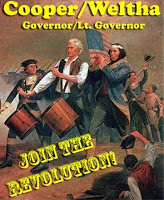
Although it’s not until next year, Eric Cooper and Nick Weltha are the Libertarian candidates for Iowa Governor and Lieutenant Governor, respectively. Cooper is an Associate Professor of Psychology and Neuroscience at Iowa State University. Weltha is a System Administrator for the Iowa Judicial Branch.

If you’re tired of politics as usual from the two big-box parties, please vote for and support Iowa’s Libertarian candidates.

ISU Professor Eric Cooper To Run For Iowa Governor

By Mike Malloy
AmesNewsOnline

(Sept. 30, 2009 – 8:30 p.m.) Eric Cooper, an Iowa State University associate professor in psychology and neuroscience, will run for governor next fall as a Libertarian. While Cooper is a veteran of local politics he is anything but a typical politician, as evidenced by his stark admission: “I’m not going to win.”

Victory for Cooper is redefined as finishing third, and receiving at least two percent of the vote, meaning the Libertarian Party would not have to petition or get signatures to be on the ballot in future elections. Cooper also hopes to raise the profile of Libertarians in the hopes that one of the two major parties would be willing to embrace Libertarian ideas.

Click here to read the full story.

(My thanks to Shrink Iowa Gov.)

O Come All Ye Faithful

Why evangelical Christians should rally to the libertarian cause.

As we wind down our celebration of the birth of Christ and prepare for the new year, I hope that “conservative” Christians, who are wondering where to go after the Republican train wreck of late, will give the Libertarian Party (L.P.) a second look.

If you’ve heard anything about us, you’ve probably heard that we want to legalize pot, gay marriage and all sorts of other things that no doubt turn your gut. Before you let that scare you off, let me explain our take on some of these issues. (Keep in mind that I hold no official position with the party, so if I muck it up, don‘t blame them.)

The L.P. is generally about freedom. The L.P.’s national platform states it fairly well: “We, the members of the Libertarian Party, challenge the cult of the omnipotent state and defend the rights of the individual. We hold that all individuals have the right to exercise sole dominion over their own lives, and have the right to live in whatever manner they choose, so long as they do not forcibly interfere with the equal right of others to live in whatever manner they choose.” How does this effect issues supposedly important to evangelicals?

Let’s get right to the most contentious issue first: Abortion. I’m not going to lie to you, most Libertarians are probably pro-choice. Wait, come back! Not all of us. There are enough of us pro-life Libertarians for the National Committee to recognize that good Libertarians fall on both sides of the issue. The L.P.’s National Platform says: “Recognizing that abortion is a sensitive issue and that people can hold good-faith views on all sides, we believe that government should be kept out of the matter, leaving the question to each person for their conscientious consideration.”

Yeah, I know that’s a cop-out, but there really is no middle ground here. Since Libertarians support individual rights (life, liberty, and property), there’s somewhat of a conundrum with this issue. Libertarians like me, who believe that life begins at conception, see abortion as the ultimate violation of an unborn person’s right to life. Libertarians who believe that life begins at birth see banning abortion as a violation of the mother’s liberty. To some degree, both sides are right. (Of course, I believe my side is MORE right!)

So where would a nation run by Libertarians leave us pro-lifers? We would be free to speak out against abortion in any manner that we chose (provided we didn’t harm or threaten to harm anyone else). With less money being taken from us in taxes we would be freer to contribute our money to pro-life groups, making them more effective. Since Libertarians support Constitutional restraints on the federal government and recognize that this is NOT a subject that the federal government has authority over, the people of each State would be allowed to decide whether or not abortion should be legal. That might be the best that pro-lifers can hope for, regardless of who’s in power.

Another benefit that a libertarian society would bring is that your church would be vastly more important in the community. Since Libertarians would get rid of government-run “welfare,” private charities and churches would become that much more vital. Religious charities have a long and proud history of helping people. They also generally do so much more efficiently and effectively than wasteful, values-neutral government programs. With lower taxes, more money would be flowing into church coffers and religious institutions could reclaim their historical role as society’s true safety net.

Another power that a libertarian society would give back to the people (and their collective representations, the churches) would be that of educating our children. Many evangelicals hate the fact that they have to send their kids to (or at least fund) government-run schools that teach their children that the basic tenants of their religion are a lot of bunk. Under a Libertarian government, parents would be free to send their kids to whatever school they chose, and they would be able to afford to so. Private and/or religious schools would become the norm, as would home-schooling.

The L.P. platform puts it thusly: “Education, like any other service, is best provided by the free market, achieving greater quality and efficiency with more diversity of choice. Schools should be managed locally to achieve greater accountability and parental involvement. Recognizing that the education of children is inextricably linked to moral values, we would return authority to parents to determine the education of their children, without interference from government. In particular, parents should have control of and responsibility for all funds expended for their children’s education.” [Emphasis added.]

This is not just a pie in the sky idea. There are small, practical steps we can take in this direction already, such as education tax credits. Groups like Iowa Advocates for Choice in Education are already working on “expanding educational options to all Iowa families.”

All in all, Libertarian policies would reduce government coercion of everyone, including evangelical Christians. So while, yes, others would be freer to do things that you might find sinful, you would be freer to worship as you choose, choose how your money is spent and instruct your children on right and wrong. If the only way to get the government off your back is to get it off everyone’s back, that sounds like a good deal to me.