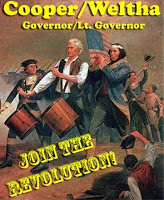
Iowa Libertarian Candidates 2010

Ed Wright, Chairman of the Libertarian Party of Iowa, recently announced the 2010 nominees selected at the Libertarian State Convention in Ames. Here are the candidates for each race:

Iowa Governor– Eric Cooper, 44, Ames, e-mail: eric@coopersmallergovernment.com, website: http://www.coopersmallergovernment.com/

Iowa Lt. Governor– Nick Weltha, 30, Des Moines, e-mail: nick.weltha@gmail.com, website: http://www.coopersmallergovernment.com/

U.S. Senate– John Heiderscheit, 46, Bettendorf, e-mail: jheiderscheit@nhquadcities.com

U.S. House District 1– Rob Petsche, 35, Manchester, e-mail: farleyrob2002@yahoo.com, website: http://www.petscheforsmallergovernment.com/

U.S. House District 2– Gary Sicard, 37, Robins, e-mail: gary@sicardforcongress.com, website: http://www.garysicard.org/

Iowa Senate District 23– Campbell DeSousa, 25, Ames, e-mail: desousacampbell@yahoo.com

Iowa House District 46– Tyler Pauly, 20, Ames, e-mail: tapastro@gmail.com

Polk County Attorney– Karen Tegtmeyer, 50, Johnston, e-mail: karen.tegtmeyer@gmail.com, website: http://www.iowasmallergovernment.com/

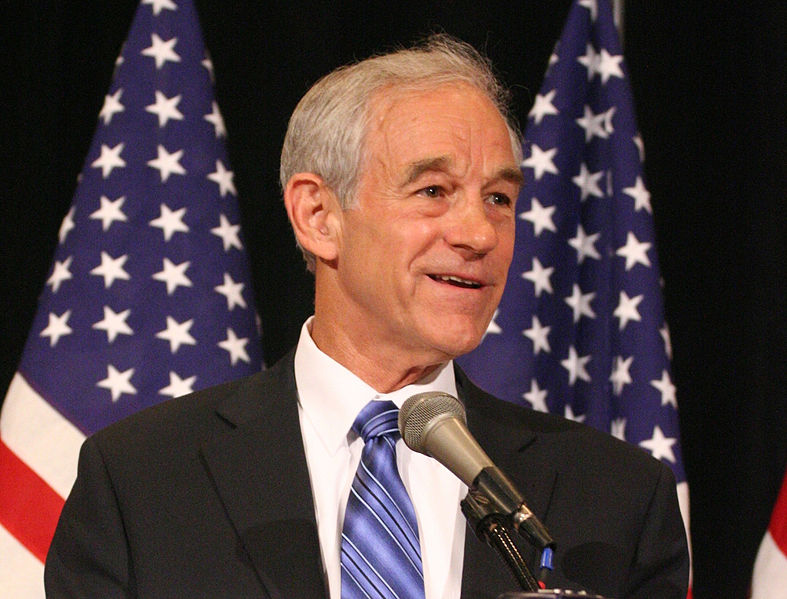
Ron Paul As Popular As Obama?

According to Rasmussen Reports, a hypothetical 2012 race between President Obama and Dr. Ron Paul would be a dead heat.

The report says: “A new Rasmussen Reports national telephone survey of likely voters finds Obama with 42% support and Paul with 41% of the vote. Eleven percent (11%) prefer some other candidate, and six percent (6%) are undecided.”

“Thirty-nine percent (39%) of all voters have a favorable opinion of Paul, while 30% view him unfavorably. This includes 10% with a very favorable opinion and 12% with a very unfavorable one. But nearly one-out-of-three voters (32%) are not sure what they think of Paul.”

I don’t think we can get that lucky, but if the GOP puts Dr. Paul at the top of the ticket in 2012, this blogger will gladly vote Republican.

10 Questions with Gubernatorial Candidate Eric Cooper

Eric Cooper of Ames and Nick Weltha of Des Moines have filed papers to seek the Iowa Libertarian Party’s 2010 nomination for Governor and Lt. Governor respectively. Cooper, 43, is an Associate Professor of Psychology and Neuroscience at Iowa State University, and is currently the Vice Chairman of the Libertarian Party of Iowa. Professor Cooper was gracious enough to answer a few questions for Cold Hard Cashner via email.

Here they are:

1. How did you get involved in politics and the Libertarian Party?

I joined the party in high school after I read a pamphlet that was available in one of my government classes. When I read the pamphlet describing the Libertarian Party’s positions, I realized that they were pretty much saying everything I already agreed with. My second year as a professor at Iowa State, I was approached by a student who wanted to start a Libertarian group on campus and wanted me to be the adviser because I was one of only two faculty members who were paid members of the party. As a result of being the adviser for the Iowa State Libertarians, I started going to Libertarian State Conventions and eventually got elected to the state party’s Executive Board, and decided to start running for office.

2. What made you decide to run for governor?

I have run for the state legislature five times previously from Ames, and in 2008, I had the most successful Libertarian campaign in the state (21% of the vote). I thought, given the experience I’ve gained campaigning for the legislature, that I was in the best position of anyone currently involved with the state party to run for Governor.

3. It’s unlikely you’ll win. Why should people vote for you?

Third parties can get everything they want without winning any elections at all. The Populists in the 1890s and the Socialists in the 1910s won almost no elections, and yet most of the major planks of their platforms were eventually implemented. The way these parties were successful was to draw enough votes away from the major parties on a regular basis that the major parties started stealing their issues in order to get their voters. This strategy can still work today, and is most effective when the major parties are ignoring a particular constituency (which currently would be people who want to reduce the size of government). If Libertarians can get 10% of the vote on a regular basis, that is enough to decide most elections between the major party candidates and will lead the major party candidates to start stealing our issues.

The reason it is important for people to vote for me for Governor is because under Iowa law, if the top candidate on a party’s ticket (which is the President during Presidential election years and the Governor in non-Presidential election years like 2010) gets 2% of the vote, that gives the party major party status in Iowa. If I get 2% of the vote, the Libertarian Party gains major party status meaning that we no longer have to petition to get our candidates on the ballot, thus making it far easier for us to run lots of candidates putting lots of pressure on the major parties to steal our issues.

4. Iowa has some of the strictest gun laws in the nation. Iowa is one of only 14 states that requires a special permit to acquire a handgun. It is one of only 13 states that doesn’t have “shall issue” laws requiring that weapons carry permits be issued to applicants who meet uniform standards. What changes would you like to see in Iowa’s weapons laws and what could you do as governor to facilitate them?

Laws are, of course, a matter for the legislature, however as Governor, one can certainly make suggestions to the legislature about what sorts of legislation might be a good idea. I don’t think there should be restrictions on peaceful people owning any sort of gun, and I think they should be able to carry those guns concealed if they so choose.

5. Because of the Iowa high court’s recent decision, gay marriage has come to the forefront of political discussion. What is your position on gay marriage and what (if anything) would you do as governor regarding this issue?

People come to America in order to follow their own cultural traditions. Peaceful people should be able to have whatever relations with other people that they would like, and they should be able to call them whatever they like. The government goes well beyond its enumerated powers when it starts deciding what does and does not constitute marriage.

6. There is currently some discussion of allowing medical marijuana to be used with a prescription in Iowa. Do you support this effort and what other changes in this area would you like to see?

I would support the legalization of medical marijuana, recreational marijuana, ornamental marijuana, and pretty much anything else that someone would like to do with marijuana. It is absolutely contradictory to the notion of a free society that the government should be dictating to adult citizens what they may or may not place into their own bodies. The drugs that are currently illegal are far less dangerous than many activities that are permitted (driving private automobiles and alcohol use are good examples), but because drug users are in the minority, the activities that they enjoy are made illegal while more dangerous activities that the majority likes are permitted. My first act as Governor would be to pardon all non-violent drug offenders currently in Iowa prisons. If the founding fathers of the United States were to see the sort of government we have today, I don’t think anything would shock them more than that we would allow the government to tell adult citizens what they are allowed to consume. One cannot honestly call oneself a free man when one has lost the right to decide what goes into one’s own body

7. On your website you say that “Iowa is currently doing education in about the most inefficient way possible.” How so and how would you remedy that?

The government is a monopoly and, like all monopolies, it has very little incentive to be cost effective and very little incentive to please its customers. In education, we have a market that should be extremely competitive if its provisioning was left to the free market because it is relatively inexpensive to start a school so there would be lots of competition among schools. The more competitive a market is, the more benefits one gets by having the free market supply a good or service, so having education provided by the free market would be the number one way we could improve education in the state. Unfortunately, the state’s involvement in education has made the education market a virtual monopoly which is exactly the sort of situation that produces goods and services inefficiently.

The best way to improve education in the state is to attach a certain amount of money to the child to help pay for his or her education. The child can take that money to any school: a private school, a homeschool, and can even use it at the current public schools if the child’s parents wish. However, all schools will be funded on exactly the same basis: they will only receive the money attached to the children who attend them. Such a system allows the government to help pay for education while getting all the benefits of a highly competitive market.

8. Fireworks have been illegal in Iowa since the 1930’s. It’s now a time-honored tradition for Iowans of all ages to flagrantly flout that law by bringing fireworks in from neighboring states and lighting them off for Independence Day. Why would you want to hinder such a beautiful annual display of civil disobedience by legalizing fireworks?

Yes, I suppose there is a vicarious thrill in breaking unjust laws for some people. Much better not to have such laws on the books in the first place, however. Getting rid of the fireworks ban is one of the key issues in our campaign because I think it symptomatic of a larger problem that when safety and freedom conflict, the laws always come down on the side of safety even though we supposedly live in the land of the free (not the land of the safe). However, the purpose of our lives is not to be as safe as possible, but to be as happy as possible. When I was growing up in Kansas, one of my favorite activities was shooting fireworks on the 4th of July, and it is really sad that the kids of our state don’t have that chance. Being safe is a part of being happy, but when you are reducing the amount of happiness in your life to make remote dangers even more remote, that is a really bad trade-off.

9. What are some of the other priorities for you and your running mate?

Our top goal is to get the 2% we need to give the Libertarian Party of Iowa major party status in Iowa. If we can do that, it will allow us to put a lot more pressure on the major parties by running more candidates which is what we have to do in order to get the major parties to start addressing our issues.

The next goal is to keep the idea of Jeffersonian Democracy alive in the United States. Libertarianism is the political philosophy of Thomas Jefferson and the essence of the philosophy is that we have a limited government that is only permitted to perform a small set enumerated functions, and that we are a free people meaning that if you aren’t hurting others or their property, you should be able to conduct your life however you want. Our government now is so different from how it was originally conceived, and currently appears to have almost no limits on what it may do nor any respect for the freedom of its citizens. I want people to understand and remember the vision the founding fathers had for America, and, even if I’m the last free man left, I’m going to stand up and protest every single encroachment on that freedom.

10. What can people do to help your campaign?

As with all campaigns, we are limited in what we can do by the amount of contributions that we are able to get, so one thing is to visit our website (http://www.coopersmallergovernment.com/) and donate.

If you can’t afford a donation, we are going to start visiting cities all over Iowa beginning this summer. We need volunteers in as many cities as possible who are interested in helping us to promote our visits by posting fliers, chalking, and telling local papers and radio stations about us. Anyone interested in being our representative in their city should e-mail me at eric@coopersmallergovernment.com

Iowa Libertarians On The Ballot

In tomorrow’s election there will be a few Libertarian Party candidates scattered around the state. Here are the ones that I’ve heard about:

  1. Nick Tabier, running for Cedar Falls city council (at large)- Says Tabier’s website: “Cedar Falls is a great place to live, and keeping it great requires initiative, fresh thinking, and a willingness to listen to ideas from everyone. I will bring unique perspective, bountiful energy, and careful leadership to the Cedar Falls City Council.”
  2. Bill Lynn, running for Davenport 5th Ward Alderman (incumbent)- Lynn is endorsed by the Quad City Times and has been serving for six years. Says The Times: “Bill Lynn has earned a fourth term. The St. Ambrose professor seems to have anchored his academic ideals to some street-level reality through his support of some smart initiatives, including the micro-loan program to foster minority business development. “
  3. Roger Fritz, running for Roland Iowa mayor- A electronic communications engineer, Fritz previously served as a Roland city councilman from 1999 to 2007.

Although it’s not until next year, Eric Cooper and Nick Weltha are the Libertarian candidates for Iowa Governor and Lieutenant Governor, respectively. Cooper is an Associate Professor of Psychology and Neuroscience at Iowa State University. Weltha is a System Administrator for the Iowa Judicial Branch.

If you’re tired of politics as usual from the two big-box parties, please vote for and support Iowa’s Libertarian candidates.

ISU Professor Eric Cooper To Run For Iowa Governor

By Mike Malloy
AmesNewsOnline

(Sept. 30, 2009 – 8:30 p.m.) Eric Cooper, an Iowa State University associate professor in psychology and neuroscience, will run for governor next fall as a Libertarian. While Cooper is a veteran of local politics he is anything but a typical politician, as evidenced by his stark admission: “I’m not going to win.”

Victory for Cooper is redefined as finishing third, and receiving at least two percent of the vote, meaning the Libertarian Party would not have to petition or get signatures to be on the ballot in future elections. Cooper also hopes to raise the profile of Libertarians in the hopes that one of the two major parties would be willing to embrace Libertarian ideas.

Click here to read the full story.

(My thanks to Shrink Iowa Gov.)

Iowa Senate Studies "Tyranny of the Majority"

When the Constitutional Convention met in 1787 there was almost immediate conflict between delegates from the large, heavily populated states and the smaller, less populous ones.

How should the national legislature be constituted? The big states proposed The Virginia Plan which assigned Congressional representation based upon population. The smaller states favored The New Jersey Plan, which assigned an equal number of representatives to each state. Ultimately, both sides accepted the “Connecticut Compromise,” wherein there would be two houses of Congress. In the Senate, each state would get an equal number of Senators and the House of Representatives would be allocated by a state’s population.

Another (somewhat cobbled together) compromise was the “Electoral College” for electing the president. Some delegates thought the president should be elected by Congress, others preferred a popular election. In the end, the Constitution allowed each state to assign a number of “electors” equal to that state’s Congressional delegation, to vote for the president.

Most people don’t really understand the electoral college (myself included). As it is now practiced, each state still gets one elector for each representative and Senator it has in Congress. All but two states instruct their electors to vote for whichever presidential candidate got the most votes in that state. These 48 states, Iowa included, are “winner-take-all,” giving all of their elector votes to the highest vote getter in that state.

It seems unduly complicated and a lot of people don’t like it. That may be why the Iowa State Senate is currently studying a bill that would alter Iowa’s participation in the electoral college.

Pushed by a national group called “National Popular Vote,” Senate Study Bill 1128 would change the instructions that Iowa would give to it’s electors. They would be instructed to vote for whichever candidate got the most votes NATION-WIDE. The new law would be an interstate compact, an agreement, with other states who pledge to do the same thing. It would go into effect as soon as enough states to collectively field 270 electoral votes have signed into the agreement. So far only Maryland, New Jersey, Illinois and Hawaii have signed into the pact.

Critics charge that such a system would create an “urban-centric” presidency. Candidates would focus their time and energy on areas where they could rack up the most popular votes quickly, places such as New York and California, rather than having to focus on winning in various sectors of the country. Once elected, the President would tailor all policies toward appeasing these areas, often at the expense of less populated states.

“National Popular Vote” (NPV) responds to allegations that their plan is an “end run” around the Constitution by correctly pointing out that the Constitution allows states to appoint electors “in such Manner as the Legislature thereof may direct[.]” NPV might want to read the rest of the Constitution, however, particularly Article One, Section 10, Clause 3 which says, “No State shall, without the Consent of Congress […] enter into any Agreement or Compact with another State, or with a foreign Power[.]”

Let’s look at NPV’s plan using Iowa as our model. Iowa has 7 electoral votes, one for each of our five Congressional districts and two Senators. Suppose Candidate A gets 60% of the popular vote here in Iowa. However, Candidate B sweeps LA, New York, Chicago, etc… and gets 51% of the popular vote nation-wide. All of Iowa’s electoral votes would go to Candidate B, who voters in Iowa soundly rejected. If we take this example to the extreme, it would be possible for all 7 of Iowa’s electoral votes to go to a candidate who did not get a single person in Iowa to vote for him.

It’s easy to see how less populous states like Iowa would quickly become mere spectators of presidential elections, allowing other, more populated states to vote FOR us. No thank you. If the electoral college needs reformed, perhaps, like our forefathers in 1787, we can find a mutually-equitable compromise.

I think a better plan would be to adopt the “Congressional District Method” currently used by Maine and Nebraska. Rather than award all of the state’s electors to one candidate, an electoral vote is given to the popular winner in each Congressional district. The two remaining electoral votes, representing the state’s two Senators, are given to whichever candidate had the most votes statewide.

It is a “winner-takes-most” system, rather than the current “winner-takes-all” system. This would ensure that voters in a conservative district of liberal California, for instance, would not be wasting their votes. Nor voters in a liberal district of conservative Texas. In 2008, John McCain carried conservative Nebraska, but Barack Obama still got one electoral vote from the state for winning in it’s 2nd Congressional District.

The “Maine-Nebraska Method” would be more democratic than the current system without completely relegating rural states to political irrelevance. Also, since it would be implemented individually by respective states, it would not run afoul of the Constitution’s “Compact Clause,” mentioned above. Perhaps history books will call the adoption of this plan “The Iowa Compromise.”

Ron Paul Gets It

In this interview on CNN, Congressman Ron Paul (R-TX) raises many of the same points about the downfall of the GOP that I raised in my post “Cinders and Ashes!”

Cinders and Ashes!

One of the benefits of having a two-year-old son is that I now know that, when something traumatic happens, Thomas the Tank Engine usually exclaims, “Cinders and ashes!” I’ll bet there were more than a few folks at the Republican National Committee using similar, albeit less family friendly, utterances the morning after election day. But Thomas’ tagline is a fitting description of the state of the GOP following the election.

If the election of ’06 was a shot fired across the GOP’s bow, the ’08 election was right in their wheelhouse. Neo-conservative (big-government authoritarian) Republican John McCain got stomped by Democrat Barack Obama electorally, 163 to 364. The popular vote was slightly less one-sided, with Obama getting 53% and McCain getting 46%. The Democrats picked up 6 seats in the U.S. Senate and picked up 17 seats in the U.S. House. At the end of it all, the Senate had 57 Democrat seats (only 3 seats short of a filibuster-proof majority) to 40 Republican seats. The House now has 252 Dems and 173 Republicans.

As a one-time stalwart Republican, when I surveyed the wreckage of the GOP, I felt like an immigrant to the U.S. seeing his war-torn former country on CNN, bombed and flattened. I felt sad for my friends who didn’t make it out, but glad that I left when I did.

I didn’t shed too many tears though, because the GOP brought this shellacking on themselves. Many people like myself fought in the trenches to put the GOP in power in the 1990’s. We sent them to DC with a simple mandate: “Cut government.” That included cutting taxes, spending, regulation and intrusiveness. The Republican-controlled federal government did the exact opposite of those things. (I know they cut taxes somewhat. But they didn’t even make those cuts permanent and they increased spending and debt so much that essentially they just delayed paying those taxes rather than eliminating them.)

In essence, once the Republicans were firmly in power, they governed like Democrats. Advocates of smaller, less intrusive federal government suddenly found themselves out in the cold. But, as the last two election cycles showed, the American people will choose real Democrats over wannabe-Democrats every time. The neo-conservative plan to out-Democrat the Democrats resulted in an electoral train wreck.

Supporters of smaller government now have four options:

  1. We can help the GOP rebuild their party, and try to get it to focus on limited government fundamentals. This is essentially what Ron Paul’s Campaign for Liberty is about.
  2. We can join the Democrats and take whatever reforms we can get.
  3. We can become detached from the political process, hunker down and hope that the big-government Panzers roll past without crushing us.
  4. We can try to build the Libertarian Party or Constitution Party into a major party able to challenge the Demublicans for control.

I’ve thrown in with the merry band of Libertarians, so it’s probably obvious that I support the last option. Paleo-conservatives, libertarians, and constitutionalists gave the Republican Party a fair chance to advance limited government principles. The GOP betrayed that trust. May it rest in peace.

NRA Endorses McCain- Part II

[For a more complete analysis of the NRA’s endorsement of presidential candidate John McCain, read the original post- Strange Bedfellows: NRA Endorses Its Enemy, directly below this post.]

Here’s McCain speaking about the NRA. This is the guy that the NRA endorsed?

http://blip.tv/play/Abf9DYeFGg

Here’s a commercial McCain did for “Americans For Gun Safety”(AGS) seeking to close a non-existent “gun show loophole” using bogus statistics. AGS was founded by Andrew McKelvey, a former member of the board of directors of Handgun Control Inc. and the primary founder of the Million Mom March (against gun rights). AGS received funding from anti-gun nuts George Soros and Teresa Heinz Kerry via the Tides Center.

Here’s a fact check for the senator: A 1997 study by the National Institute of Justice said only 2% of criminal guns came from gun shows. Hardly an epidemic. Of these few crime guns procured at gun shows, many were purchased by “straw buyers” who could pass a criminal background check (a practice that is already illegal), so additional background checks would do no good. All gun sales at gun shows are governed by the SAME legal requirements as they are anywhere else. There is no “loophole” specific to gun shows.

Gun owners should disregard the NRA sellout and support Bob Barr, who serves on the NRA’s board of directors and has an excellent Second Amendment record. (Bob’s NRA rating: A+, McCain’s NRA rating: C+, McCain’s Gun Owners of America rating: F-)

Strange Bedfellows: NRA Endorses Its Enemy

It’s official: the National Rifle Association (NRA) has endorsed Senator John McCain for President. That’s somewhat surprising considering that the NRA once labeled McCain as “one of the premier flag carriers for the enemies of the Second Amendment” [right to keep and bear arms], which the NRA supposedly defends. So, how did McCain gain the NRA’s ire, then, ultimately its endorsement?

How McCain got a bad name with gun owners is easy. He co-sponsored the McCain-Lieberman Gun Show Bill to close the supposed “gun show loophole.” While the bill didn’t technically outlaw gun shows, it did open gun show organizers up to so much potential legal trouble as to not make it worth the risk. It was a backdoor ban on gun shows. Thankfully this bill failed.

Later, the McCain-Feingold Act specifically sought to muzzle groups like the NRA from criticizing anti-gun candidates. NRA Executive V.P. Wayne LaPierre called it “the most significant change in the First Amendment since the Alien and Sedition Acts of 1798, which tried to make it a crime to criticize a member of Congress.” The NRA was literally first in line at the courthouse doors to file a lawsuit to stop McCain’s law after President Bush signed it. (The lawsuit failed and McCain-Feingold is still the law of the land.)

McCain did commercials for the moderate sounding, yet anti-Second Amendment, group Americans for Gun Safety. McCain voted in favor of both of Bill Clinton’s Supreme Court nominees who voted against the Second Amendment in DC vs Heller. These are just some of McCain’s transgressions against gun owners. For a complete reading check out “John McCain: Conservative or Gun-Grabber?”

Why did the NRA endorse candidate McCain? Because his challenger, Barack Obama, is worse. (For a complete rundown of Obama’s anti-gun record, click here.) But why they would endorse someone who is a proven enemy of the Second Amendment rather than just not endorsing either candidate (as they’ve done several times before) is puzzling. This is just the most recent example of the NRA placing political expediency above principle.

NRA Board Member Russ Howard resigned because the NRA kept giving A grades to anti-gun legislators in his home state of California.

The NRA brags about the recent victory for gun owners in the Supreme Court case of DC vs. Heller, but the group played a negligible role in the win and, fearing a lose, tried to squash the case. Robert A. Levy, the lawyer who helped create and personally financed the case that reaffirmed the Second Amendment as an individual right, said “The N.R.A.’s interference in this process set us back and almost killed the case. It was a very acrimonious relationship.”

In 2007 NRA actively supported the “NICS Improvement Amendments Act of 2007’’ which was dubbed “the Veteran’s Disarmament Act” by pro-gun critics. Written by Carolyn McCarthy (D-NY), arguably the most anti-gun member of Congress, the bill mandated that states turn over all types of personal information about their citizens, potentially including medical records, to the federal government to use in it’s “National Instant Criminal Background Check System” (NICS) for approving gun buyers. Wholly unnecessary, the bill could prevent veterans who have ever sought professional help for post traumatic stress disorder or depression from ever owning guns, even if they present no threat to themselves or others. (How’s that for a disincentive to get the help that some may need?) In addition to hurting gun owners, this bill is a nightmare for advocates of personal privacy rights and state rights.

In 2001 NRA pushed for and got “Project Safe Neighborhoods,” a national initiative supposedly aimed at reducing gun violence. As the libertarian-leaning Cato Institute explains it, “Project Safe Neighborhoods is the public-policy embodiment of the National Rifle Association sound bite ‘we don’t need any new gun control laws; we need to enforce the gun laws on the books.’ The program funds more than 800 new prosecutors (around 200 federal, 600 state level) who will do nothing but pursue gun-law violations full time.” It essentially makes every petty street crime involving a firearm into a federal crime, Tenth Amendment be damned. It is a program of zero-tolerance enforcement of the very gun laws that NRA often argues are unconstitutional and ineffective. Otherwise law-abiding gun owners who get caught in this web for regulatory infractions or accidental violations are acceptable “collateral damages” to the NRA.

The website NRAwol has volumes of examples of the NRA selling out the Second Amendment and America’s gun owners in the name of political expediency dating back to the National Firearms Act of 1934. [A link to this site will now be located in the “National Links” Section to the right.]

Despite all this, I’m not going to cancel my life-membership in the NRA. (I already paid for it after all.) They still do some good too. Their work with match shooting and firearms training is second to none. Politically I believe that they may still fight against the most egregious gun bans. I will just have to bear in mind that their endorsement of candidates and some legislation is meaningless. For all things political I will pay attention to what Gun Owners of America has to say, and continue to roll my eyes when the NRA sends me its usual panhandling fundraiser letters every other week.