
I forgot at least one more good gun bill in Des Moines, House File 170, the Iowa Firearms Protection Act. This bill follows the lead of several other states that have passed similar laws. It would exempt “firearms, firearm accessories, or ammunition owned or manufactured commercially or privately in this state and that remains exclusively within this state” from enforcement of federal laws or regulation.
Superficially this may seem like a Second Amendment issue, since it deals with guns, but it’s actually a Tenth Amendment issue. The concept is that arms made and remaining in the state don’t fall under the federal government’s authority under the U.S. Constitution’s commerce clause.
The bill would forbid Iowa state officials and Iowa gun dealers from enforcing federal regulations on Iowa made arms remaining in state. It would also make it illegal for any federal agent to enforce federal regulations on Iowa arms. Federal agents doing so would be guilty of a class “D” felony. It would also allow the Iowa attorney general to defend a citizen of Iowa who is prosecuted by the United States government for any of the above.
Our friends at the Tenth Amendment Center had a brief writeup on the bill here.
Category: Tenth Amendment
"Santorum and Obama: Two Peas in a Pod?"
 |
| Senator Rick Santorum: As president would impose his personal values judgements in place of U.S. Constitution. |
An excerpt from an article by our friends at The Tenth Amendment Center:
Congresswoman Bachmann […] has positioned herself repeatedly as a leader in the tea party, state’s rights, and Tenth Amendment movements. Asked last night whether there was a difference between the state or federal government mandating that an individual buy a product (referring primarily to health care insurance), Bachmann responded that there was no difference. It is “unconstitutional,” she maintained, regardless of whether it is imposed by the state or federal government. She did not cite which part of the Constitution denies states this authority.
Of course, that’s because no clause in the Constitution prevents states from doing it, as Congressman Paul rightly noted in response to Bachmann’s doublethink. Paul stated that the federal government is not empowered to go in and stop states that do bad things.
Moments later, Senator Santorum jumped in to criticize both of them, claiming that their responses were indicative of “the Tenth Amendment run amok.” Said Santorum:
Michelle Bachmann says that she would go in and fight health care being imposed by states, but she wouldn’t go in and fight marriage being imposed by the states. That would be okay. We have Ron Paul saying oh, whatever the states want to do under the Tenth Amendment is fine. So if the states want to pass polygamy, that’s fine. If the states want to impose sterilization, that’s fine. No! Our country is based on moral laws, ladies and gentleman. There are things the states can’t do. Abraham Lincoln said “the states do not have the right to do wrong.” I respect the Tenth Amendment, but we are a nation that has values. We are a nation that was built on a moral enterprise. And states don’t have the right to tramp over those because of the Tenth Amendment.
Leaving aside the fact that he inaccurately portrayed Rep. Paul’s stance, it is obvious that Santorum is no Tenther, but rather a power-loving thug looking to impose his personal set of morals and values on any people living under whatever level of government he can use to accomplish his goals. In this respect, he’s hardly different from Barack Obama at all.
Obviously, Santorum has either not read or understood the Tenth Amendment — included in the Constitution which he has on several occasions sworn an oath to support and defend — which provides for the very things he is criticizing.
States do have the ability, under the constitutional system the Founders put in place, to “do wrong.” They have the sovereign authority to decide whatever they wish on whatever matters they like, provided that this authority has not already been delegated to the federal government, or has not been explicitly denied them in the Constitution.
When we sit back for a moment and recognize that the federal government already claims the power to require to you to purchase health insurance, to tell you what size toilet you can have, what kind of plants you can grow in your back yard, what kind of light bulb you can use, and so much more – don’t we realize there’s already too much federal power? For people like Obama and Santorum, it sure doesn’t seem that way.
Read the entire article here.
Healthcare Sovereignty Bill In Iowa
I normally don’t post emails that I get, but since this one was extremely time sensitive and may interest regular readers of this blog, I’ve included the following “action alert” from Iowa Campaign For Liberty (CFL). It deals with the “Growing Movement to Nullify National Health Care.” For a quick overview of the state sovereignty/10th Amendment issue, read my interview with 10th Amendment Center founder Michael Boldin. -Ben
Action Item – State Sovereignty Legislation
During Iowa’s legislative session Bills are assigned to committees. In order for a Bill to become law it must first be released out of committee.
This FRIDAY, February 12, @ 5:00 pm is the deadline for having Bills out of committee. If a Bill has not been released by a committee by then it is considered “DEAD” and NOTHING will become of it.
Iowa CFL has been working with Legislators to pass several Bills that relate to Health Care and/or State Sovereignty. One in Particular is HF 2177.
HF 2177 simply states, “This bill establishes that no law shall restrict a person’s right to choose private health care systems or private health care plans.” This Bill is designed to establish Iowa law that says the federal government cannot dictate to private citizens what they choose to do regarding their health care.
CFL urges all of its members to email, call and/or visit all 21 House Human Resources committee members and urge their support for HF 2177.
Here is some suggested language for you to “cut and paste” into your own email:
Dear Committee Member,
I am emailing you regarding HF 2177. This Bill is about health care, which is very personal to me. I want to insure that I will always be able to choose my own health care plan; if I choose one at all.
I’m calling for your support on this Bill and for you to insure that it comes out of Committee before the deadline on Friday, February 12, at 5:00 pm.
This Bill is important in that it will insure that the overreaching federal government will not be able to dictate any part of my health care. The Tenth Amendment to the Constitution of the United States guarantees that each individual state has the authority to over rule federal mandates not enumerated in the constitution.
So in part, your support for this Bill, is simply re-affirming your oath of office; in that you will uphold the Constitution of the United States.
Here’s the list of email addresses for all 21 House Human Resources committee members:
mark.smith@legis.state.ia.us; deborah.berry@legis.state.ia.us; linda.miller@legis.state.ia.us; ako.abdul-samad@legis.state.ia.us; dwayne.alons@legis.state.ia.us; clel.baudler@legis.state.ia.us; greg.forristall@legis.state.ia.us; dave.heaton@legis.state.ia.us; lisa.heddens@legis.state.ia.us; bruce.hunter@legis.state.ia.us; kevin.koester@legis.state.ia.us; mary.mascher@legis.state.ia.us; tyler.olson@legis.state.ia.us; janet.petersen@legis.state.ia.us; renee.schulte@legis.state.ia.us; chuck.soderberg@legis.state.ia.us; sharon.steckman@legis.state.ia.us; phyllis.thede@legis.state.ia.us; linda.upmeyer@legis.state.ia.us; roger.wendt@legis.state.ia.us; beth.wessel-kroeschell@legis.state.ia.us
You can email them as a group or individually if you want for a more personal touch.
If one of these committee members happens to be your own Representative (you can use this link to find your state representative: http://www.legis.state.ia.us/FindLeg/ ) you will be more likely to get their attention, so send them their own individual email from you and feel free to insert this or similar language after the first sentence:
As a constituent in your District I will surely be watching your action on this Bill. If you are unable to support this Bill you will surely not receive my vote in this upcoming election.
Phone calls (or even a personal visit) to the capitol are also effective. The House switchboard number is 515-281-3221
Your action is greatly appreciated and necessary.
Ron Truhlar
Campaign for Liberty/State Sovereignty Co-coordinator
319.248.9869
10th Amendment Revival In 2010?
Could 2010 bring a resurgence in the importance of the Tenth Amendment to the U.S. Constitution, after it spent most of the 20th century in relative obscurity? At least one group that studies Constitutional governance thinks so.
According to Michael Boldin, founder of the Tenth Amendment Center,a Los Angeles-based think tank, “With people looking to resist D.C. through state laws on everything from national health care to medical marijuana, the 10th Amendment appears ready to be front and center in the national debate once again this year.”
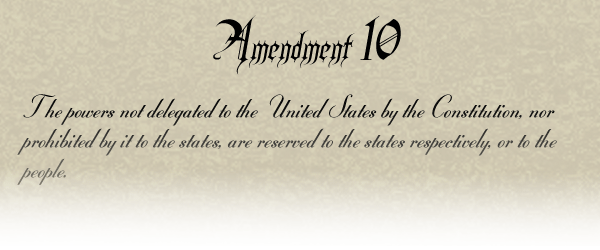
The Tenth Amendment states, “The powers not delegated to the United States by the Constitution, nor prohibited by it to the States, are reserved to the States respectively, or to the people.” It is an encapsulation of the principle of federalism, reserving much sovereignty for states and individuals.
“Already, over a dozen states are considering laws or state constitutional amendments that would effectively ban, or nullify, any proposed national health care plan in their state, and we expect that number to reach at least twenty in 2010,” said Boldin. “In conjunction with 20+ states that have already said ‘No’ to the Bush-era Real ID act, another dozen or more considering state laws to nullify federal gun laws, and the steady growth of states refusing to comply with federal marijuana laws, some might consider what we see today to be an unprecedented state-level rebellion to the federal government.”
This nonviolent “rebellion” is based upon the traditional (yet long neglected) principal of nullification. By nullifying a federal law, a state declares that law to be null and void within that particular state. “Nullification has been used to stand up for free speech, resist the fugitive slave laws, reduce tariffs and more,” explains Boldin. “It’s a peaceful and effective way to resist the federal government, and might be our only hope for moving towards the constitution.”
In addition to the many state government efforts to proclaim sovereignty under the Tenth Amendment or to nullify various federal laws, Tenth Amendment rallies are planned in at least 10 states in January.
With so much activity afoot, 2010 may indeed be the year of the Tenth Amendment.
Related posts:
State Sovereignty Group Supports Lawsuit Against Obamacare
In my post four days ago I said to expect lawsuits challenging Obamacare’s constitutionality. Well, the ink is barely dry on the recently-passed Senate bill and the lawsuits are gearing up already. The Utah-based Patrick Henry Caucus may be the first one to challenge the (sure to be signed) new law. Here’s their press release from today:
UTAH PATRICK HENRY CAUCUS UNANIMOUSLY SUPPORTS A LAWSUIT AGAINST THE FEDERAL GOVERNMENT IN ORDER TO STOP THE FEDERAL HEALTH CARE BILL
Leading state sovereignty caucus strongly opposes the federal health care bill and supports lawsuits based on two violations of the U.S. Constitution.
The Patrick Henry Caucus adopted a unanimous position Wednesday, December 23, 2009, to oppose the Health Care Reform Bills, and to support a lawsuit against the federal government in order to stop the national health care bill from becoming law.
Calling the law unconstitutional, The Patrick Henry Caucus, which is comprised of legislators from both the Utah House of Representatives and the Utah Senate, vows to fight the federal law on multiple fronts. The Patrick Henry Caucus has an opt-out provision drafted and ready for presentation to the Utah Legislature next month. The opt-out would make it illegal for Utah agencies to implement any portion of the new federal law. The Caucus is calling on the State of Utah to join in with other States and take the lead on filing a lawsuit to stop the bill, should it receive final approval.
The Caucus believes the law is unconstitutional in at least two respects. First, the law unfairly gives preferential treatment to residents of Nebraska as a result of efforts by Senate Democrats to court the vote of Nebraska Senator Ben Campbell. The Caucus
believes that this preferential treatment violates principles of due process and equal protection and is therefore unconstitutional under the Fifth and Fourteenth Amendments.Second, the law amounts to an excess of Congress’s enumerated powers inasmuch as it requires every American to acquire health insurance. This legislation marks the first time in history that Congress has required every single American to purchase a particular good or service, and cannot be reconciled with the notion that Congress possesses only those limited powers granted by the Constitution.
The Patrick Henry Caucus calls on the leaders from all States to join in the effort to file a lawsuit against the federal government in order to stop this wrongheaded piece of legislation. We must not allow Congress to commandeer one sixth of our nation’s fragile economy while simultaneously undermining the authority of the States.
10 Questions with TAC founder Michael Boldin
 Michael Boldin is the founder of the Tenth Amendment Center (TAC). According to its website: “The Tenth Amendment Center works to preserve and protect Tenth Amendment freedoms through information and education. The center serves as a forum for the study and exploration of state and individual sovereignty issues, focusing primarily on the decentralization of federal government power.”
Boldin was raised in Milwaukee Wisconsin, but now lives in Los Angeles. In addition to his duties at TAC, he is a contributing writer for PopulistAmerica.com.
Cold Hard Cashner recently interviewed him via email.
1.What is the 10th Amendment?
Boldin: The 10th is the defining amendment of the Constitution – its exclamation point! It’s a “rule of construction” which makes clear that it was “We the People,” as sovereigns, who created the federal government to be our agent for certain, enumerated purposes..and nothing more.
2. Why should the average American care about it?
Boldin: If there’s anything people should learn from history is that a government without limits is a tyranny.
3. There have been many federal programs, from Social Security to Cash For Clunkers, that are apparently popular but probably wouldn’t survive a literal interpretation of the 10th Amendment and the rest of the Constitution. Why should the American people be willing to support strict adherence to the Constitution if they may potentially lose federal programs they appreciate?
Boldin: For years and years, people have allowed politicians to bend or break “the rules” (that is, the Constitution) for one “emergency” or another. But the bottom line is this – after years and years of allowing politicians to break the rules, eventually you’ll end up with politicians who feel that the rules don’t apply at all. Arbitrary government – government without rules – is another name for despotism.
4.What is the Tenth Amendment Center? What are its goals?
Boldin: I created the Tenth Amendment Center (TAC) in mid-2006 and launched the website, TenthAmendmentCenter.com, in January 2007. It was my way of recognizing that it doesn’t matter which political party has the power in D.C. – year in and year out, the power of the federal government continues to grow while your liberties are increasingly lost. It’s essential that people in this country understand the principles that the founders and ratifiers passed on to us – that a government without limits is a tyranny.
Our goals? Oh, they’re pretty small – we just want to empower you – and millions of others – to understand the principles of the Constitution and liberty. That way you can take that knowledge and take action.
5.What motivated you to found T.A.C.?
Bolden: see above
6.Media Matters For America, a “progressive research and information center,” recently castigated T.A.C. for reprinting several articles on its website that mention secession. Are the “Tenthers” (as 10th Amendment supporters are sometimes called) some type of secessionist movement?
Boldin: Yes, they sure did. They were angry that Lou Dobbs would interview the founder of such an awful organization as TAC!
The essential thing here is that this country was founded on the principle of secession, and while the Tenth Amendment Center is advocating adherence to the Constitution – which is the only that this country won’t fall to pieces – we still feel it’s essential to discuss and explore this important part of our American tradition.
I wonder – would Media Matters, if they were around in the 18th century, have castigated Thomas Paine, or Thomas Jefferson, or Patrick Henry for simply talking about breaking away from “The Crown?” Seems to me that the cheerleaders for tyranny never really go away…they just change faces.
7.Here in Iowa we had a “state sovereignty resolution” introduced in the Iowa legislature this year. Similar measures are popping up all over the country. What is the purpose of these resolutions?
Boldin: These non-binding resolutions, often called “state sovereignty resolutions” do not carry the force of law. Instead, they are intended to be a statement of the legislature of the state. They play an important role, however.
If you owned an apartment building and had a tenant not paying rent, you wouldn’t show up with an empty truck to kick them out without first serving notice. That’s how we view these Resolutions – as serving “notice and demand” to the Federal Government to “cease and desist any and all activities outside the scope of their constitutionally-delegated powers.” Follow-up, of course, is a must.
8.What are “interposition” and “nullification?” What are the differences between them?
Boldin: Some would say they are virtually the same in practice – they are the principle that the State governments are to resist unconstitutional laws and regulations emanating from the federal government.
When a state ‘nullifies’ a federal law, it is proclaiming that the law in question is void and inoperative, or ‘non-effective,’ within the boundaries of that state; or, in other words, not a law as far as that state is concerned. The state apparatus, then, would “interpose,” or stand between you and the federal government to protect your liberty.
9.Isn’t it up to the U.S. Supreme Court to decide whether or not a law is unconstitutional?
Boldin: Sure – that’s just what kings and tyrants all through history have always wanted. And that’s probably why most of us who’ve gone through government-schools come out believing that a branch of government filled with unelected, unaccountable bureaucrats would be the one determining how much power the other branches of that same government would have. Absurd, really. James Madison and Thomas Jefferson warned us that if the federal government would ever have the exclusive right to judge the extent of its own powers, its power would continue to grow – regardless of elections, the separation of powers, and other much-touted limits on government power. Sure sounds familiar to me.
10.What can people do to help rescue the 10th Amendment from obscurity?
Boldin: Get informed. Get others informed. Get active – and most of all – recognize that the Constitution isn’t a conservative or a liberal document. It’s there to ensure the powers of the federal government are limited – and the most difficult, the most divisive issues would be handled where they can be handled best … close to home.
The Growing Movement to Nullify Nat’l Health Care
[From our friends at the Tenth Amendment Center. Reprinted with permission.]
by Michael Boldin
In response to what some opponents see as a Congress that doesn’t represent their interests, State Legislators are looking to the nearly forgotten American political tradition of nullification as a way to reject any potential national health care program that may be coming from Washington.
In 2010, residents of Arizona will be voting on a State Constitutional Amendment that would let them effectively opt out of any proposed national health care plan. Legislatures in Florida, Michigan, Ohio and Pennsylvania are also considering similar State Constitutional Amendments.
And now, Missouri is joining them. According to a report in The Missourian, “Rep. Cynthia Davis, R-O’Fallon, pre-filed a bill Dec. 1 that, if approved by voters, would effectively put a halt on any national health care legislation. Davis said her intent was to give voters a way to protect themselves.”
FREEDOM TO PARTICIPATE
The bill, HJR48, “Proposes a constitutional amendment which would prohibit compelling a person to participate in any health care system.”
It states:
“To preserve the freedom of citizens of this state to provide for their health care, no law or rule shall compel, directly or indirectly or through penalties or fines, any person, employer, or health care provider to participate in any health care system. A person or employer may pay directly for lawful health care services and shall not be required to pay penalties or fines for paying directly for lawful health care services. A health care provider may accept direct payment for lawful health care services and shall not be required to pay penalties or fines for accepting direct payment from a person or employer for lawful health care services. Subject to reasonable and necessary rules that do not substantially limit a person’s options, the purchase or sale of health insurance in private health care systems shall not be prohibited by law or rule.”
NULLIFICATION: A HISTORY LESSON
The principle behind such legislation is nullification, which has a long history in the American tradition. When a state ‘nullifies’ a federal law, it is proclaiming that the law in question is void and inoperative, or ‘non-effective,’ within the boundaries of that state; or, in other words, not a law as far as the state is concerned.
Early nullification movements began with the Virginia and Kentucky Resolutions of 1798. These resolutions, secretly authored by Thomas Jefferson and James Madison, asserted that the people of the states, as sovereign entities, could judge for themselves whether the federal government had overstepped its constitutional bounds – to the point of ignoring federal laws.
Virginia and Kentucky passed the resolutions in response to the federal Alien and Sedition Acts, which provided, in part, for the prosecution of anyone who criticized Congress or the President of the United States.
Nullification was regularly called upon by states all over the country in response to everything from higher taxes to the fugitive slave law of 1850.
A MODERN NULLIFICATION MOVEMENT
Besides the Health Care legislation in Arizona, activists and state-legislators are pushing forward with nullification efforts all across the country – and it spans the political spectrum.
Thirteen states now have some form of medical marijuana laws – in direct contravention to federal laws which state that the plant is illegal in all circumstances. Massive state nullification of the 2005 Real ID Act has rendered the law nearly void. And, two states, Montana and Tennessee, have already passed laws nullifying federal gun laws and regulations within their states.
HOWEVER WE CHOOSE
“We (Missourians) don’t like it when people try to take away our freedom,” Davis told The Missoulian. “We will maintain the right to purchase health care however we chose. This national health care debate is not about health care as much as it is about redistribution of the wealth. This resolution allows voters to say don’t redistribute our wealth here in Missouri.”
George Senate Majority Leader Chip Rogers, in an interview with the Atlanta Business Chronicle said, “Proposals to deny or limit access to the purchase of private health care are simply unacceptable. Our basic freedoms are at risk with the government-run health care proposals coming out of Washington.” Legislators from Georgia recently announced that they would be introducing a similar resolution in 2010.
REAL ID AS THE BLUEPRINT?
Supporters of modern nullification efforts look to the successful rebellion by states against the Bush-era Real ID Act.
In early 2007, Maine and then Utah passed resolutions refusing to implement the federal Real ID act on grounds that the law was unconstitutional. Well-over a dozen other states followed suit in passing legislation opposing Real ID.
Instead of attempting to force the law to implementation, the federal government delayed implementation not once, but twice. And in June of this year, the Obama administration, recognizing the insurmountable task of enforcing a law in the face of such broad resistance, announced that it was looking to “repeal and replace” the controversial law.
Supporters see this as a blueprint to resist various federal laws that they see as outside the scope of the Constitution. Some say that each successful state-level resistance to federal programs will only embolden others to try the same – resulting in an eventual shift of power from the federal government to the States and the People themselves.
Michael Boldin is the founder of the Tenth Amendment Center
Copyright © 2009 by TenthAmendmentCenter.com. Permission to reprint in whole or in part is gladly granted, provided full credit is given.
Constitution Day
Excerpted from this article by Michael Boldin at The Tenth Amendment Center:
The Constitution was signed on September 17, 1787, and every year that date passes by with hardly a sound. Sure, now that it’s considered a day of “federal observance” you’ll find government schools around the country including it in their lesson plans. But these discussions generally focus on “Constitution Trivia” instead of what’s really important. While it may be good to educate our young on how many years a Senator serves, or how Supreme Court justices are appointed, it’s not enough. Seriously lacking in the public discourse is the actual purpose of the Constitution – its underlying principles.
When the Constitution was being considered for ratification, there was strong opposition from famous American figures that included George Mason and Patrick Henry. One major reason for this was a fear of too much power. The founding generation spent their lives toiling under a tyranny – a government without limits. But, when the Constitution was written, it was done to codify in law that the powers of government would be limited to those which had been delegated to it. The entire system was created under the principle of popular sovereignty – that ‘We the People of the Several States’ created the government, and all powers not delegated to it, were retained.
But that’s not something you’re likely to hear from politicians in Washington DC, political pundits, schools, or just about anywhere else. It’s generally not in their interest, either. If politicians and their backers were promoting such crazy ideas as “originalism” and “limited government” they’d never be able to convince you that they have the power to tell you what kind of health care plan you’ll be getting, how big your toilet can be, what kind of plants you’re allowed to grow, where you’re allowed to exercise your “right” to free speech, whom you can buy and sell from, and even when you must send your children to die for them.
[To read the entire article, click here.]
The Great Debate, Part 3: What Now?
In the last two posts we’ve analyzed the ongoing Constitutional debate of: “Is the federal government to be a small government with a few enumerated powers or an expansive government with a few enumerated restrictions?” We’ve looked at how those who want an expansive federal government have used imaginative interpretations of the Constitution’s general welfare and commerce clauses as the basis of their expansion.
But what about those of us in the first camp, who believe the Constitution outlines a small, restrained federal government? Although things may look bleak (what with massive new government bailouts, “stimulus,” entitlements and corporate takeovers from both major political parties), there is reason to believe that the government expansion pendulum may be reaching its apogee.
Firstly, there is the cost of unfettered government. The federal government is currently $11.8 trillion in debt. Social Security and Medicare spending are set to rise as baby-boomers age and retire. Both of the big-box parties have shown no willingness to curb spending. To put it mildly, this is unsustainable. Something WILL change, one way or another, and it probably won’t be pretty when it does.
Secondly, as I noted in the previous post, many people are getting fed up. They are increasingly protesting the federal governments policies, be they seemingly never-ending wars, taxes or government controls. They are quite literally marching in the streets. And although it’s not usually the topic of polite political conversation, with some 70 to 80 million of them bearing arms, the American people are not a force to be trifled with.
Voters gave Republicans control of Congress in 1994, then the Democrats in 2006, showing a “throw the bums out” attitude both times. (Hopefully this continues and the current batch of bums will get their walking papers in 2010.)
Thirdly, the Supreme Court has lately begun to recognize at least some limits upon federal power (as also noted in the last post).
Lastly, the states themselves seem to be awakening against federal usurpation. With or without the aid of the Supreme Court, they may well be able to push the federal government back within its Constitutional bounds.
The “Real ID Act,” a Bush-era security measure mandating federal standards on state-issued IDs, never got off the ground because too many states simply refused to comply with it. Short of sending in troops, what were the feds to do?
More recently many states have introduced “state sovereignty resolutions” declaring their rights under the Constitution’s Tenth Amendment. They have passed in at least two states so far. These are, however, mostly symbolic declarations with no enforcement mechanisms.
Besides ad hoc noncompliance and symbolic gestures, the states have the old legal theories of nullification and interposition at their disposal. These ideas were most famously articulated in the Kentucky and Virginia Resolutions of 1798, state protests against the federal “Alien and Sedition Acts.” Later, northern states used nullification to disregard federal fugitive slave laws that they found odious.
The theory holds that the states, as the creators of the Constitution, are the ultimate judges of a law’s constitutionality, not the Supreme Court. Laws introduced in several states may soon test these theories or at least get the Supreme Court to reexamine it’s interpretation of the commerce clause.
Montana passed the Firearms Freedom Act, which states that firearms manufactured, sold and used only in Montana are exempt from federal firearms laws, since they don’t involve interstate commerce. Tennessee also passed similar legislation and it has been introduced in at least five other states. Gun rights groups are already preparing for the court battles.
Red and blue states alike seem to have federal intrusions they don’t like. California is poised to pass a resolution demanding the federal government stop meddling in the state’s medical marijuana laws. Arizona, Georgia and several other states have proposed plans to opt out of any national health care plan.
If you add up all these elements it’s easy to see that, despite the appearance otherwise, the era of big government may finally be set to ebb. But, no doubt, this great debate over the role of government in our lives will rage on indefinitely.
 Cold Hard Cashner