
Although I’m probably the only one in Iowa who cares about this, I’ll keep banging on about the need for an active state defense force (SDF) or “state guard,” such as 22 other states and Puerto Rico already have.
In previous writings I’ve stated that since SDFs are funded and administered entirely by the state, they would be immune from the inevitable federal cuts when the federal government teeters into bankruptcy. Also there is no risk that they might be deployed overseas when a disaster springs up here at home. A state guard can tap into several pools of volunteers that the National Guard cannot. As unpaid volunteers, a state guard can be operated at comparatively little expense. Lastly it could be made to conform to the requirements for the state militia as laid out in the Iowa Constitution.
An active Iowa State Guard would provide Iowa a security and response force all its own into an uncertain future where numbers of it National Guard troops may be cut by federal austerity measures or deployed out of state on federal missions when a catastrophe strikes at home. It would increase the state’s ability to fend for itself until (or if) outside help arrives in a catastrophic disaster as well as the age-old, though presently unlikely, roles of quelling insurrection and repelling invasion.
Historically, state defense forces were organized as light infantry or military police. Nowadays most state guard units are unarmed support units such as civil affairs or medical units designed to assist the state’s National Guard in peacetime and provide relief during state disasters. While these are certainly important duties, the traditional role of the state militia, armed defense, is still important and may be more so in the future.
There are many local civilian relief agencies that do great work during a disaster but none of them provide armed security to backup local and state police forces to maintain order. In a truly catastrophic emergency (think Hurricane Katrina, a nuclear detonation or long-term grid-down situation) police agencies can quickly find themselves overwhelmed. Iowa has a population of 3,000,000 and has about 8,000 cops statewide (most of whom are local police and couldn’t be deployed where needed). The IANG currently has about 7,200 soldiers on the books (many of whom are no doubt support staff), minus those deployed elsewhere or eventually cut from service, and may take several days to mobilize. A state guard would provide a relatively low-cost force to help fill in the cracks.
But what would such a force look like? Below is one possible option for an Iowa State Guard company-size unit that could fulfill the disaster relief mission as well as the more traditional armed defense mission. One could be formed at Camp Dodge (HQ of the Iowa National Guard as well as Iowa’s emergency operations center) and if deemed a success, another one could formed elsewhere in the state. If that one succeeded another could be formed. Let’s take a closer look at the company.
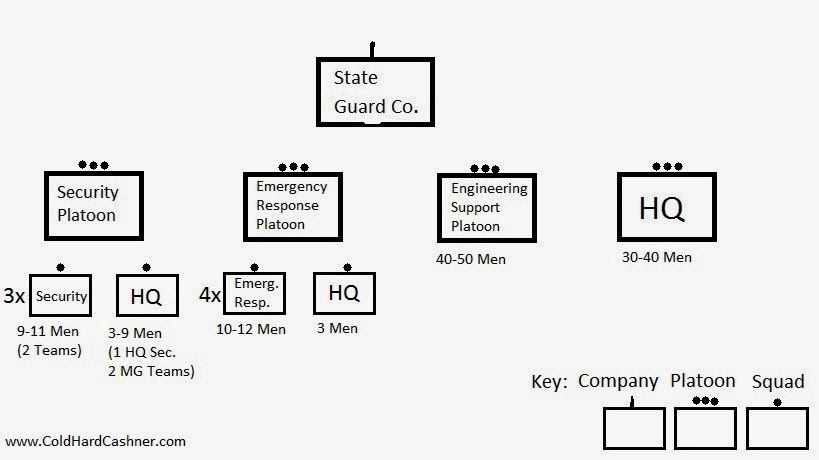 |
| Table of organization for the author’s proposed State Defense Force company. (The word “Men” is used for space concerns. Soldiers might be either gender.) |
Security Platoon:
Organized along the lines of an Army light infantry rifle platoon, this would have three squads of 9 to 11 soldiers. Each squad would have a squad leader and two fire teams of four or five soldiers. It would also have one headquarters squad consisting of a platoon leader, platoon sergeant and a radio operator as well as two machine-gun teams of three soldiers each. The platoon would train in the use of small arms, small unit tactics, riot control, first aid, and chemical, biological, radiological and nuclear defense.
Weapons would depend on what the state could afford to scrounge up (and what they felt comfortable entrusting the SDF with). Normally, infantry squads would be equipped with M16s or M4s, as well as one M203 grenade launcher and one M249 light machine-gun per fire team (2 per squad). The two platoon-level machine-guns are normally M240 medium machine-guns.
If on a truly shoestring budget, state guard members could be required to provide their own rifles (although perhaps restricted to standard military calibers of 5.56mm and 7.62mm NATO). This was how state militias were originally armed in this country. Perhaps a cheap supplemental weapon would be to have one tactical shotgun per fire team. This would give a lethal close-quarters and guard duty weapon as well being able to fire numerous types of less-than-lethal rounds in a riot control mission. Platoon-level MG’s could be replaced with 2 or 3 well-trained sniper teams.
Emergency Response Platoon:
This would be comprised of a three-person headquarters section and four Emergency Response squads modeled after the 10-person “Citizen Corps” volunteer Community Emergency Response Team (CERT). Each squad would have a squad leader, an assistant squad leader/safety NCO, as well as the following two-soldier teams: Fire Suppression Team, Search and Rescue Team, Medical Triage Team, and Medical Treatment Team. Unlike the community based CERTs, State Guard ER Platoons and Squads would be quickly deployable around the state.
Like in a CERT, all members would be cross-trained in all roles of the squad. Civilian CERTs receive about 20 hours in training and that curriculum could be used for the Emergency Response Platoon. In an environment of civil unrest the Platoon leader and senior NCOs could wear sidearms and/or a two-soldier armed Security Team could be added to each squad to guard supplies and personnel.
Engineering Support Platoon:
This platoon would have the equipment you might want see rolling into your town after a major disaster: light excavating vehicles, chainsaws, water pumps, or generators. More importantly it would have the men and women who could operate and maintain them. These wouldn’t necessarily have to be former combat engineers, there are plenty of Iowa farmers, mechanics and construction workers who could lend their expertise. In a defensive mission the platoon could be put to work digging bunkers, trenches, or tank traps and building other necessary structures.
Headquarters Platoon:
This is the administrative center of operations for the company. In addition to the company commander and his senior leaders, this platoon would contain communications, clerical, and supply personnel, as well as an armorer and a nuclear, biological and chemical (NBC) specialist. A few medics and a field kitchen (for the militiamen as well as for disaster evacuees) would be great. If the state could swing it, a couple of mortar teams would add huge combat capability to the company.
Thoughts on Training & Uniforms:
No doubt many people who would volunteer for an Iowa State Guard would have prior service in the active duty military. That training should be taken into account. For other enlistees a “basic training,” perhaps as simple as an overnight weekend, might be required.
Active National Guard and Reserve units typically meet for drills one weekend per month and two weeks during the summer. For the unpaid volunteers of a State Guard, perhaps that could be cut down to four quarterly musters per year, with some additional training times available on nights and weekends to fit around their busy schedules. When you’re asking people to do something just out of the goodness of their hearts it’s best not to put too many obstacles in their path.
The State Guard Association of the United States (SGAUS), a non-profit organization advocating for the advancement and support of regulated state military forces, offers its “Military Emergency Management Specialist” (MEMS) certification. This is comprised of three qualification levels: Basic, Senior, and Master. Perhaps these could be required of officers and senior NCO’s.
Necessary to secure Geneva Convention protections in a full-blown national invasion by another nation state, uniforms could be as simple as a distinctive armband. However, there’s something attractive about the idea of putting on a nice-looking uniform. Just ask any military recruiter. Supplying volunteers with a decent uniform may be one of the few tangible benefits they’ll receive for their service. It would no doubt be worth the cost not to scrimp on it.
While the unpaid volunteers of an Iowa state defense force would probably not be mistaken for the Marine Corps Silent Drill Team, they wouldn’t need to in order to be a valuable asset in times of catastrophe.
 Cold Hard Cashner