Federal Stimulus Package: Part One

Debate continues on the federal “stimulus package.” The House passed an $820 billion package last week that ballooned to over $900 billion in the Senate. Currently it appears that that might get trimmed to a “svelte” $780 billion. Regardless of what the grand total ends up being, as I see it, there are four reasons not to like the stimulus package: 1) It won’t work. 2) We can’t afford it. 3) It will be rife with waste, fraud and abuse. 4) It will drive up inflation. Let’s consider each of these in turn.
1. It won’t work.
The history of Keynesian “stimulus” is not promising. Daniel J. Mitchell, a Senior Fellow at Cato Institute, lists numerous examples of Keynesian failures. For instance Herbert Hoover, at whose feet the Great Depression is popularly laid, was no free-market libertarian. He increased taxes, imposed protectionism, and increased regulation of private markets. Most importantly to this debate, he increased federal spending by 47% in four years. None of these big government policies kept the Depression from knocking at the door.

Hoover’s replacement was the Keynesian poster child Franklin Delano Roosevelt. The New Deal wrapped federal tentacles around every aspect of private business. The top tax rate was hiked to 79%. FDR boosted government spending by 106% from 1933 to 1940. Still unemployment remained high and economic output didn’t recover until we ramped up during World War II. A recent study by Lee E. Ohanian and Harold Cole of UCLA suggests that New Deal policies prolonged the Depression by 7 years.

The Keynesian idea of tax rebates, wherein people are given money taken from other people, to stimulate the economy has been tried several times. President Ford tried it during the 1970’s and President George W. Bush tried it in 2001 and 2008, all with lackluster results. Bush was also the biggest spending president since LBJ, but his prolific spending apparently hasn’t helped the economy.

Mitchell also uses the experience of Japan to illustrate the folly of stimulus through government spending. He writes: “[T]hroughout the 1990s [Japan] tried to use so-called stimulus packages in an effort to jump-start a stagnant economy. But the only thing that went up was Japan’s national debt, which more than doubled during the decade and is now even far more than Italy’s when measured as a share of GDP. The Japanese economy never recovered, and the 1990s are now known as the ‘lost decade’ in Japan.”

I already wrote about the fallacy of job “creation” by public works projects in “Rebuild Iowa Wisely,” using a favorite passage from Henry Hazlitt, so I won’t rehash it here.

All these reasons and more led a group of 300 of the nations’ top economist (including 3 Nobel laureates) to sign on to a full page ad in national newspapers, denouncing Democrat’s bloated stimulus package. (See ad at the right.)

All signs point to this stimulus as being not only a failure, but a damned expensive one.

Iowa City Tea Party

I can see how cities effected by the 2008 floods may need additional funds, but still, you have to like these local tax-protesters’ style.

From the Iowa City Press-Citizen, February 4, 2009:

“A local group has sent boxes of tea to Iowa City councilors to protest the possibility of a local option sales tax.

“The Iowa City Council is considering calling for a referendum on a 1-cent sales tax. Each city in Johnson County could accept or reject the tax.

“Mike Thayer of Coralville said a group of about 30 people met Monday night to discuss the measure. A statement from the group states that the tea ‘kicks off an aggressive campaign of opposition to the tax.’

“In a play on the Boston Tea Party, Thayer said one box of loose-leaf tea was sent to each councilor with a tag including the names and addresses of those opposed to the sales tax.

“‘Local government needs to spend the money they’ve already been given more responsibly,’ he said.

“Thayer said examples of money poorly spent include $50,000 to support The Englert Theatre and $62,000 that was spent in 2007 to fund a downtown study. He said the city shouldn’t be funding a ‘failing theater’ and said the downtown survey didn’t ‘tell us anything we didn’t already know.’

“Thayer said that local government needs to cut back ‘just like Johnson County families are.'”

To learn more about the tax protest, go to http://coralvillecourier.typepad.com/community/2009/02/no-new-taxes.html.

Let’s hope things don’t go all “Concord Bridge” down there.

3 Good Bills In Des Moines

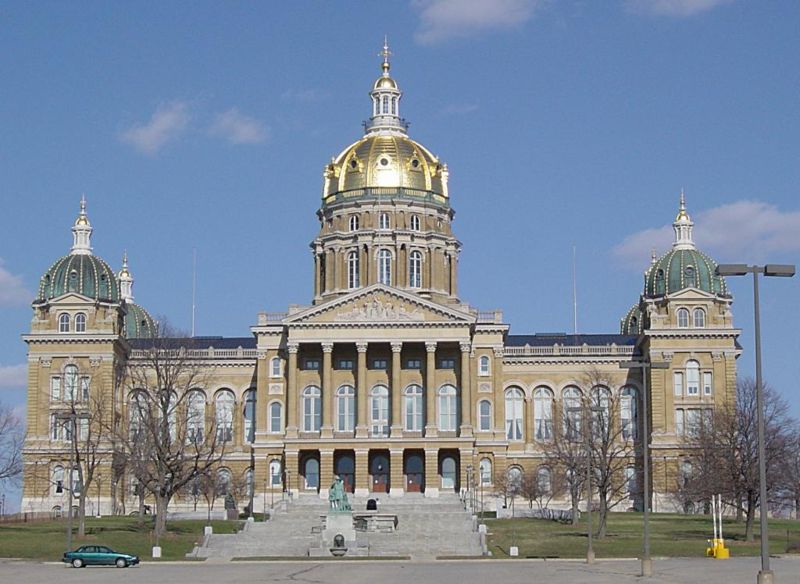
The Iowa legislature is now in session and there is the usual assortment of bills that will raise taxes and increase regulations on hapless Iowans. But amidst this tidal wave of bad bills are at least three good ones.

House File 74, the “Iowa Taxpayer Transparency Act of 2009,” would mandate that the state establish a website with a “searchable budget database website for the public to access the details of the expenditure of state tax revenues and a searchable tax rate database for the public to access the details of each tax rate for all taxing districts in the state.” In other words, you would be able to look up where the state is spending all its money and also figure up how much all the various levels of government are bilking you on taxes.

Modeled after one of President Obama’s few signature pieces of legislation while in the U.S. Senate, this bill was introduced by Republicans in the Iowa legislature (probably in the hopes that some of Obama’s mojo will rub off on them). Currently nine other states have followed Obama’s lead and set up state government transparency sites of their own. Interestingly it’s only a few Democrats opposing it here in Iowa, presumably because their fingerprints will be all over the wasteful spending that will be discovered because of the website.

The estimated cost would be about $40,000 for the website. (That’s a government estimate, so it will be higher.) But if it helps taxpayers and watchdog groups keep Iowa government on the fiscally straight and narrow path, it will quickly pay for itself.

Ed Falier Jr., President of Iowans for Tax Relief, had this to say about the new bill: “Iowans for Tax Relief agrees with President Obama and we endorse his call for change. The people are the consumer of government, and all Iowans should be able to find out exactly how their tax dollars are being spent. I want to thank the bill sponsors who are here today and ask all other Legislators to honor the agenda of our new President and support swift passage of this bill.”

House File 116 cleans up language in current law dealing with transporting firearms. Let’s say you’re one of the many new gun owners who went out and bought their first gun because you think the Obama Administration is going to ban them soon. You go to the local shooting range to practice. Knowing that it is illegal to transport a LOADED weapon in your vehicle, you pull the magazine of ammo out of the gun, put the gun in its case and into the trunk. You toss the magazine into your glove compartment and head home.

You just broke the law! According to the way it’s worded now, a loaded detachable-magazine is considered a loaded weapon, even if it’s not IN the weapon. HF 116 would change that, making it harder for recreational shooters to inadvertently become criminals.

Also dealing with firearms is House File 86, “An Act relating to the justifiable use of reasonable force.” Under current law, Iowans have a duty to flee from criminal attack before being “justified” to use deadly force outside their home. The proposed law would specify that “a person has no duty to retreat, and has the right to stand the person’s ground, and meet force with force, if the person believes reasonable force, including deadly force, is necessary under the circumstances to prevent death or serious injury to oneself or a third party, or to prevent the commission of a forcible felony.”

So good guys could legally stand their ground, and it would become the criminal’s “duty” to run like hell. Often called the “Castle Doctrine” (because “a man’s home is his castle”), it is an old concept based on English common law.

Despite cries from alarmists that such laws (which they cleverly call “Make My Day Laws”) will lead to constant bloodbaths, at least 19 other states have adopted Castle Doctrine laws of one sort or another without any problems.

Since these three bills only benefit taxpayers and common citizens, there is a risk that they will be pushed aside in favor of bills that are supported by powerful special interests. Please write your State Representative and ask him or her to support one or all of these bills. You can find your Rep here.

Iowa City: First Things Last

On January 22 an unidentified man assaulted a 7-year-old girl outside of an Iowa City school. The man ( an adult, black male with a shaved head, 5 feet 9 inches and of medium build) ran off and is still at large.

Watching the local evening news, I’ve noticed similar stories of street crime coming from Iowa City (I.C.) on a pretty regular basis, at least every month. Mine is a fairly rural area where such events still make the news. The crime scenarios coming from I.C. are usually pretty similar: a pedestrian victim is attacked on or near a street or walking trail. I wondered if I.C. has a crime problem and, if so, why?

Iowa City, as I’ve noted in other posts, is probably the most liberal town in Iowa. This is no doubt due to it being home to the University of Iowa (UI). The University is the city’s biggest employer and is so marbled throughout the community it’s hard to tell were UI ends and the city government begins.

What about I.C. is so liberal? I.C. has led the way in new “health regulations,” from public smoking bans to drinking bans. I.C. has been most noticeably supporting (and licking it’s chops about) the prospect of a new Iowa law allowing cities to impose income taxes on it’s citizens. It is proudly home to one of Iowa’s few remaining abortion mills.

The community’s central pillar, UI, is a typically liberal public university. It embraces “diversity” in all its forms, except for white skin. When a black female student was arrested for sending threatening emails in 2000, UI’s then Vice President and spokeswoman Ann Rhodes famously declared that white guys between 25 and 55 are the root of most evil.

The instructor of a required course at UI forced students to watch videos of gay sodomy, even after several protested. (Gays should be allowed to do whatever they want, just don’t force our kids to watch it!) The UI school of law is currently facing a lawsuit alleging that it discriminates against conservatives. (We libertarians might want in on that action.)

Back to crime in I.C.: I wanted to know if the stories I was always seeing on the news were just anecdotal or did I.C. have crime rates higher than others. Looking online I found that neighboring Cedar Rapids had per capita crime rates higher than I.C. in all categories except for forcible rape and aggravated assault.

Believing that these two crimes, particularly rape, might be problematic for college towns, I decided to compare I.C. with the towns housing Iowa’s two other public universities, Ames and Cedar Falls. I used crime statistics for 2006 from areaconnect.com.

Of the three towns, Iowa City had the highest per capita rates in forcible rape, robbery, aggravated assault, and vehicle theft. Ames, home of Iowa State University, led in burglary and larceny theft. University of Northern Iowa’s hometown of Cedar Falls didn’t lead in any category. (That was surprising since Cedar Falls borders Waterloo, which had relatively high crime rates across the board.) None of the three college towns had any murders in 2006. Confirming my suspicion, all three college towns were above the national average on forcible rape.

I.C. has higher per capita violent crime rates than other similar Iowa college towns. If I was an I.C. taxpayer I would be angry that my city government always had the time and resources to harass smokers, bar owners and Wal-Mart, but can’t keep the streets safe.

If the local government won’t defend its citizens, you would think that they would at least allow them to defend themselves. Not so!

While Iowa allows citizens who have passed background checks and safety courses to apply for a permit to carry concealed firearms, it is up to the county sheriff whether or not to issue the permit. Some sheriffs simply refuse to issue them to anyone. This map from IowaCarry.org shows the issuance policy of each county. As you can see, Johnson County (of which I.C. is county seat and largest city) is red, meaning it is all but impossible for a citizen to get a permit. Of course even if you do get a concealed carry permit, you can’t carry your gun on campus. Only deranged killers like Gang Lu are allowed to do that.

There are reams of statistics suggesting that an armed citizenry lowers crime rates. Denying citizens the means to defend themselves is the exact wrong answer.

A study by the Carter Justice Department found that of attempted rapes, 32% were actually committed. If the woman was armed with a gun or a knife only 3% of the attempted rapes were successful.

When faced with a spree of rape in the 1960s, Orlando Florida set up a course to teach women how to use guns. It was highly publicized in the local press. Orlando’s rate of rape dropped by 88% in one year (while remaining constant in the rest of the state). Those in I.C., who pride themselves on “empowering” women, would never stand for such a course.

As a libertarian, I disagree with liberals on matters of limited government and economic freedom, but I AGREE with them on many matters of personal freedom. So I don’t mean to pick on liberals in general or Iowa City in particular. Rest assured, if I see evidence of a major Iowa town that is as consistently and buffoonishly conservative as Iowa City is liberal (perhaps one that finally outlaws that oh-so-phallic Chapstick) I’ll let you know, dear reader.

In the mean time, Iowa City residents and city council members need to decide whether Wal-Mart or the thugs roaming its streets represent a greater threat to the populace. They might want to ask the parents of a certain 7-year-old girl.

Rebuild Iowa Wisely

As I noted previously, I just started reading the classic “Economics In One Lesson” by Henry Hazlitt. Although it was originally written in 1946, the subject matter seems to be torn from today’s headlines. Chief among these are the many “make-work” projects being advanced by the ruling Democrats.

Not to be outdone by President Obama’s national public works plan, our own Iowa Governor Chet Culver has trotted out his own $700 million infrastructure plan. “In an effort to stimulate economic growth during this recession, create good private sector jobs, and address unmet infrastructure needs, I propose the creation of the Rebuild Iowa Infrastructure Authority,” Culver said in his recent Condition of the State speech. “But when I say infrastructure, I’m not just talking about bridges and roads. I mean all infrastructure: rail, trails, public buildings, water and sewer treatment facilities, the utility grid, and telecommunications, too.”

After the 2008 floods and tornadoes, there is definitely no shortage of infrastructure that needs fixed. But what about the two primary goals, stimulating economic growth and creating jobs, that Culver listed even before “address[ing] unmet infrastructure needs?” Culver boasted that “for every $100 million spent on highway construction alone, more than 4,000 new jobs are created!” He predicts that if the legislature spends as much as he hopes, 28,000 jobs would be created.

Will any bill like this really “stimulate economic growth” and “create good private sector jobs?” Economist Hazlitt would say, “NO.”

In the chapter “Public Works Mean Taxes,” Hazlitt uses the erection of an otherwise unneeded bridge as his example of a typical government make-work project. He writes: “It is true that a particular group of bridgeworkers may receive more employment than otherwise. But the bridge has to be paid for out of taxes. For every dollar that is spent on the bridge a dollar will be taken away from taxpayers. If the bridge costs $10 million the taxpayers will lose $10 million. They will have that much taken away from them which they would otherwise have spent on the things they needed most.

“Therefore, for every public job created by the bridge project a private job has been destroyed somewhere else. We can see the men employed on the bridge. We can watch them at work. The employment argument of the government spenders becomes vivid, and probably for most people convincing. But there are other things that we do not see, because, alas, they have never been permitted to come into existence. They are the jobs destroyed by the $10 million taken from the taxpayers. All that has happened, at best, is that there has been a diversion of jobs because of the project. More bridge builders; fewer automobile workers, television technicians, clothing workers, farmers.”

In other words, if you need a bridge (or park or community building), then build it. But do so because you need it, not to “stimulate” the economy or create jobs. It will do neither.

The necessity of many of the projects covered in Culver’s plan is unquestionable. Iowa’s infrastructure took a pounding last year. But some of the projects should give taxpayers pause.

Mass transit projects such as “light rail” are often expensive boondoggles for governments that build them. (This fact was even lampooned in an episode of The Simpsons wherein an unscrupulous traveling salesman sells the gullible Springfielders on the idea of building a monorail.) I don’t know if Culver is referring to light rail when he mentions rail, but it wouldn’t surprise me. There’s been talk about it.

Even Iowa Public Radio would get some of Culver’s $700 million largesse, as would the governor‘s residence.

Culver pointed out that “unlike the federal government, [Iowa] can’t deficit spend. And, we’re not going to tax our way out of this, like California or New York.” Culver instead proposes to fund the $700 million by selling bonds. That means $700 million in state debt that will be need to be repaid over 20 years. So Culver does plan to “tax our way out of this,” although through delayed taxation rather than immediate taxation. Thanks, you Big Lug!

We have $620 million in “rainy day funds” and now is obviously a good time to use some of it. Governor Culver proposes taking $43 million from the fund: $20 million for property tax replacement, $10 million in “Jumpstart” assistance, $5 million in non-profit assistance, $5 million for individual unmet needs, $2 million for the Rebuild Iowa office and $1 million for skills training. Why not withdraw a little more and skip the bond debt?

I don’t doubt that Iowa needs to spend a lot of money to rebuild. I just hope that the Iowa legislature spends that money carefully and wisely.

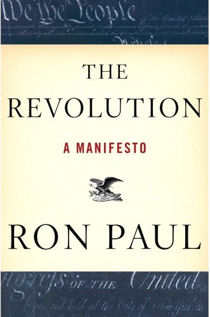
The Revolution: A Manifesto

Back in October I received a copy of Ron Paul’s book “The Revolution: A Manifesto.” I did something with it I had never done with a book before. No, not read it. I read it cover to cover twice in a row.

Usually books written in association with a presidential campaign aren’t very good. They tend to be just the written form of the meaningless sound bites that we expect from modern politics. Paul’s book is, unsurprisingly, different. Although Ron Paul sought the Republican nomination for president, philosophically he is a libertarian and has done more to advance that school of thought than any Libertarian Party candidate. The Revolution isn’t a campaign book at all, but a wide ranging dissertation on libertarian and paleo-conservative philosophy.

The first chapter is titled “The False Choices of American Politics.” Paul writes: “[E]very four years we are treated to the same tired, predictable routine: two candidates with few disagreements on fundamentals pretend that they represent dramatically different philosophies of government.” The false choice presented is, how should the government control something, not should the government control it. This chapter seemed particularly apropos after this election between statists Obama and McCain, and after a Republican president began nationalizing the banking industry like a Democrat on steroids.

Chapter 2 deals with “The Foreign Policy of the Founding Fathers.” Paul spends a good deal of time outlining the policy of “peace, commerce, and honest friendship with all nations, entangling alliances with none,” advocated by Thomas Jefferson and others. He chronicles how far we’ve strayed from that advice and how our intervention in other nations has made us a target for terrorists while draining our treasury.

The third chapter deals with the constitution and how much the federal government has slipped loose from its constraints. Paul again quotes Jefferson, who wrote in 1798, “Confidence is everywhere the parent of despotism. Free government is founded in jealousy, and not in confidence… In matters of Power, let no more be heard of confidence in man, but bind him down from mischief by the chains of the Constitution.” Paul urges us to “rally and recall our people to the Constitution, the rule of law, and our traditional American republic.”

Chapter 4 expounds upon “Economic Freedom.” He details his thoughts on government waste and spending (but I repeat myself), taxes, and regulation of private markets. In Chapter 5, “Civil Liberties and Personal Freedom,” he deals with privacy rights and other civil protections that have been buffeted by the “wars” on terror and drugs. Writes Paul: “Freedom means not only that our economic activity ought to be free and voluntary, but that government should stay out of our personal affairs as well. […] Economic freedom and personal liberty are not divisible.” This flies in the face of conservatives and liberals that want one but not the other, conservatives wanting only the former and liberals wanting only the latter.

The sixth chapter deals with Paul’s true passion: “Money: The Forbidden Issue in American Politics.” Here Paul chronicles America’s monetary policy and how it creates inflation, encourages debt and government spending, and causes the economic “bubbles” that seem to be bursting everywhere lately. Chief among Paul’s concerns is the Federal Reserve, which orchestrates all of the above. To remedy our problems, Paul advises abolishing the Federal Reserve and returning the dollar to the gold standard.

In the final chapter, “The Revolution,” Paul explains what can be done to peacefully implement the points he raised in the previous chapters.

If you’re at all interested in understanding libertarian ideas, you should read “The Revolution: A Manifesto.” It touches on just about every subject of importance and is an easy, enjoyable read. It’s available at the Campaign For Liberty Store online, amazon.com and anywhere else books are sold.

Out With The Old In With The… Old

It’s obviously the time of year to write a retrospective of the old year and predictions for the new. The retrospective is easy. Not to put too fine a point on it, 2008 sucked.

Here in Iowa, we started 2008 buried in snow and ice. By June that had turned to tornadoes and floods. Not just any tornadoes and floods, but Iowa’s worst tornado since 1976 and our worst flooding in recorded history. The political climate didn’t prove any better than the weather.

Despite starting the year optimistic that libertarian Republican candidate Ron Paul would do well in the Iowa Caucus and New Hampshire primary, giving him a bounce into a credible run for the GOP’s nomination for president, the Republicans instead nominated another big government neo-conservative. Although I myself have been lulled into the “lesser of two evils” mindset in previous elections, I could never vote for John McCain because I don’t believe he is any “lesser.” For the first time in my adult life, I truly didn’t care whether the Democrats or Republicans won the Whitehouse.

Let’s look at what went on in the categories of personal and economic freedom.

2008 Economic Freedom

On the national front we saw the emergence of a strong new socialist leader who led the country toward nationalization of several major industries. To my chagrin it was not Barack Obama but “free-market Republican” President George W. Bush who has marched us hip deep into socialism. On an encouraging note, however, the RNC is poised to issue a rebuke to Bush and congressional Republicans for the massive “bailouts.”

In my state of Iowa, the Democrats, who control the statehouse and governorship, went into a holding pattern after hiking the minimum wage in 2007 (which went into effect Jan.1, 2008). However, they replaced the 1% SILO (School Infrastructure Local Option sales tax), which had to be occasionally approved by voters in each county, with a “Statewide Penny Tax,” thereby taking the decision away from local voters who might be too dumb to constantly reauthorize it. Lobbyists and politicians in Des Moines are already proposing other uses for this “school infrastructure” money.

In similar disdain for democracy, when voters in two Iowa localities (a county and school district) voted down tax increases, the respective governing bodies rescheduled special elections to vote on the same measure. The elections will be held after the county and school board have had time to properly “educate” voters on the issue. Sounds like, heads we win, tails we flip again, to me.

In December, Governor Culver announced his pragmatic move to cut state spending by 1.5 percent across-the-board. This is a nice departure from the usual Democrat idea to increase government spending during economic downturns. It leaves libertarians wondering why it takes a recession to get that done, however.

2008 Personal Freedom

Gun owners got a needed boost when the U.S. Supreme Court ruled in June that the Second Amendment protects an individual, as opposed to collective, right to own firearms. This led to several U.S. cities dropping gun ban ordinances.

Gun owners in Iowa, however, had a setback when a modest bill to standardize training and issuance of concealed-weapons permits died in the legislature in April.

Personal freedom also took a hit when a statewide smoking ban went into effect in July. This lessened the liberty of Iowa’s smokers as well as its business owners.

2008 marked the first year that voters could register as Libertarian Party members on Iowa’s voter registration forms. As of July, however, only 150 had officially done so, although party membership is much higher. The Party’s presidential candidate, former congressman Bob Barr, received 4,608 votes statewide.

Peering into my crystal ball (which are issued to all bloggers), let’s examine the trends for 2009.

2009 Economic Freedom

This year will probably be more of the same, or worse, for proponents of small government and free markets. President Obama and the Democrat Congress will no doubt treat Bush’s socialist power grab in the market as a floor, not a ceiling. Expect massive amounts of new regulations, new taxes, and scores of new bureaucrats administering it all. I think we’ll see a lot of that at the state level also.

The state of Iowa already has income and sales taxes and localities have sales and property taxes. A new proposal by some Iowa legislators would allow Iowa cities to also levy a tax on their denizens’ incomes. This is being sold largely as “property tax relief.” Ed Failor, Jr., President of Iowans for Tax Relief said: “Iowans are smart people, and we are smart enough to understand a new tax to reduce reliance on another tax is how politicians describe a tax increase.” The new income taxes will be around longer than any short-lived “relief” in property taxes.

There is also the ongoing chatter about getting rid of the deductibility of federal taxes on Iowan’s state income taxes. Essentially this would require Iowans to pay taxes on money that goes directly to the federal government that the wage earner never even sees.

2009 Personal Freedom

This will be hit and miss depending upon whether you are in a group favored by liberal Democrats, but I would say the general trend is downward.

Hopes that Obama would do better on civil liberties than Bush, faltered somewhat when Obama supported a sweeping intelligence eavesdropping law opposed by his own party. Police state policies don’t look so bad when you will be the one wielding them. Civil libertarians should brace for more such letdowns.

Gun owners should follow the advice of Samuel L. Jackson in “Jurassic Park” and, “Hold onto your butts.” At a minimum we should expect federal efforts to resurrect and expand the ban on so-called “assault weapons,” banning of gun shows, gun storage laws and gun owner harassment.

Since the Iowa legislature has shown itself to be willing to regulate any human activity in the name of “public health,” Iowans can expect efforts to strengthen the smoking ban, bans on drink specials at bars, and bans on junk food in schools. All of these are already in discussion. A new mandate that only self-extinguishing “fire safe” cigarettes be sold in Iowa went into effect January 1st, despite complaints by smokers that they are hard to smoke and taste bad. (No, I don’t smoke. I just hate unnecessary regulation and meddling.)

The Iowa Supreme Court may rule soon on gay marriage in Iowa. A lawsuit against Iowa’s unfair concealed weapons issuance law may be advanced this year. Both could either help or harm their intended beneficiaries.

Not counting the weather, I believe 2009 will be about the same as 2008. The few glimmers of hope for personal freedoms will largely be extinguished by massive reductions in economic freedom. Since these infringements upon economic freedom will also have a negative effect upon the economy as a whole, more people will be harmed than helped and the recession will be longer than it needs to be.

Of course, I’ve been wrong before. Happy new year.
O Come All Ye Faithful

Why evangelical Christians should rally to the libertarian cause.

As we wind down our celebration of the birth of Christ and prepare for the new year, I hope that “conservative” Christians, who are wondering where to go after the Republican train wreck of late, will give the Libertarian Party (L.P.) a second look.

If you’ve heard anything about us, you’ve probably heard that we want to legalize pot, gay marriage and all sorts of other things that no doubt turn your gut. Before you let that scare you off, let me explain our take on some of these issues. (Keep in mind that I hold no official position with the party, so if I muck it up, don‘t blame them.)

The L.P. is generally about freedom. The L.P.’s national platform states it fairly well: “We, the members of the Libertarian Party, challenge the cult of the omnipotent state and defend the rights of the individual. We hold that all individuals have the right to exercise sole dominion over their own lives, and have the right to live in whatever manner they choose, so long as they do not forcibly interfere with the equal right of others to live in whatever manner they choose.” How does this effect issues supposedly important to evangelicals?

Let’s get right to the most contentious issue first: Abortion. I’m not going to lie to you, most Libertarians are probably pro-choice. Wait, come back! Not all of us. There are enough of us pro-life Libertarians for the National Committee to recognize that good Libertarians fall on both sides of the issue. The L.P.’s National Platform says: “Recognizing that abortion is a sensitive issue and that people can hold good-faith views on all sides, we believe that government should be kept out of the matter, leaving the question to each person for their conscientious consideration.”

Yeah, I know that’s a cop-out, but there really is no middle ground here. Since Libertarians support individual rights (life, liberty, and property), there’s somewhat of a conundrum with this issue. Libertarians like me, who believe that life begins at conception, see abortion as the ultimate violation of an unborn person’s right to life. Libertarians who believe that life begins at birth see banning abortion as a violation of the mother’s liberty. To some degree, both sides are right. (Of course, I believe my side is MORE right!)

So where would a nation run by Libertarians leave us pro-lifers? We would be free to speak out against abortion in any manner that we chose (provided we didn’t harm or threaten to harm anyone else). With less money being taken from us in taxes we would be freer to contribute our money to pro-life groups, making them more effective. Since Libertarians support Constitutional restraints on the federal government and recognize that this is NOT a subject that the federal government has authority over, the people of each State would be allowed to decide whether or not abortion should be legal. That might be the best that pro-lifers can hope for, regardless of who’s in power.

Another benefit that a libertarian society would bring is that your church would be vastly more important in the community. Since Libertarians would get rid of government-run “welfare,” private charities and churches would become that much more vital. Religious charities have a long and proud history of helping people. They also generally do so much more efficiently and effectively than wasteful, values-neutral government programs. With lower taxes, more money would be flowing into church coffers and religious institutions could reclaim their historical role as society’s true safety net.

Another power that a libertarian society would give back to the people (and their collective representations, the churches) would be that of educating our children. Many evangelicals hate the fact that they have to send their kids to (or at least fund) government-run schools that teach their children that the basic tenants of their religion are a lot of bunk. Under a Libertarian government, parents would be free to send their kids to whatever school they chose, and they would be able to afford to so. Private and/or religious schools would become the norm, as would home-schooling.

The L.P. platform puts it thusly: “Education, like any other service, is best provided by the free market, achieving greater quality and efficiency with more diversity of choice. Schools should be managed locally to achieve greater accountability and parental involvement. Recognizing that the education of children is inextricably linked to moral values, we would return authority to parents to determine the education of their children, without interference from government. In particular, parents should have control of and responsibility for all funds expended for their children’s education.” [Emphasis added.]

This is not just a pie in the sky idea. There are small, practical steps we can take in this direction already, such as education tax credits. Groups like Iowa Advocates for Choice in Education are already working on “expanding educational options to all Iowa families.”

All in all, Libertarian policies would reduce government coercion of everyone, including evangelical Christians. So while, yes, others would be freer to do things that you might find sinful, you would be freer to worship as you choose, choose how your money is spent and instruct your children on right and wrong. If the only way to get the government off your back is to get it off everyone’s back, that sounds like a good deal to me.

Man vs. Meat

One of the last official Republican functions that I attended, when I still had any hope for that party, was a county convention here in Iowa. To my surprise, the target of most of the ire from the assembled delegates was not Al Qaeda, illegal immigrants or even monogamous gays, it was Iowa’s deer herd. There was even a platform plank proposed to make a continuous open season for deer in Iowa. (I don’t think it made it onto the state platform though.)

The growing resentment for the horned pests is understandable. The Iowa Department of Natural Resources (DNR) estimated a deer population of about 380,000 after the 2007 hunting season. That many deer cause massive damage to Iowa crops and massive headaches for Iowa drivers.

Statistics on DeerCrash.com show that there are usually 7,000 to over 8,000 deer-vehicle collisions in Iowa each year. The Iowa Department of Transportation reports that 12 people were killed in deer-related accidents in 2007, double the previous five-year average. According to data from State Farm Insurance, the number of deer-vehicle collisions in Iowa has risen 12.2 percent over the past five years. Iowans now have a one in 105 chance of hitting a deer every time they drive, the fourth highest likelihood in the nation behind West Virginia, Michigan and Pennsylvania.

Besides all this, these animals taste great and their heads make attractive wall furnishings. Although I’ve never been deer hunting, even I can recognize the fact that if ever God made an animal crying out to be killed, eaten and stuffed, it is the Iowa whitetail!

Luckily, the Iowa DNR allows ample opportunities to hunt them. For deer, Iowa now has a youth season, a disabled hunter season, two archery seasons, two muzzleloader seasons, two shotgun seasons, two antlerless seasons and a nonresident holiday season. My problem comes with some of the regulations that the DNR places on deer hunters.

The most glaring one is the ban on “two-way mobile radio transmitters,” (which includes cell phones) during deer hunting. According to the DNR regs: “You cannot use a two-way mobile radio transmitter to communicate the location or direction of game or furbearing animals, or to coordinate the movement of other hunters.” [Emphasis added.] To me, this would seem to be a safety issue.

My wife and I can’t walk around Wal-mart without coordinating our efforts over the cell phone. It would seem that diverging groups of armed men walking about in the woods should be afforded the same level of coordination. One team in a hunting party should be able to find out EXACTLY where their other team is before they start shooting.

Perhaps the Iowa DNR should revisit some of its regulations. Some of them probably made sense when Iowa’s relatively small deer herd needed a “sporting chance” against hunters. Now deer are everywhere and hunting basically amounts to pest control, so its time for some of these rules to go, especially rules that place the safety of some soon-to-be-sausage over hunters. Hunting accidents are statistically rare in Iowa. Let’s keep it that way.

Dr. Obama, First Do No Harm

Speaking about the failing economy, President-elect Obama coolly diagnosed, “We understand that we’ve got to provide a blood infusion to the patient right now to make sure that the patient is stabilized, and that means that we can’t worry short-term about the deficit. We’ve got to make sure that the economic stimulus plan is large enough to get the economy moving.” Since the “patient’s” infusion would come from the patient itself (through either taxes or debt), “Doctor” Obama’s treatment may be more like an old-fashioned bloodletting than a true cure.

Obama, like many in Washington (in both parties), is a devotee of Keynesian economics, the ideas of British economist John Maynard Keynes. His theories were first published in 1936 and were quickly adopted by America’s big government progressives, like President Franklin Delano Roosevelt. One of the key theories of Keynesian economics is that during economic downturns the government can “prime the pump” by increasing its spending. Since Keynes’ theories increase the size and power of government, it’s no wonder his ideas have always found so many acolytes in D.C.

Keynesian economics has many critics however. Notable detractors include economists Milton Friedman, Robert Lucas, Murray Rothbard, and Henry Hazlitt. Austrian economist Friedrich Hayek criticized the collectivist approach of Keynesian economics, which requires centralized planning, which Hayek argued leads to totalitarian abuses.

Besides its push for bigger, more authoritarian government, Keynesian economics just doesn’t seem to work. As the Cato Institute, a libertarian think tank, points out: “[T]he notion that bigger government leads to more growth is theoretically suspect: any money that the government ‘injects’ into the economy with new spending (or tax rebates) must first be borrowed and diverted from private use. The economic pie gets sliced differently, but it is not any bigger.”

Many argue that the Great Depression wouldn’t have been as long or severe if it wasn’t for the Keynesian “cures” employed by the Roosevelt Administration. Later examples of Keynesian policy in practice haven’t fared much better. “Huge increases in government spending under both Hoover and Roosevelt did not help the economy during the 1930s, and more recent Keynesian initiatives—Gerald Ford’s rebates in the mid-1970s, Japan’s stimulus efforts in the 1990s, and President Bush’s rebates in 2001 and 2008—do not seem to have generated positive results,” states the Cato Institute.

Since our public debt currently stands at about $10.6 trillion, and the government is already racking up record deficits this year and no doubt next year, can we really afford to increase spending on anything, particularly for economic “cures” that don’t generally work? (To put that $10.6 trillion figure in some kind of perspective, remember that it took America the time period from George Washington to Ronald Reagan to accumulate ONE trillion in debt. We’re now on pace to add that amount of debt this year alone. With the looming crisis in Social Security and Medicare, that number is sure to go up.)

Dr. Obama, your “patient” is hemorrhaging. Before you apply your Big Government leeches, you might want to pay heed to the medical dictum, “First, do no harm.”