Taxpayers Ejected From Tax Hearing

During a public hearing on the Democrat plan to tax Iowans’ taxes, House Speaker Pat Murphy ordered state troopers to remove the citizens sitting in the Capitol galleries when they refused to quit booing tax supporters and applauding tax opponents.

IowaPolitics.com’s Lynn Campbell reported Wednesday:

“More than 500 people packed the Iowa Capitol and the House galleries Tuesday night, largely in opposition to a plan that would eliminate the ability of Iowans to deduct their federal tax payments when calculating state tax liability. They wore red T-shirts from Iowans for Tax Relief that stated, ‘no tax on a tax.’

“The crowd booed and hissed supporters of the legislation, and applauded opponents. They were reprimanded several times by House Ways and Means Chairman Paul Shomshor, but the boos and applause continued. Murphy initially came out, ordered that decorum be kept and threatened to clear the chamber, but the applause continued.

“The final straw came when Greg Baker, a University of Iowa student and state chairman of the College Republicans of Iowa, told lawmakers: ‘Please quit messing up this state.’

“The crowd burst into applause. Shomshor pounded the gavel and ordered the galleries cleared at 8:27 p.m. Murphy came out to enforce the order, which was immediately followed by angry shouts by the audience.

“‘This is our House!’ one person shouted.

“‘We pay you!’ another shouted.

“‘You’re fired!’ a third shouted.”

The first two people are right. Let’s hope the third person turns out to be prophetic.

When Good Bills Go Bad

HF 193’s fall from grace and it’s hoped redemption.

German Chancellor Otto von Bismarck said, “There are two things you don’t want to see being made—sausage and legislation.” Watching the political tug-of-war going on in the Iowa legislature right now over Iowa’s concealed carry permit system, I can see what he meant. Sausage-making usually renders a usable product, however, while legislating might not.
Such is the fate of House File 193, a bill partially reforming Iowa’s weapons permit process. About two weeks ago I included HF193 in my “Funnel Week” report as one of the “good bills” to have survived. How quickly things change.
I reported at that time: “HF 193 would improve the licensing regime in several ways. First, if a sheriff denies a permit he has to give the applicant a written reason why it was denied. Secondly, a denial can be appealed to the Iowa commissioner of public safety (and then to a judge, if needed). Thirdly, it would standardize training requirements statewide. Fourthly, it would grant reciprocity, recognizing weapons permits from other states. Lastly, it would grant immunity to the issuing sheriff or commissioner of public safety for any unlikely harm done by a permit holder.”
That was how the bill read as it was originally introduced by pro-Second Amendment legislator Clel Baudler. However, it emerged from the Iowa House’s Public Safety Committee “sausage factory” much different than it went in. It even came out sporting a new name: HF 746.
HF 746 still leaves discretion on issuing permits to the county sheriff, meaning Iowa will retain its 99 different policies on issuance requirements. It would keep the appeals process from HF 193, but permit denials would be upheld so long as they were “uniformly applied to all nonprofessional permits issued pursuant to standards published by the sheriff[.]”
In other words, all that Iowa’s many anti-Second Amendment sheriffs would have to do is post a list of their “standards” for issuing permits, perhaps requiring applicants be blue-eyed Eskimo amputees who are native-speakers of Portuguese. (It doesn’t say how these standards would be disseminated. Presumably, an 8.5” X 11” photocopy hung in the sheriff’s personal restroom would suffice.) So long as these standards were “uniformly applied” to all applicants, the sheriff doesn’t even need to give you a written reason for the denial and the appeals process would be meaningless.
The new bill was so bad that Gun Owners of America (GOA) said it would consider a legislator’s vote for HF 746 as an “anti-gun” vote. According to GOA, the bill would also:

  • Permanently ban you from getting a permit if you have been convicted of a simple misdemeanor assault or harassment charge (charges that can include such things as “pushing and shoving” cases);
  • Raise the permit age from 18 to 21;
  • Remove some of the confidentiality restrictions on psychiatric records(which means that military veterans suffering from Post Traumatic Stress Disorder could be unduly affected by [HF 746]);
  • Require that an abused spouse attempting to get a permit to protect herself from her abusing husband pass a marksmanship test;
  • Specify that the Lautenberg amendment be strictly enforced, even though strict enforcement of the Lautenberg amendment in other jurisdictions has interpreted its language to reach parents who spank their kids, wives who spit at their husbands, and even spouses who inflict “emotional abuse.”

Since anti-Second Amendment legislators trashed Baudler’s original bill, a few pro-Second Amendment legislators decided to try to return the favor. Representative Kent Sorenson (who had earlier seen his “Vermont Carry” bill go down in flames) and several others, introduced three new amendments to HF 746.
Again according to GOA, these amendments (labeled H 1184, H 1185, and H 1186) would “reaffirm[…] your right to carry a firearm without the gracious permission of the government” (Sorenson’s Vermont Carry), and include “‘Castle doctrine’ language which would allow you to defend yourself, your family, and others without retreating,” and “[l]anguage to move Iowa toward a ‘shall issue’ state in which your concealed carry permit could not be withheld for arbitrary reasons[.]”
The pro-Second Amendment group Iowa Carry reports that Speaker of the House Pat Murphy has stated that he will not allow HF 746 to come to a vote on the house floor with these amendments attached. Iowa Carry encourages concerned gun owners to contact Representative Murphy and tell him to allow a vote on HF 746 WITH the amendments H 1184, H 1185, and H 1186. (Remember, without the amendments this is a bad, bad bill. With the amendments, it’s okay.)
That’s where concealed carry reform in Iowa stands at the moment.

Beth Cody on Gay Marriage

As the issue heats up in Iowa, Iowa City Press-Citizen writer Beth Cody weighs in on her website:

“Conservative Republicans have traditionally upheld personal freedoms and limited government (which is why I am still a registered Republican).

“Insisting that government get out of the marriage business is the only opinion that is consistent with Conservative belief in limited government.

“How could any advocate of Constitutional freedoms believe otherwise? Just as freedom of speech is not limited to speech that the majority finds agreeable, freedom to associate is not limited to majority-approved groups.

“Whether or not one personally approves of homosexual relationships, no rationale exists for government interference in such personal matters.

“As government once prohibited men and women of different races from marrying, now government appointees and bureaucrats believe they are wise enough to decide whether same-sex couples should be allowed to marry.

“Why is it that people invariably look to government to help them, when government is nearly always the main force to be overcome in the pursuit of happiness?

“Marriages should be private contracts between individuals of legal age. Government would simply record civil union contracts as they occur, and enforce them like any other contract.

“Whether to call such unions “marriages” would be decided by couples, their families, their churches – not by government.

“Other people and businesses should be free to recognize (or not) these marriages; and churches not required to marry any specific couples.

“No matter how the Iowa legal case is decided, we will have made little progress toward real freedom from our government masters. I believe it will be up to Constitutional Conservative groups to ask the real question: who should control marriages: the state or free individuals?”

Read the entire article here.

Funnel Week

During each legislative session of the Iowa General Assembly there are what are as known as “funnel weeks” where, if a bill has not been atleast passed out of committee, it is dead for that year. (They may still resurface latter as amendments to other bills, however.) This does not apply to certain spending bills, tax bills and leadership bills. The week of March 9-13 was the sessions first funnel week.

Of the many Iowa bills discussed on this blog, the following ones, good and bad, are still alive:

Bad Bill- House File 179, “An Act including members of the clergy as mandatory reporters of child abuse, and making penalties applicable.” This bill flies in the face of the First Amendment right to free exercise of religion. It would require State determination of who is and who is not “clergy.” Also (as I pointed out in “How About A Little Separation of Church And State?”) this would discourage people from going and talking to their minister, who is “a small town’s first responder for family crises.”

Bad Bill- Senate File 227, “An Act relating to an agreement among the states to elect the president by national popular vote.” Formerly called SSB 1128, this bill would require all of Iowa’s electoral votes be awarded to whichever presidential candidate wins the most votes nationwide, regardless of how they fared in Iowa. In “Iowa Senate Studies ‘Tyranny of the Majority’” I stated that a candidate therefore could “win” Iowa without having a single person in Iowa vote for them.

Good Bill- House File 74, the “Iowa Taxpayer Transparency Act of 2009.” This bill would require the state to create a “searchable budget database website for the public to access the details of the expenditure of state tax revenues and a searchable tax rate database for the public to access the details of each tax rate for all taxing districts in the state.” [Referenced in “3 Good Bills In Des Moines“]

Good Bill- House File 721, “An Act relating to the carrying of a gun in or on a vehicle on a public highway and making penalties applicable. Called HF 116 when I wrote about it in “3 Good Bills In Des Moines,” this bill would alter the silly Iowa law that considers a loaded magazine to be a loaded weapon even if it isn’t in a weapon. This was a pain in the neck for shooters who had to spend valuable range time loading and unloading their magazines. If they forgot to unload one, they could become criminals on the drive home.

Good Bill- House File 193, “An Act relating to the issuance of permits to carry weapons and providing an effective date.” Although I didn’t actually endorse HF 193 in “‘Shall Issue’ In Iowa?,” I did mention it. In the eyes of libertarian purists, it certainly wasn’t the best of the five bills to reform Iowa’s concealed weapons permit system, but it’s the last man standing, and it is pretty good.

HF 193 would improve the licensing regime in several ways. First, if a sheriff denies a permit he has to give the applicant a written reason why it was denied. Secondly, a denial can be appealed to the Iowa commissioner of public safety (and then to a judge, if needed). Thirdly, it would standardize training requirements statewide. Fourthly, it would grant reciprocity, recognizing weapons permits from other states. Lastly, it would grant immunity to the issuing sheriff or commissioner of public safety for any unlikely harm done by a permit holder.

There are still plenty of other bad bills and probably even a few good ones that made it through the funnel. Since tax and spending bills aren’t affected by funnels, don’t let go of your wallet just yet.

"Shall Issue" In Iowa?

While the National Rifle Association dozes quietly on the sidelines (no doubt dreaming of new fundraising appeals), five separate “shall issue” concealed weapons bills have been introduced in the Iowa General Assembly. This fact alone shows that there is growing support for fixing Iowa’s concealed carry law.

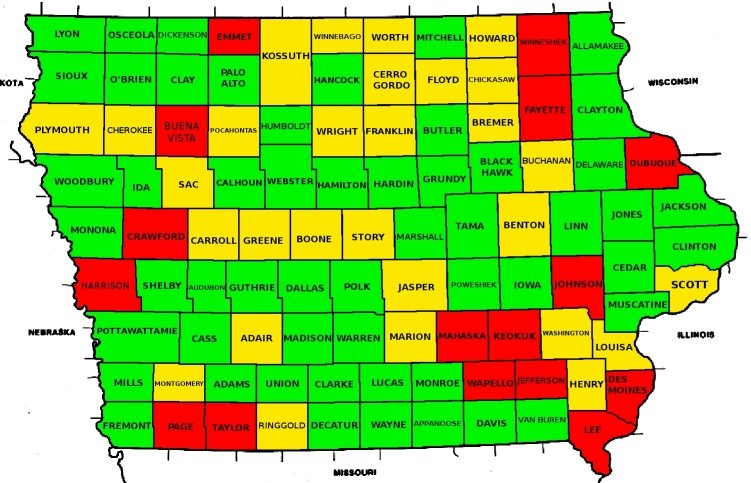
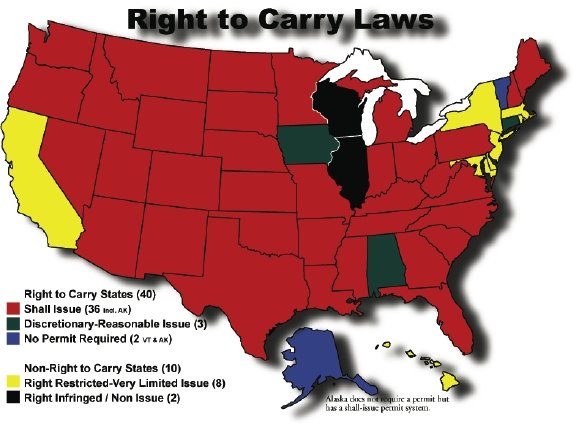
Concealed carry laws simply allow that citizens who have passed criminal background checks and firearms training courses can be issued a permit to carry a firearm concealed on their person. Thirty-six states have “shall issue” laws which declare that the issuing authority must issue a permit to qualified applicants. Iowa currently has what is called a “may issue” law. The decision whether or not to issue permits to qualified applicants (or at all) is left to each individual county sheriff. This means that there are 99 separate policies setting standards for proper training and issuance of permits in Iowa, although the permits themselves are valid statewide. [The Iowa map to the upper right shows the relative ease of getting a permit by county, with green being the easiest, yellow medium, and red the hardest. Map courtesy of IowaCarry.org ]
Why would Iowa, or any state, want private individuals to be able to carry guns? Concealed carry laws are partially responsible for the massive declines in crime rates that we’ve seen in America. States which passed concealed carry laws reduced their murder rate by 8.5%, rape by 5%, aggravated assault by 7% and robbery by 3%. Since 1991, 23 states have adopted some form of concealed carry law, the number of privately-owned guns has risen by almost 70 million, while violent crime has declined 38%. Every year, about 500,000 people defend themselves with a firearm while away from their home. [U.S. map to the left from NRA-ILA.]

Of the five bills introduced in the Iowa legislature, three do not fix all the problems of the current system. Some appear to be “shall issue” measures, but leave out important elements such as an appeals process or standardized statewide training requirements. Leaving training standards to local sheriffs allows anti-gun sheriffs to obstruct issuing permits by making the standards impossible to meet. The two best bills are HF 559 and HF 596.

HF 559 is the bill being championed by the pro-gun group Iowa Carry. This bill meets the four requirements that Iowa Carry has fought for: It states that the sheriff “shall issue” to qualified applicants, it standardizes training statewide, it allows for “reciprocity” (recognizing permits from other states), and although it allows sheriffs to deny permits for specified reasons, it allows for an appeals process for applicants who feel they were wrongly denied.

This bill is currently stuck in a three-man subcommittee, the chair of which has a reputation as being the ax man for bills that the Democrat majority wants to disappear. When asked about HF 559, another member of the subcommittee states that he is “[not] in favor of a bunch of idiots running around shooting each other.” The last representative on the committee, Clel Baudler, while a stalwart supporter of the Second Amendment, is the author of one of the other concealed carry bills (HF 193) and therefore might not go to the mat for this one.

HF 596 is a much more sweeping reform of Iowa‘s permit system (and therefore much less likely to pass). According to Gun Owners of America, which supports it, the bill would: Allow law-abiding citizens to carry firearms concealed or openly on their hip, without a permit. This is often called “Vermont Carry” after one of the two states that use this policy. (The other, more recent, one is Alaska.) It would allow people to be issued a permit, if they wished to carry in other states that recognize such. Moving beyond right-to-carry issues, this bill would eliminate Iowa’s requirement to get a special permit just to purchase a handgun. This requirement is redundant now that a federal law mandates that all commercial gun sales require a criminal background check.

Although it is good, HF 596 has only slightly better odds of passage than a resolution declaring that hog farmers and the Iowa Hawkeyes suck.

Of the five bills, only Baudler’s HF 193 (SF 258 in the Senate) seems to be going anywhere. This bill is a definite improvement as it would standardize training requirements statewide, grant reciprocity to other states and would establish an appeals process for denied applicants. However, it can’t be considered a true “shall issue” bill since it would still leave issuance criteria solely to the county sheriff.

With five bills floating around the statehouse, there’s a chance that at least one can pass and maybe modestly improve Iowa’s confused weapons permit system. Then again, maybe not.

End The War(s)!

Excerpted from a post by Jeff Yager, one of our friends at Advocates of Liberty:

“One of the major news stories from the last week is that Barack Obama has decided that he will end the war in Iraq. Well, not really. Removing “combat” troops in Iraq is at least a step in the right direction, even if they are baby steps. This policy announcement mirrors what appears to be his stance in another war going on that’s closer to home and perhaps claiming even more lives than the one in the Middle East: The War on Drugs.

“Last week, Eric Holder announced that the raids on medical marijuana users would end. This could mark the beginning of the end for marijuana prohibition. However, if Obama’s Iraq War timeline is any indication at the speed at which he will be delivering his wonderful change, then I wouldn’t go looking for that new bong on Ebay quite yet.”

Read the entire article here.

Time To Tax Our Taxes?

According to the Sioux City Journal, Governor Culver said Tuesday that he “would give ‘serious’ consideration to eliminating federal deductibility as a way to simplify and streamline Iowa’s tax code.” This came just the week after Iowa Senate Democrat leaders announced their support for eliminating federal deductibility. Obviously there is growing support in Des Moines for this idea. What does that mean for Iowa taxpayers?

Federal deductibility simply means that, when figuring your state income taxes, you may deduct from your income the money that you’ve already paid in federal income taxes. For most of us, these federal taxes are withheld from our checks. It is money that we never get to see, touch, deposit or spend, so why on earth should it be counted as income?

For many low and middle-income taxpayers who don’t have mortgage interest or property taxes to deduct from their income, federal deductibility represents a significant savings on their state tax bill.

Federal deductibility is a matter of fairness. To eliminate it would mean allowing the state to charge a tax upon a tax.

Proponents of changing the deduction say that it would simplify the tax code. But one already-existing line on the tax form seems to be a worthwhile complexity to assure fairness. If they really wanted to simplify the tax code, they could eliminate the personal income tax altogether like Alaska, Florida, Nevada, South Dakota, Texas, Washington, and Wyoming have already done. Or they could move to a flat rate personal income tax such as Colorado, Illinois, Indiana, Massachusetts, Michigan, Pennsylvania, and Utah have.

Proponents also claim that the deduction forces the state to charge higher taxes in order to compensate for its lost income from federal deductibility. This argument could also be made against any other state deduction. The watchdog group Iowans for Tax Relief is fond of pointing out that, when “simplifying” the tax code, any promised tax cuts are short-lived while the lost deductions are usually gone for good.

While the idea of eliminating federal deductibility might be popular with those who charge taxes, it is unpopular with the Iowans who pay the taxes. A January 2009 poll showed that 72.5% of Iowans support maintaining their right to deduct federal tax payments.

If you are a member of this majority of Iowans, you can look up your state legislators here and ask them to retain federal deductibility on state income taxes.

Further reading: Public Interest Institute Policy Study No. 07-3 “Federal Tax Deductibility in Iowa: Who Benefits and Why It Should Continue”

Iowa Senate Studies "Tyranny of the Majority"

When the Constitutional Convention met in 1787 there was almost immediate conflict between delegates from the large, heavily populated states and the smaller, less populous ones.

How should the national legislature be constituted? The big states proposed The Virginia Plan which assigned Congressional representation based upon population. The smaller states favored The New Jersey Plan, which assigned an equal number of representatives to each state. Ultimately, both sides accepted the “Connecticut Compromise,” wherein there would be two houses of Congress. In the Senate, each state would get an equal number of Senators and the House of Representatives would be allocated by a state’s population.

Another (somewhat cobbled together) compromise was the “Electoral College” for electing the president. Some delegates thought the president should be elected by Congress, others preferred a popular election. In the end, the Constitution allowed each state to assign a number of “electors” equal to that state’s Congressional delegation, to vote for the president.

Most people don’t really understand the electoral college (myself included). As it is now practiced, each state still gets one elector for each representative and Senator it has in Congress. All but two states instruct their electors to vote for whichever presidential candidate got the most votes in that state. These 48 states, Iowa included, are “winner-take-all,” giving all of their elector votes to the highest vote getter in that state.

It seems unduly complicated and a lot of people don’t like it. That may be why the Iowa State Senate is currently studying a bill that would alter Iowa’s participation in the electoral college.

Pushed by a national group called “National Popular Vote,” Senate Study Bill 1128 would change the instructions that Iowa would give to it’s electors. They would be instructed to vote for whichever candidate got the most votes NATION-WIDE. The new law would be an interstate compact, an agreement, with other states who pledge to do the same thing. It would go into effect as soon as enough states to collectively field 270 electoral votes have signed into the agreement. So far only Maryland, New Jersey, Illinois and Hawaii have signed into the pact.

Critics charge that such a system would create an “urban-centric” presidency. Candidates would focus their time and energy on areas where they could rack up the most popular votes quickly, places such as New York and California, rather than having to focus on winning in various sectors of the country. Once elected, the President would tailor all policies toward appeasing these areas, often at the expense of less populated states.

“National Popular Vote” (NPV) responds to allegations that their plan is an “end run” around the Constitution by correctly pointing out that the Constitution allows states to appoint electors “in such Manner as the Legislature thereof may direct[.]” NPV might want to read the rest of the Constitution, however, particularly Article One, Section 10, Clause 3 which says, “No State shall, without the Consent of Congress […] enter into any Agreement or Compact with another State, or with a foreign Power[.]”

Let’s look at NPV’s plan using Iowa as our model. Iowa has 7 electoral votes, one for each of our five Congressional districts and two Senators. Suppose Candidate A gets 60% of the popular vote here in Iowa. However, Candidate B sweeps LA, New York, Chicago, etc… and gets 51% of the popular vote nation-wide. All of Iowa’s electoral votes would go to Candidate B, who voters in Iowa soundly rejected. If we take this example to the extreme, it would be possible for all 7 of Iowa’s electoral votes to go to a candidate who did not get a single person in Iowa to vote for him.

It’s easy to see how less populous states like Iowa would quickly become mere spectators of presidential elections, allowing other, more populated states to vote FOR us. No thank you. If the electoral college needs reformed, perhaps, like our forefathers in 1787, we can find a mutually-equitable compromise.

I think a better plan would be to adopt the “Congressional District Method” currently used by Maine and Nebraska. Rather than award all of the state’s electors to one candidate, an electoral vote is given to the popular winner in each Congressional district. The two remaining electoral votes, representing the state’s two Senators, are given to whichever candidate had the most votes statewide.

It is a “winner-takes-most” system, rather than the current “winner-takes-all” system. This would ensure that voters in a conservative district of liberal California, for instance, would not be wasting their votes. Nor voters in a liberal district of conservative Texas. In 2008, John McCain carried conservative Nebraska, but Barack Obama still got one electoral vote from the state for winning in it’s 2nd Congressional District.

The “Maine-Nebraska Method” would be more democratic than the current system without completely relegating rural states to political irrelevance. Also, since it would be implemented individually by respective states, it would not run afoul of the Constitution’s “Compact Clause,” mentioned above. Perhaps history books will call the adoption of this plan “The Iowa Compromise.”

How About A Little Separation Of Church And State?

Christian conservatives and the ACLU get along almost as famously as the Hatfields and McCoys. However, it appears the two may have to grit their teeth and work together to oppose a legislative bill here in Iowa.

The religion clause of the First Amendment reads: “Congress shall make no law respecting an establishment of religion, or prohibiting the free exercise thereof[…].” The ACLU focuses on the first part of the clause, the religious right focuses on the second part. (Libertarians like to focus on both parts.)

The ACLU often defends the First Amendment’s supposed “wall of separation” between church and state. The Christian right likes to point out that the First Amendment mentions no such wall and concludes that the ACLU is merely trying to keep Christians from participating fully in the public realm. Now however, Christians may be willing to step into a breach in that wall of separation with the ACLU to fight House File 179.

HF 179, “An Act including members of the clergy as mandatory reporters of child abuse, and making penalties applicable,” was introduced into the Iowa legislature by a Republican and a Democrat. The sponsors are supposedly an evangelical Christian and a Baptist, respectively. The bill would require members of the clergy to be mandatory reporters of child abuse, just like doctors, teachers and cops are now. There is an exception for information obtained during religious confession.

Nobody wants children in Iowa to be abused, so what can the problem be with this proposed law? The ACLU of Iowa lists several.

For one, ACLU-IA explains, the bill makes an exception for “penitential communication”, which means “confession.” Since the Catholic Church is the only one that has formal rules about seeking penitence through a clergy member, religious counseling in other religions would be open game. (This may be why the Catholic Conference is the only religious group to have endorsed the legislation so far.)

Since Iowa is always shorthanded on psychiatrists and family counselors, the minister is often a small town’s first responder for family crises. Do we really want to discourage people from talking to their minister for fear of immediate police involvement?

Another problem is, what is “a member of the clergy?” The bill defines it as “a person authorized by ordination, licensing, or other form of entitlement of the religious group or sect with which the person is affiliated to provide pastoral care and counseling to the group, sect, or others.” Huh?

Some churches have more formal training and accreditation procedures for their clergy than do others. In some churches all members are considered “ministers.” In the end, the state would have to issue some kind of standards on who is and who is not clergy, if the law is to be enforceable. See the wall crumbling?

All in all, the bill would open up a huge can of First Amendment worms regardless of what clause your group likes to focus on. Let’s hope that these two unlikely allies, conservative Christians and the ACLU, like Churchill and Stalin, can crush the common threat. Then they can get back to clobbering each other.

Federal Stimulus Package: Part Two

As debate continues on the federal “stimulus package” in Congress, I continue to discuss four possible objections to it: 1) It won’t work. 2) We can’t afford it. 3) It will be rife with waste, fraud and abuse. 4) It will drive up inflation. In Part One, we saw the poor track record of Keynesian “stimulus.” Let us continue:

2. We can’t afford it.


The Treasury currently lists the total public debt as $10.7 trillion. To clarify how much a trillion dollars is, keep in mind that it took from the founding of our country to 1987 for our government to accumulate ONE trillion in debt. Since 1987 we’ve added another 9.7 trillion.

And the pace is accelerating. We added about a trillion dollars to that debt in 2008 alone, and we’ll probably add almost TWO TRILLION of additional debt in 2009. With levels of debt like this, it’s amazing that Congress should need convincing to NOT add on almost another trillion of debt in a single bill, especially with the coming tsunamis in Social Security and Medicare spending as baby boomers retire.

How much money is in this bill? Here are some factoids from the Heritage Foundation:

  • The $900 billion Senate bill is equal in size to the entire economy of Australia. It is twice the size of oil-rich Saudi Arabia.
  • That is enough money to provide every current high school Junior and Senior student a four-year education at a private university, and still have $150 billion to spare.
  • The House spending bill last week of $819 billion is equivalent to borrowing $10,520 from every family in America. This borrowed money equals what the average family spends on food, clothing, and health care in an entire year.
  • 2010 spending from this bill would more than double New Deal spending in 1936, in today’s dollars. Despite doubling federal spending, unemployment after the New Deal was enacted remained above 20 percent until World War II.

Whether you think the stimulus is a good idea or not, our children will be staggering under the weight of its debt into the foreseeable future.

3. It will be rife with waste, fraud and abuse.

Like most of the Senators and Representatives now voting on it, I have NOT read the stimulus bill. Nor do I need to in order to know that whatever version passes will be full of wasteful spending, dirty deals and political paybacks.

Wasteful spending? How about $88.6 million for new construction for Milwaukee Public Schools? Due to declining enrollment, MPS currently has 15 vacant schools and no plans to build more. I guess no one told Congress.

How about $650 million for the digital television converter box coupon program? Or $248 million for furniture at the new Homeland Security headquarters. Or $50 million for the National Endowment for the Arts. While American families and businesses are tightening their belts, Congress has taken theirs off. You can search the bill at http://readthestimulus.org

In this bill there will also be plenty of ways for Congress and President Obama to pay back those who helped them get elected. Some are speculating that, as the bill is currently written, groups that backed the Democrats, such as Association of Community Organizations for Reform Now (ACORN) and MoveOn.org could receive millions, if not billions of stimulus dollars. It’s easy to see that the Democrats are as concerned with “stimulating” their political fortunes as they are the economy.

4. It will drive up inflation.

Most of us don’t think much about inflation. It’s just kind of there, like gravity, death and taxes. We should think about it.

Inflation is not the yearly increase in prices. That is just the symptom. Inflation is the increase in the amount of money in circulation every year, causing the money itself to be worth less and less.

It’s not a hard idea to conceptualize. Imagine that you’re holding an authentic 1952 Mickey Mantle baseball card. Worth some dough, right? Now imagine that you wave a magic wand and create 820 billion more. Guess what happened to the value of each one.

Now imagine that you’re holding a dollar bill. Congress is going to wave its magic wand and conjure up 780 billion to 900 billion more just like it. Guess what happens to the value of each one. (I borrowed and paraphrased this analogy from Ron Paul, by the way.)

As this wave of new money washes across the economy it will be worth less and less. This aspect of the “stimulus” bill will hurt everyone in the country, but especially the poor who already have a hard time stretching their dollars without having them shrink more than usual.

Those of us in our 30’s or younger have never had to deal with the ungodly inflation that America had in the 1970’s and 80’s. We might want to prepare ourselves.

So, there are four possible objections to the stimulus package. It won’t work. We can’t afford it. It will be rife with waste, fraud and abuse. It will drive up inflation.

I thought about adding a fifth objection, that the stimulus bill is unconstitutional, that Article I, Section 8 gives Congress no authority to do most of what the bill spells out. But 10th Amendment federalism is already a dead letter. I’ll honor it’s memory by not disturbing it now.