Christopher Peters Ranks Highly

According to Libertarian Party News, the official newspaper of the Libertarian National Committee, the performance of Iowa City surgeon and Libertarian Party candidate Christopher Peters in the November election ranked high among all Libertarian candidates nationwide.  In races for state legislature with either no Republican or no Democrat in the race, Dr. Peters finished sixth in the country.

Peters ran for State Senate District 15 in the heavily Democratic Johnson County.  No Republican volunteered to be a sacrificial lamb in this Democratic Party stronghold.  Peters received 25.22% of the vote, a new record for an Iowa Libertarian candidate.

Here’s the 2010 results as listed by LP News:

Top ten percentages for state legislature (either no Republican or no Democrat in the race)

  1. Sean T. O’Toole         MO State Rep., Dist. 40              33.42%
  2. Brad Hyatt                 IN State Rep., Dist.56                 31.57%
  3. Scott A. Kohlhaas      AK State Rep., Dist. 20               30.10%
  4. Jonathan Loya            MA State Rep., Middlesex 8        28.74%
  5. Ron Cenkush              IN State Rep., Dist. 5                 27.97%
  6. Christopher Peters   IA State Senator, Dist. 15        25.22%
  7. Fred Fogel                 HI State Rep., Dist. 5                  24.39%
  8. Bob Ludlow               MO State Senator, Dist. 10          23.65%
  9. Richard W. Shuey      TX  State Rep., Dist. 43               22.44%
  10. Don Crossley             IN State Senator, Dist. 27            21.72%

Way to go, Doc!

Four Myths About Iowa’s New Gun Law

As I read the plethora of news and commentary that are critical of  Iowa’s new “shall issue” weapons permit law I’m detecting at least four recurring themes.  I’ll use examples of each from a recent post at Blog for Iowa (BFIA) titled “Iowa: A Gun In Every Pot,” since it appears fairly typical of what’s out there and has hints of all four myths.

Myth One- “Carried weapons had to be concealed, now they don’t.”:  Blog for Iowa laments, “[M]ore people can have weapons that wouldn’t have qualified before, and they no longer have to be concealed, but don’t worry. Nothing has changed in Iowa.”  [Emphasis added.]  Here BFIA‘s attempted sarcasm that “nothing has changed” is absolutely true in regard to concealed carry.

According to the Iowa Department of Public Safety website: “Iowa law has not changed in this regard. You may carry concealed or you may carry openly; however, most permit holders carry concealed to avoid making it obvious that the person is armed, thus avoiding unnecessary attention, concern, or alarm.”

Although it’s exactly the same as under Iowa’s old licensing procedure which was in effect for decades, since the fact that the weapon doesn’t have to be concealed has been so hyped by the media recently, I imagine that some newly-issued permit holders will carry openly just because they can.  If so, let me put the hoplophobes’ fears to rest:  I have been around firearms all of my life and I have never suffered, nor ever heard of anyone suffering any ill health effects simply by laying eyes upon them.  So, to quote the great philosopher Sgt. Hulka from Stripes, “Lighten up, Francis!”

Myth Two- “Permit holders couldn’t carry in bars, now they can.”:  BFIA quotes Cerro Gordo County Sheriff Kevin Pals in a KAAL-TV story regarding the “most controversial” part of Iowa’s new law.  “I don’t think it’s a good idea to mix alcohol with guns, I don’t think they belong together, however Iowa law does not ban that from happening, ” says Pals.

Although this country was founded and settled by hard-drinkers with guns (in 1790 the average American over 15 years of age consumed 34 gallons of beer or hard-cider, five gallons of hard liquor, and one gallon of wine per annum), the idea of mixing alcohol and guns does indeed fly in the face of our effete modern sensibilities.  Even those who support the new law certainly don’t advise carrying a firearm while intoxicated, which is exactly what the new law prohibits.

The new law says that a permit to carry becomes invalid if the holder is legally intoxicated (i.e. has a blood alcohol level of .08, the same threshold to operate a vehicle on public roadways).  The myth here is that this new standard is less strict than the status quo.  The previous statewide standard for carrying in bars and/or consuming alcohol was no standard at all.

A few county sheriffs did put restrictions on the permits that they issued, such as “Not valid in bars,” but many others did not.  For instance, I’ve heard Linn County put such restrictions on its permits, however I could have carried weapons in Linn County with my unrestricted Jones County permit and sat at Moose McDuffy’s in Cedar Rapids and drank Jager bombs to my heart’s content without any standards applying toward being armed.  (I’m speaking hypothetically of course, I long ago traded in my drinking hat for a daddy hat.)  The new law at least applies some standard to all permit holders.

They couldn’t go with a simple “no carrying weapons in taverns” decree because, what is the difference between a tavern that serves food and a restaurant that serves alcohol?  Permit holders would have to audit the books of potential eating joints to find out what percent of their revenues came from alcohol sales or just get stuck eating at McDonalds.

Fanning the hysteria, BFIA notes, “[A]ll a person has to do if you happen to see someone in a bar or a restaurant brandishing heat is call law enforcement and they will promptly show up and make sure the person has a permit to carry.”  [Emphasis added.]  Wrong.  Permit or not, brandishing your weapon has serious legal consequences.  One thing that Mike Sieverding of FIERCE Training really hammered into our heads in the permit to carry class I took a few years ago was that if you ever pull your pistol in public, even for a legitimate self-defense use, your life is about to change and not for the better.  So when opponents of the new law make it sound like it gives permit holders legal permission to get drunk and wave their pistols around in the local Red Robin, they’re either being disingenuous or genuinely ignorant.

Myth Three- “Sheriff knows best.”:  BFIA complains, “Under the new law, permits to carry weapons cannot be denied [italics BFIA’s] unless ‘the applicant is a felon or if they have been through some sort of mental health commitment process. Previously, Iowa sheriffs had the discretion to deny permits if a background check turned up something of concern, such as a history of substance abuse.'”

The dirty little secret here is that under the old law, sheriffs could arbitrarily deny your permit for any reason, known only to themselves.  Some just chose not to issue them at all.  Many of the people opposing the new law are liberals who would be up at arms if some local official had been allowed to arbitrarily deny voting rights or housing or some other benefit based on their own whims, for fear that that decision might be based upon the applicant’s race, gender, religion or sexual orientation.  But when gun rights are involved, nary a peep of protest.

The argument often given is that “sheriffs know the folks in their county and know who the bad eggs are who shouldn’t get a permit,” so we should leave discretion to deny permits solely with them.  Now, Sheriff Andy Taylor may have known all the denizens of Mayberry by their first names, but that’s not realistic nowadays, not even in Iowa.

Under the new law all permit applicants have to undergo a criminal background check and specified training requirements.  Even then the sheriff can still deny the permit if he thinks there is a problem with the applicant.  The difference now is that the sheriff has to give the applicant a written statement explaining why the permit was denied and the applicant can now appeal that decision if he feels it was unfair.  What, I ask, is so scary about that?

Myth Four- “Blood in the streets.”: The common belief that more private citizens with guns will lead to increased violence is the central and underlying myth that feeds the rest.  This idea has been so thoroughly debunked on a national scale that I can’t believe it still has so many adherents.  Mythbusters should do an episode on this.

Many Iowans are too engrossed in whether Vinny and Snooki are going to hook up to realize that “shall issue” is not some strange new idea that fell out of outer space and landed in Iowa.  36 other states have passed similar laws.  (Three states go even further and allow weapons to be carried with no permit required.)  Violent crime in the U.S. peaked in 1991, since then, 24 states have adopted shall issue laws and the number of privately owned firearms has risen by about 90 million.  Now violent crime rates, including  murder, are at historic lows.  (Remarkably, accidental gun deaths are at historic lows as well.)

A comprehensive study by University of Chicago Professors John R. Lott, Jr. and David B. Mustard showed that states which passed “concealed carry laws” reduced their murder rate by 8.5%, robbery by 3%, rape by 5%, and aggravated assault by 7%.  I don’t know if Iowa’s will go down that much, because we already had limited concealed carry and fairly low crime rates to begin with, but it puts the lie to the idea that shall issue will drive violence up.

While statistically rare, nothing can totally eliminate the chance of some nutjob going on a shooting rampage like we saw in the recent assassination attempt in Tucson Arizona.  But research by Professor Lott and William Landes suggests that concealed handgun laws reduce the likelihood of a “multi-victim public shooting” in a state by up to an incredible 70%.  And when they do occur they most often occur in a “gun-free zone” where permit-holders are forbidden from carrying.

I don’t know if this technically fits under the “blood in the streets myth” heading, but I’ll include it just because it annoyed me.  BFIA‘s post included “a couple of great letters to the editor” regarding the new shall issue law, cherry-picked from the Iowa City Press Citizen.  One letter writer moans: “I understand that schools still can have rules that prevent gun-toters from entering school buildings. But can they prevent people carrying high-powered rifles from standing across the road from school property? No, they can’t. Hey, parents, doesn’t that warm your hearts?”

While I believe that there are several laws that would come into play in such an unlikely scenario, this moronic comment doesn’t really deserve a response.  It’s only useful to illustrate the absolute disgust that some of these people view their gun-owning neighbors with.  I’m shocked that someone would think that permit holders like myself, who merely want the means to defend our families from harm, really are just looking to get our jollies by standing across from schoolyards with high-powered rifles, licking our chops like hungry foxes watching a chicken coop, waiting for a juicy target to present itself.  What more outrageous and hurtful venom can these people spew at us?  Can there be a rational debate with people who view us as such vile monsters?

Thankfully I don’t think that most people who have concerns with the new Iowa law are that extreme.  Like those of us on the pro-carry side of the debate, they just want what is best to ensure the safety of their families and communities.

If we can learn from the experience of other states, a safer community is exactly what the new shall issue law will deliver.  Consider the words of Former Colorado Asst. Attorney General David Kopel, who already went through this process in his own state: “Whenever a state legislature first considers a concealed carry bill, opponents typically warn of horrible consequences….But within a year of passage, the issue usually drops off the news media’s radar screen, while gun-control advocates in the legislature conclude that the law wasn’t so bad after all.”

A year or two from now, when the sky doesn’t fall and the bodies aren’t stacked in the streets like cordwood, most Iowans can go back to not remembering that we have a carry law.


Neo-Prohibitionist Wants Your Rum and Cola

Our governing leaders always seem to be concerned that someone, somewhere, might be enjoying their life, especially if they’re enjoying it in a way that doesn’t involve taxpayer-funded frisbee golf courses or ice skating rinks.  As a case in point, Iowa Freedom Report’s Steve Hoodjer reports that one legislative teetotaler, Iowa state Senator Brian Schoenjahn (D-Arlington), has proposed a ban on the “dangerous” practice of mixing alcohol and caffeinated substances (like pop or coffee).

According to Hoodjer: 

Simple possession of such drinks would land a person in jail for 30 days and bartenders who mix caffeinated cocktails would cost their employers their liquor licenses permanently. It is not clear whether the Senator introduced the measure as a means of increasing unemployment in the entertainment sector or if he is merely looking to drive up prison populations in an effort to stave off cutbacks in criminal justice spending.

Hoodjer also quotes Reason magazine’s Hit and Run blog that also picked up on the story:

[The bill] apparently applies not only to drinks with a noticeable caffeine kick but also to coffee-flavored liqueurs with detectable amounts of the stimulant, such as Kahlua or Tia Maria, and any cocktails made with them, such as a Black Russian or a Mudslide. In addition to jail time and fines, violators would face revocation (not just suspension) of their liquor licenses, and therefore loss of their livelihoods—a pretty harsh penalty for following the instructions in a Mr. Boston book.

Although Schoenjahn, the latter-day Elliot Ness who proposed the ban, is a Democrat, Hoodjer worries that the bill could make it out of committee “if nanny-state Republicans cross the aisle to support it[.]”  If this legislative buzzkill does pass, it will no doubt be followed, at some point, by the formation of yet another blue-ribbon panel of state hand-wringers who will spend my tax money to try to figure out why young adults flee Iowa in droves.  It’s enough to drive a man to drink!

Muscatine Journal: "Gun law transition smooth"

Iowa’s new “shall issue” law went into effect January 1st and the news media in the state have been reporting the heck out of it, often with a can you believe that they’re doing this? tone.  Here’s a rare news story that doesn’t sensationalize the new law, found in the Muscatine Journal, that interviews an equally rare sheriff that supported passage of the new law.

The new law eliminates a sheriff’s discretion in issuing a permit to carry a weapon, except to convicted felons and people convicted of a domestic assault.

[Muscatine County Sheriff Dave] White hailed the uniformity of the new law.

“People used to be restricted by what a sheriff’s feelings were,” he said. “There were 99 counties with 99 sets of rules.”

White said he doesn’t mind giving up a little bit of his authority if it means Muscatine County’s 42,934 residents will be safer.

“We were told that if we let this happen, we will lose some of our power,” White said. “I’ve been in law enforcement since 1973, and I didn’t get into it for the power. We get into this line of work because we want to protect people and see crime rates go down.”

And it has, he said, in many of the 39 other states that have adopted “shall issue” laws.

“The likelihood that people will have to use a weapon (to defend themselves or others) is pretty slim,” he said. “But people want to have that option. They don’t want to be a victim.”

Yikes, common sense!  How did that get into print?  You can read the entire article here.

AOL News: Are TSA Scanners Safe?

As long as I’m already making friends at Dept. of Homeland Security, I’ll stick with the TSA stuff for one more post.  An investigation by AOL news shows that the job of maintaining and calibrating the TSA’s funky new body scanners belongs to “somebody else,” although nobody is really sure who.

According to Aol.News.com:

The Transportation Security Administration says that when working properly, the backscatter Advance Imaging Technology X-ray scanners emit an infinitesimal, virtually harmless amount of radiation.

The problem is that the TSA offers no proof that anyone is checking to see if the machines are “working properly.”

The TSA ticks off a litany of groups that it says are involved with determining and ensuring the safety of the controversial devices, including:

•The Food and Drug Administration
•The U.S. Army Public Health Command
•Johns Hopkins Applied Physics Laboratory
•The Health Physics Society

However, AOL News has found that those organizations say they have no responsibility for the continuing safety of the alternative to TSA’s grope.

Why worry about maintaining the machines?

To assure that the doses are as low as they are billed to be, it is imperative to accurately calibrate the machines and carefully monitor their performance.

A spike in the intensity of the scanning beam, or a slowdown or pause in the timing of that beam’s sweep across a traveler’s body, could cause significant radiation damage, AOL News was told by a radiologist and two radiological health physicists, who are trained and certified to ensure the safety of those exposed to or working with radioactive material.

The FDA and many state radiation safety offices license, inspect and monitor almost all medical radiation devices everywhere they’re used. But even identical X-ray machines used in nonmedical government venues fall outside FDA scrutiny, the agency said last week.

Nevertheless, the TSA maintains that when it comes to the safety of the full-body scanners, “everything is working fine,” an agency spokesman told AOL News.

So who does verify the safety of these machines?

“The safety of our scanning systems are routinely and thoroughly tested by the manufacturer, FDA, the U.S. Army, the Health Physics Society, Johns Hopkins Applied Physics Laboratory and others,” the spokesman said when asked last month how the TSA knows if the scanning system is safe.

But in interviews with those same safety sentinels, AOL News found that none of the groups was doing any routine testing of operating scanners in airports. Further, they all said they have no responsibility to monitor the safety of those passing through the airport scanners.

For example, the FDA says it doesn’t do routine inspections of any nonmedical X-ray unit, including the ones operated by the TSA.

The FDA has not field-tested these scanners and hasn’t inspected the manufacturer. It has no legal authority to require owners of these devices — in this case, TSA — to provide access for routine testing on these products once they have been sold, FDA press officer said Karen Riley said.

You can read the entire article here.

New TSA Policies Not Protecting Us

Not long after a Canada Free Press article broke news that a leaked U.S. Department of Homeland Security memo supposedly called for creating an enemies list of people who agitated against the new enhanced TSA security screening procedures, I had a guest column in the Cedar Rapids (Iowa) Gazette agitating against those very TSA security screening procedures.  [Hat tip to Between Two Rivers blog, where I first read about the DHS/TSA enemies list.] 

My column in the paper (which appeared Monday Dec. 13th, with the above title) was edited for space and brevity, but I present here my original long-winded submission:

The Transportation Security Administration’s new procedures, which involve taking naked body images of or giving intense pat-downs to American citizens without reasonable suspicion or probable cause, would have been unfathomable to most Americans a decade ago. Now, however, many view them as a necessary trade off to make us safer against the terrorist threat. But how much safer do they make us?

The procedures are being justified as being in response to the 2009 “Underwear Bomber,” Umar Farouk Abdulmutallab. However a report from the Government Accountability Office, the auditing and evaluation arm of Congress, concluded that it was “unclear” whether the new scanners would have detected the materials used by Abdulmutallab. Ben Wallace, an ex British Army officer who later worked for a defense firm that made such scanners, says that it’s “unlikely” that they would.

The debate may be moot because Al Qaeda has already developed a way of eluding the scanners, as well as the pat-downs. In an assassination attempt against a Saudi prince in 2009, an Al Qaeda operative snuck a pound of explosives and a detonator through security in his rectum. A device hidden in this manner could only be detected by a full body cavity search. So it’s “unclear” to “unlikely” that the TSA’s new procedures would make us safer against an “underwear bomber” and are useless against cutting edge suicide bomber tactics.

If the scanners don’t make us much safer, then how did we end up with them? According to David Rittgers, an analyst at the Cato Institute: “An army of executives for scanner-producing corporations — mostly former high-ranking Homeland Security officials — successfully lobbied Congress into spending $300 million in stimulus money to buy the scanners. But running them will cost another $340 million each year. Operating them means 5,000 added TSA personnel, growing the screener workforce by 10 percent. This, when the federal debt commission is saying that we must cut federal employment rolls, including some FBI agents, just to keep spending sustainable.”

Borrowing more money to purchase marginal technology and increasing spending to employ it, at a time when the U.S. appears on the verge of economic collapse, does not make us safer.

Then there are privacy and Fourth Amendment concerns. According to one congressman, the scanners “offer a disturbingly accurate view of a person’s body[.]” British officials banned their use on people under 18, for fear of running afoul of child pornography laws. Documents obtained by Electronic Privacy Information Center show that the scanners “include the ability to store, record, and transfer images” and “include hard disk storage, USB integration, and Ethernet connectivity” that raise significant privacy concerns. Comparable scanners that more adequately address privacy concerns are available and used in Europe, but then former DHS officials don’t sell those scanners.

The Fourth Amendment states, “The right of the people to be secure in their persons […] against unreasonable searches and seizures, shall not be violated[.]” According to law professor Jeffrey Rosen, as an appeals court judge in 2006, Supreme Court Justice Samuel Alito said that to be constitutionally “reasonable” airport screening procedures must be both “effective” and “minimally intrusive” as well as “well-tailored to protect personal privacy.” The new TSA procedures seem to miss the mark.

Most Americans don’t need to hear legal opinions to know that the TSA searches are an affront to their liberties. As the millions of people lying in mass graves around the globe would surely attest if they were able, when a government begins to disregard the rights and dignity of its people and the people do nothing, we are all decidedly less safe.

Benjamin R. Cashner is a freelance writer from Monticello and a member of the Iowa Libertarian Party. He blogs at  http://coldhardcashner.blogspot.com/ and is a contributing writer at Iowa Freedom Report.com.

Blasts From the Past

Last Christmas I got a Barnes & Noble gift card that I used to buy Brian Doherty’s book Radicals for Capitalism: A Freewheeling History of the Modern American Libertarian Movement.  Although it’s a great book, I’m still working on it since it will often sit unmolested on my nightstand for weeks on end.  Periodicals always seem more pressing and, given my work schedule, my pillow usually seems more alluring than the book.

Doherty is a senior editor at Reason magazine and also the author of This Is Burning Man: The Rise of a New American Underground and Gun Control on Trial: Inside the Supreme Court Battle Over the Second Amendment.  In Radicals for Capitalism, Doherty traces the philosophical evolution of the libertarian movement and provides brief biographies of many of its influential thinkers.

Lysander Spooner

One of these early proto-libertarians was Lysander Spooner.  Spooner (1808-1887) was an American anarchist (before allegations of bomb-throwing nuts ruined the term) and a staunch abolitionist.  He is best known for illegally starting his own postal service, the American Letter Mail Company, to compete against the USPS.

In one of my favorite quotes, Spooner explains the difference between a highwayman (robber) and the government: 

The fact is that the government, like a highwayman, says to a man: Your money, or your life… [But] the highwayman […] does not pretend that he has any rightful claim to your money, or that he intends to use it for your own benefit. […] He has not acquired impudence enough to profess to be merely a ‘protector[.]’ Furthermore, having taken your money, he leaves you[.] He does not persist in following you on the road, against your will; assuming to be your rightful ‘sovereign,’ on account of the ‘protection’ he affords you. He does not keep ‘protecting’ you, by commanding you to bow down and serve him; by requiring you to do this, and forbidding you to do that; by robbing you of more money as often as he finds it for his interest or pleasure to do so; and by branding you as a rebel, a traitor, [and] shooting you down without mercy, if you dispute his authority, or resist his demands. He is too much of a gentleman to be guilty of such impostures, and insults, and villainies as these. In short, he does not, in addition to robbing you, attempt to make you either his dupe or his slave.

Another influential libertarian was Isabel Paterson (1886-1961).  Paterson was a  journalist, novelist, and a leading literary critic.  Her 1943 book The God of the Machine featured a chapter titled “The Humanitarian with the Guillotine.”  (You can read the entire chapter here.)  In it she includes a warning about those who demand to “help” their fellow man, even those who don’t want to be helped (which then usually requires the coercive force of government):

Isabel Paterson

If the primary objective of the philanthropist, his justification for living, is to help others, his ultimate good requires that others shall be in want. His happiness is the obverse of their misery. If he wishes to help “humanity,” the whole of humanity must be in need. The humanitarian wishes to be a prime mover in the lives of others. He cannot admit either the divine or the natural order, by which men have the power to help themselves. The humanitarian puts himself in the place of God.

I look forward to reading more little pearls of wisdom like these in Radicals for Capitalism.  Hopefully I’ll have it all read by Christmas… next year.

[Addendum- 12/17/2010: In my own defense I should add that I did get a few other books last Christmas that I did finish reading and that I didn’t use the gift certificate to get Radicals for Capitalism until awhile after Christmas.  Whew!  I feel better getting that off my chest.]

Four Minutes For Freedom

“All that is necessary for evil to triumph is for good men to do nothing.”
attributed to Edmund Burke
Americans have been asked to do a lot to secure the blessings of liberty over the years.  I hope that you’ll do two more things to that end.  They won’t involve suffering through a long winter at Valley Forge or getting tear gassed and billy clubbed at Selma.  They’ll only take a few minutes each and you can do them right over the computer before you now.  Let me explain why they’re important.
In the previous post I chronicled a few personal horror stories of the Transportation Security Administration’s (TSA) new enhanced security measures.  These involve expensive new “body scanners” that basically conduct a virtual stripsearch of air travellers and transmit the image to a TSA officer for viewing.  The naked image of the citizen can also be stored and transferred elsewhere.  Other technologies, that are equally effective yet raise fewer privacy concerns, already exist and are operation in European airports.  The only alternative the TSA offers for its body scanners is an even more intrusive full-body pat-down.
These searches are clearly in violation of the Fourth Amendment rights of U.S. citizens.  The Fourth Amendment says, “The right of the people to be secure in their persons, houses, papers, and effects, against unreasonable searches and seizures, shall not be violated, and no Warrants shall issue, but upon probable cause, supported by Oath or affirmation, and particularly describing the place to be searched, and the persons or things to be seized.” [Emphasis added.]
While the Supreme Court has not ruled on airport screening technology yet, lower courts have.  According to George Washington University law professor Jeffrey Rosen in a recent Washington Post article:
[T]he U.S. Court of Appeals for the 9th Circuit ruled in 2007, that “a particular airport security screening search is constitutionally reasonable provided that it ‘is no more extensive nor intensive than necessary, in the light of current technology, to detect the presence of weapons or explosives.’ “
In a 2006 opinion for the U.S. Court of Appeals for the 3rd Circuit, then-Judge Samuel Alito stressed that screening procedures must be both “minimally intrusive” and “effective” – in other words, they must be “well-tailored to protect personal privacy,” and they must deliver on their promise of discovering serious threats. Alito upheld the practices at an airport checkpoint where passengers were first screened with walk-through magnetometers and then, if they set off an alarm, with hand-held wands. He wrote that airport searches are reasonable if they escalate “in invasiveness only after a lower level of screening disclose[s] a reason to conduct a more probing search.”
As currently used in U.S. airports, the new full-body scanners fail all of Alito’s tests.

Most Americans don’t need these highfaluting legal opinions to tell us what our gut is already telling us, namely that there is something wrong with all this.  We know that the new TSA procedures look, sound, feel and stink like a police state.  So, what can we do about it?  I suggest two things for starters.

First, write your elected officials.  I know that seems trite and lame.  I’ve pretty well given up on that civics class pap, but this is important enough that it’s worth a try.  If we raise enough of an uproar perhaps even our representatives might have to awaken and do something.  If you go to the ACLU’s website you can send a pre-written message to DHS Secretary Napolitano, your U.S. Senators and U.S. Representative urging them to “rein in these invasive searches, and to implement security measures that respect passengers’ privacy rights.”  It only takes a few clicks and you can use the service even if you’re not a fan of the ACLU. 

CLICK HERE.

Secondly, please help out Electronic Privacy Information Center (EPIC).  Back in July, when the rest of us were thinking about barbecues and fireworks, EPIC was already slapping a lawsuit on the DHS to stop them from implementing the new scanner/pat-down procedures.  Unfortunately the wheels of the justice system turned too slowly to have it stopped before it started, but better late than never.  The on-going lawsuit alleges that the new procedures violate travelers’ Fourth Amendment rights, and violate both the Privacy Act and the Religious Freedom Restoration Act as well as a bunch of administrative regulations.
Legal battles aren’t cheap, especially when you’re going up against the federal government with it’s deep pockets (our pockets, that is).  According to its website, “EPIC is a public interest research center in Washington, D.C. It was established in 1994 to focus public attention on emerging civil liberties issues and to protect privacy, the First Amendment, and constitutional values.”  Contributions to EPIC are tax-deductible.  I know times are tight, but please try to send them whatever you can.  Even $5 would help, if enough of us do it.  You can DONATE ONLINE or send a check to:  “EPIC,” 1718 Connecticut Ave. NW, Suite 200, Washington, DC 20009.
So please, there are two small things we can do to defend freedom.  It will only take a few minutes and a few clicks.  The other option is to do nothing and allow evil to triumph.

TSA Travel Terror

Holiday travelers be on alert: An organized and determined group has launched a coordinated effort to disrupt airline travel and terrorize American citizens.  The “good” news is that the group is our own federal government.

No doubt you’ve already heard horror stories of the Transportation Security Administration’s new “enhanced pat-down” techniques and body scanners.  The new security measures are supposedly in response to the Christmas bomber Farouk Abdulmutallab who snuck explosives onto a plane in his underwear.

David Rittgers of the Cato Institute explains that the expensive new body scanners, “that look beneath clothing to perform virtual strip searches,” aren’t the panacea they’re made out to be.  “Despite what their proponents would have us believe, body scanners are not some magical tool to find all weapons and explosives that can be hidden on the human body,” writes Rittgers.  “Yes, the scanners work against high-density objects such as guns and knives — but so do traditional magnetometers.”

He continues: “And the scanners fare poorly against low-density materials such as thin plastics, gels and liquids. Care to guess what Abdulmutallab’s bomb was made of? The Government Accountability Office reported in March that it’s not clear that a scanner would’ve detected that device.”

Rittgers also explains how Al Qaeda in the Arabian Peninsula (AQAP) has already figured out a low-tech way of defeating the machines by inserting the explosives in their rectums.  Drug smugglers have been doing this for years with their product and AQAP has already tried this in an assassination attempt against a Saudi official.  A would-be terrorist could smuggle the explosive device on board a plane, then remove it from its “hiding place” during the flight in the plane’s lavatory.

What the scanners lack in effectiveness they make up for in expense.  According to Rittgers, “executives for scanner-producing corporations — mostly former high-ranking Homeland Security officials — successfully lobbied Congress into spending $300 million in stimulus money to buy the scanners. But running them will cost another $340 million each year. Operating them means 5,000 added TSA personnel, growing the screener workforce by 10 percent. This, when the federal debt commission is saying that we must cut federal employment rolls, including some FBI agents, just to keep spending sustainable.”

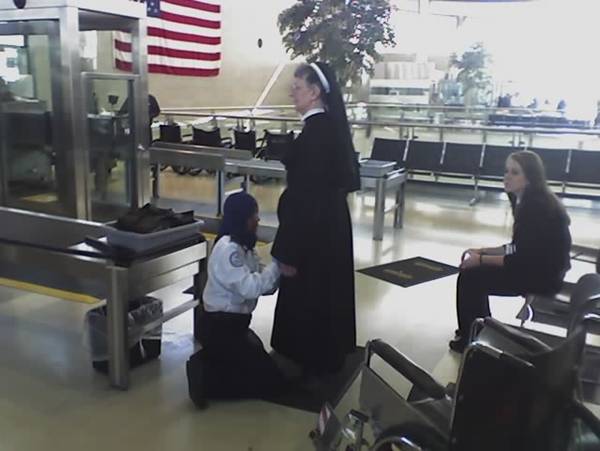
For airports that don’t yet have the expensive scanners, or for people who decline to be scanned by them (perhaps out of fear of the unknown long-term health effects), or for people on whom the scanners see something suspicious, an “enhanced pat-down” becomes necessary.  During this procedure TSA agents manually check passengers intimate areas for weapons or explosives.

This experience is traumatic enough for most travelers but especially for a rape survivor like “Celeste” in Minnesota who, despite public assurances that pat-downs will be performed only by same-sex agents, had hers performed by a male agent.  She recounts her encounter with the TSA here:  “He started at one leg and then ran his hand up to my crotch. He cupped and patted my crotch with his palm. Other flyers were watching this happen to me. At that point I closed my eyes and started praying[.]  He also cupped and then squeezed my breasts. That wasn’t the worst part. He touched my face, he touched my hair, stroking me. That’s when I started crying. It was so intimate, so horrible. I feel like I was being raped. There’s no way I can fly again. I can’t do it.”

Or there’s the story of 61 year old Thomas D. Sawyer of Lansing Michigan.  According to an msnbc.com article, “Sawyer is a bladder cancer survivor who now wears a urostomy bag, which collects his urine from a stoma, or opening in his stomach. ‘I have to wear special clothes and in order to mount the bag I have to seal a wafer to my stomach and then attach the bag. If the seal is broken, urine can leak all over my body and clothes.'”

When the scanners picked up Sawyer’s urostomy bag he was pulled aside for a pat-down procedure.  When Sawyer tried to explain his condition to the TSA agents they said they didn’t need to know about it.  Once Sawyer removed his sweatshirt and they spotted the bag they finally asked him about his medical condition.

“One agent watched as the other used his flat hand to go slowly down my chest. I tried to warn him that he would hit the bag and break the seal on my bag, but he ignored me. Sure enough, the seal was broken and urine started dribbling down my shirt and my leg and into my pants.”

The security officer finished the pat-down, tested the gloves for any trace of explosives and then, Sawyer said, “He told me I could go. They never apologized. They never offered to help. They acted like they hadn’t seen what happened. But I know they saw it because I had a wet mark.”

Humiliated, upset and wet, Sawyer said he had to walk through the airport soaked in urine, board his plane and wait until after takeoff before he could clean up.

These are just two examples, but a quick search of the internet will show more stories like this than you’d care to read.  These are all real Americans being treated like cattle by their government.  Thankfully the people appear to be fighting back.  Multiple lawsuits have been filed against the TSA and there has been a vocal public outcry against the new procedures.  Some local district attorneys have threatened to prosecute TSA agents who engage in inappropriate behavior.  Despite all this, TSA head John Pistole has said that they’re not going to change the policies.

Pistole and the rest of the federal security bureaucracy, as well as many fellow citizens, probably think that all of this is a perfectly acceptable trade-off to keep the American people “safe.”  However, as the government is diligently fondling Grandma’s labia in a vain attempt to prevent the previous terrorist attack, they will meanwhile be failing to “connect the dots” to prevent the next one.  When it hits, Homeland Security will treat the present level of intrusiveness as a floor, not a ceiling, and the current infringements upon our liberty and dignity will have all been for naught.  They will just demand more of our liberty the next time.

Perhaps the best summation of the situation comes from Thomas D. Sawyer, the traveler who had his urostomy bag ruptured by the probing fingers of an overreaching government.  “I am a good American and I want safety for all passengers as much as the next person.  But if this country is going to sacrifice treating people like human beings in the name of safety, then we have already lost the war.”  Wise words from someone whose dignity was a collateral casualty in the federal government’s “war on terror.”

Iowa Firearms Coalition Announces 2011 Legislative Agenda

The dust had barely settled from the 2010 election when the Iowa Firearms Coalition (formerly Iowa Carry) announced its 2011 legislative agenda, working in conjunction with the National Rifle Association.  The two groups successfully pushed through a “shall-issue” weapons permit law which was signed by Governor Culver in April of this year.  The ambitious 2011 agenda includes an amendment to the state constitution, as well as legislation strengthening Iowa’s firearms preemption laws, protecting those who use a gun in self-defense from civil liabilities, and allowing Vermont/Alaska-style carry of firearms without a permit.

The “Iowa Right to Keep and Bear Arms Constitutional Amendment” was first announced by the group on Jan Mickelson’s radio show in early October.  Iowa is one of only six states that has no provision in its constitution protecting the right to keep and bear arms.  Since Iowa voters rejected a constitutional convention on the November ballot, amending the state constitution will require that an identically worded amendment pass two successive legislatures, then be approved by Iowa voters.

The proposed wording for the amendment by IFC/NRA is: “The right of individuals to acquire, keep, possess, transport, and use arms to defend life and liberty and for all other legitimate purposes is fundamental and inviolable. Licensing, registration, special taxation, or any other measure that suppresses or discourages the free exercise of this right is forbidden.”

Second, the “Iowa Firearm Preemption Act” would modify “the current preemption law to completely disallow a series of confusing, indiscernible ‘Gun Free’ zones intermittently spread across the state causing confusion,” according to IFC’s website.  State firearms preemption laws basically state that local governments may not pass gun restrictions more strict than the state.  This bill no doubt comes in response to recent efforts by local governments, such as Shelby and Hancock Counties and the cities of Ottumwa and West Burlington, to circumvent the state’s current preemption law and ban permit-holders from carrying  concealed weapons on county or municipal property.

Next is the “Iowa Family Defense Act.”  According to IFC: “Today, in Iowa, should you be forced to defend your life, you can be held liable for your act of defense in a civil court. Your act of self defense, or the defense of another, could be used against you. This piece of legislation would ensure your right to self defense without potential exposure to prosecution in a civil case from an attacker.”

Lastly the “Iowa Constitutional Carry Bill” would apparently require “no permit for carrying or for the acquisition of firearms,” thereby ensuring “that our right to keep and bear arms is not infringed at all, just as our forefathers intended.”  This would appear to be similar to legislation sought by the group Iowa Gun Owners in the 2010 legislative session. 

This system is often called “Vermont Carry” and, in addition to that state, it is currently enjoyed in Alaska and most recently Arizona.  IFC President Sean McClanahan told me recently that permits would still be available to those who wanted them, such as for people who wanted to carry concealed weapons into other states that recognize Iowa’s permits, but would not be required to carry in Iowa.

McClanahan says the group will be considering other legislation as well, but these four measures will be the prime focus.

[This story also posted at Iowa Freedom Report.]