
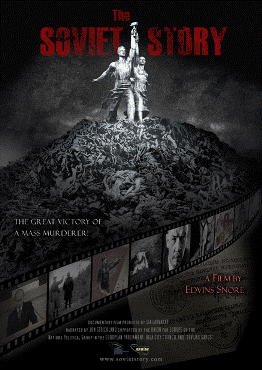
Review: "The Soviet Story"

At the Libertarian Party of Iowa’s state convention in March the keynote speaker, Dr. Yuri N. Maltsev, recommended watching the 2008 documentary “The Soviet Story.” The film studies the fascinating relationship and similarities between the Soviet Union (USSR) and Nazi Germany. I just watched it and I too highly recommend the film. If you watch it, you will learn a lot about communism and our World War Two ally that they didn’t teach you in school. It is available on Amazon video, YouTube and probably elsewhere.

The film first spends some time illustrating that communism and Nazism are not as different as many think. It shows how both are largely based on the writings of Marx & Engels. You’ll see early Nazi symbology with the swastika literally between the hammer and sickle.

The film highlights the many mass extermination atrocities committed by the Soviet Union including The Holodomor, the deliberate starvation of 7 million Ukrainians in one year alone. The film attributes some 20 million total murders to Soviet communism over the course of its history. In his book “The Great Terror,” researcher Robert Conquest puts that number at about 15 million. Whichever, it’s a lot.

It’s important that we remember and understand this bloody history, lest we repeat it. While the crimes of the Nazis have rightly been widely denounced and their ideology discredited as a result, the same can’t be said for the communists. You can say, “Soviet communists made mistakes and had some excesses, but they were mostly right,” among Western intelligentsia today, whereas saying the same thing about the Nazis would get you booed out of the room. While modern Germany condemns the Nazi regime, Vladimir Putin, current ruler of Russia, calls the collapse of the Soviet Union “the greatest geopolitical catastrophe of the [20th] century.” Most American millennials wouldn’t know to disagree with him.

The film also spends significant time on the wartime collaboration between the USSR and Nazi Germany. I was aware the two countries had a non-aggression pact with each other initially, but was unaware of the degree that the two regimes actively aided each other. There were plans on which country would get to consume which smaller countries, Poland was split between the two, the Soviets let the Nazis use their naval base to stage their invasion of Norway, the Soviet NKVD (secret police) taught the Nazi Gestapo torture techniques and how to set up concentration camps, and the Soviets provided food and materials to the Nazi war machine. When many Jews fled to the USSR to escape the Nazis, the NKVD rounded them up and turned them over to the Gestapo.

It’s obvious that Stalin and Hitler were planning on carving up Europe for themselves before the two monsters began quarreling. This is not the image of our wonderful World War Two ally that we are often presented with in the West.

Please check out this film! You’ll learn a lot. This is a Latvian film (Latvia being one of the three “Baltic states” that didn’t appreciate their time under the boot of Soviet oppression) and there are several different versions of the film out there in different languages. Make sure you grab one in English.

Resistance Is NOT Futile!

“Resistance is futile,” the evil Borg would warn enemies that they intended to assimilate into their collective on Star Trek: The Next Generation. It seems like we hear that exhortation from all types of progressive “experts” these days when it comes defending ourselves from those who would prey upon us.

While Colorado was passing its recent gun bans (including banning licensed concealed carry on college campuses), for instance, University of Colorado at Colorado Springs advised its students to vomit or urinate on themselves to repel a rapist. Active resistance could get the girl harmed, don’t you know? This despite the fact that research going all the way back to the Jimmy Carter administration shows that of attempted rapes 32% were actually committed, but when a woman was armed with a gun or knife, only 3% of the attempted rapes were actually successful.

Rape isn’t the only crime that armed defense has proven effective in resisting. After the Newton shootings President Obama called for a review of existing research on gun violence. The results he got probably weren’t what he was looking for. The assessment from the Institute of Medicine and the National Research Council concludes that crime victims who use guns in self-defense have lower injury rates than other victims.

One 2006 Florida State University study cited in the assessment found that “self-protection in general, both forceful and nonforceful, reduced the likelihood of property loss and injury, compared to nonresistance.” It found that using a gun in self-defense reduced the risk of property loss as well minor or serious injury to the victim. In clinical language, it concludes: “Combined with the fact that injuries following resistance are almost always relatively minor, victim resistance appears to be generally a wise course of action.” In other words, “Resist, damn it!”

You can see the macro-effects of individual armed resistance on our crime rates as well. Since violent crime peaked in 1991, twenty-four more states have enacted “shall issue” laws giving citizens a lawful means to carry the most effective tool of resistance. Researchers found that “when state concealed handgun laws went into effect[,] murders fell by 8.5 percent, and rapes and aggravated assaults fell by 5 and 7 percent.” In our nation we now see that gun ownership is at an all-time high while the nation’s murder rate is at all-time lows. (Despite this, 56% of Americans think gun crime is worse than 20 years ago. Thank you mainstream media!)

Of course our Second Amendment right to keep and bear arms wasn’t meant just to give us the means to resist muggers, murderers and rapists. It also gives us a defense “against sudden foreign invasions, domestic insurrections, and domestic usurpations of power by rulers” (in the words of jurist and Supreme Court Justice Joseph Story).

Although 65% of Americans believe the 2nd Amendment exists as a hedge against tyranny, I’ve heard this idea pooh-poohed by modern intelligentsia who believe that common citizens armed with light weapons would no longer be able to stand up to a foreign invader or domestic tyrant armed with heavy weapons and even nuclear weapons. (“Resistance is futile.”)

However, there are numerous examples of primitive indigenous forces wreaking havoc on more-advanced foreign occupiers. The Afghans, for instance, were able to fight the Soviets for nearly a decade, eventually expelling them, and they have kept us hemorrhaging blood and treasure and unable to declare victory for over twelve years now.

Whether the tyrannical oppressor is foreign or domestic, in his book The War of the Flea, Robert Taber makes a convincing case that as long a guerrilla force retains the support and good will of the general populace it is very nearly unbeatable. An American resistance movement fighting honorably against despotism would no doubt retain a great deal of popular support from the American people.

Even if it were to fail, would it not be better to try? Better to stand against tyranny? Is not better to die on your feet than live on your knees? In The Gulag Archipelago,  Aleksandr Solzhenitsyn’s book about the Soviet forced labor camp system, it is  recounted how the victims of Communist brutality regretted not standing up against their oppressors early on:

“During an arrest, you think since you are not guilty, how can they arrest you? Why should you run away? And how can you resist right then? After all, you’ll only make your situation worse; you will make it more difficult for them to sort out the mistake.

“And how we burned in the camps later, thinking: What would things have been like if every Security operative, when he went out at night to make an arrest, had been uncertain whether he would return alive and had to say goodbye to his family?

“Or if, during periods of mass arrests, as for example in Leningrad, when they arrested a quarter of the entire city, people had not simply sat there in their lairs, paling with terror at every bang of the downstairs door and at every step on the staircase, but had understood they had nothing left to lose and had boldly set up in the downstairs hall an ambush of half a dozen people with axes, hammers, pokers, or whatever else was at hand?

“The Organs would very quickly have suffered a shortage of officers and transport and, notwithstanding all of Stalin’s thirst, the cursed machine would have ground to a halt! We did not love freedom enough. Every man always has handy a dozen glib little reasons why he is right not to sacrifice himself.”

No wonder that our Founding Fathers wrote in several of their state Bills of Rights that, “The doctrine of nonresistance against arbitrary power, and oppression, is absurd, slavish, and destructive of the good and happiness of mankind.” Whether it be against the petty crimes of street criminals or the high crimes of tyrants: Stand and resist!

Fight Terrorism With Freedom

Once again I’m responding to a column in the newspaper. I sent the following to my hometown paper:

I felt compelled to respond to the recent column by retired Army Colonel Clyde Meyer about militant Islam. I agree with Col. Meyer that Islam has a long history of violence. I also agree with his point that throughout history there have been fanatics from all religions who have used violence to advance their cause. Where I begin to disagree with the good Colonel is how best to fight Islamic extremists today.

Let me preface this by saying that, as a former military member myself, I am not reflexively anti-war. I understand its utility and occasional necessity, but I am not reflexively for war either. While I’ll leave the foreign policy side of the debate for another day, I would encourage anyone interested in the subject to read the book Imperial Hubris by CIA veteran Michael Scheuer for a thoughtful analysis of the motives of the Islamic terrorists.

Colonel Meyer states that since some terrorists have reached American soil they need to be “weeded out” through “counter-insurgency measures.” He casually shrugs off potential violations of the U.S. Constitution that he once swore an oath to defend. (As Republican activist and former-Marine Bill Salier likes to point out, that oath has no expiration date.) Meyer writes that the measures he endorses include “the control of people and resources and can infringe on some of the individual rights to which we are entitled by our constitution.”

Before we unleash the counter-insurgency tactics that we employed in Vietnam and Iraq on the American public, perhaps we could try something else: Freedom. I believe that we can defend ourselves against those who would harm us not by destroying our individual liberties but by defending them and expanding them.

For instance, Meyer mentions the recent Fort Hood attack by a suspected jihadist. Soldiers on that base were, as a matter of policy, denied the Second Amendment right to carry firearms that people elsewhere in Texas and 39 other states currently enjoy. That section of Ft. Hood (like Columbine and Virginia Tech) had become a “gun-free zone,” a proven magnet for mass murderers.

The same could also be said of the September 11th attacks. Government restrictions on the rights of Americans turned airliners into “gun-free zones” and government policy dictated that crews and passengers not resist hijackers. If people had been allowed to resist (as those on Flight 93 did anyway) or if the pilots had been allowed to keep pistols in the cockpit (as was common practice until the 1960’s) then 19 terrorists probably wouldn’t have been able to kill 2,976 Americans armed only with box cutters.

These are just two quick examples of how the answer is more freedom, not less. On this issue, as on many issues, the best thing the government can do for the American people is to stay out of our way. Surrendering our freedom and power to the government in exchange for promises of security ensures that the government will always find new threats so as to expand its power.