Muscatine Journal: "Gun law transition smooth"

Iowa’s new “shall issue” law went into effect January 1st and the news media in the state have been reporting the heck out of it, often with a can you believe that they’re doing this? tone.  Here’s a rare news story that doesn’t sensationalize the new law, found in the Muscatine Journal, that interviews an equally rare sheriff that supported passage of the new law.

The new law eliminates a sheriff’s discretion in issuing a permit to carry a weapon, except to convicted felons and people convicted of a domestic assault.

[Muscatine County Sheriff Dave] White hailed the uniformity of the new law.

“People used to be restricted by what a sheriff’s feelings were,” he said. “There were 99 counties with 99 sets of rules.”

White said he doesn’t mind giving up a little bit of his authority if it means Muscatine County’s 42,934 residents will be safer.

“We were told that if we let this happen, we will lose some of our power,” White said. “I’ve been in law enforcement since 1973, and I didn’t get into it for the power. We get into this line of work because we want to protect people and see crime rates go down.”

And it has, he said, in many of the 39 other states that have adopted “shall issue” laws.

“The likelihood that people will have to use a weapon (to defend themselves or others) is pretty slim,” he said. “But people want to have that option. They don’t want to be a victim.”

Yikes, common sense!  How did that get into print?  You can read the entire article here.

Caffeinated Thoughts on Constitutional Convention

Today there was a good post by Eric Goranson at Caffeinated Thoughts blog, dealing with (among other things) the constitutional convention ballot question.  Here it is an excerpt:

The following question is on the back of your ballot: “Shall there be a convention to revise the constitution, and propose amendment or amendments to same?”

My vote will be a resounding YES! The Legislature has failed to act, I can’t see Republicans (sadly, at this point anyway) having the spinal fortitude to get two Assemblies to vote for a marriage amendment should they win control, and this is a Constitutional remedy we should jump on.

The opposition from the Right and the Left will point out that all kinds of bad things can happen in a convention and then the people might vote on them. The simple truth is this: All proposed amendments would be voted on individually. With that in mind, the opposition always wants the people to vote when the polling shows that the people agree with them and avoid popular votes when the polling tells them they might lose. Anyone who opposes the Constitutional Convention is either disingenuous, saying that calling a convention is “playing fast and loose with the Constitution” (It’s a CONSTITUTIONAL REMEDY, numbskull!) or they use fear to scare people into making a “risky” convention take place. They have succumbed to elitism. We either trust the people with the vote or we don’t.

With polls showing the people of Iowa pretty evenly split on the gay marriage issue, a marriage amendment wouldn’t be a slam dunk for either side.  But a convention could also allow many other important reforms that the legislature won’t move on, such as term limits, sunshine laws, and recall of elected officials to at least be voted on by the people.  You can read Goranson’s entire post here.

Register Article on Constitutional Convention

Today’s DesMoinesRegister.com had one of the better articles about the Iowa constitutional convention vote that I’ve read. 

A nonprofit group called Call the Convention is working to shoot down commonly held worries about a convention.

“Any amendment would have to pass the people of Iowa,” said Bill Gustoff, a Des Moines lawyer who is on the steering committee for Call the Convention. “Iowans need not fear the constitutional convention process unless they fear the people. I think clearly public sentiment is in favor of the Defense of Marriage Act.”

Social conservatives are listening and trying to decide whether a convention would be the best option to ban gay marriage.

“If you had asked me a year ago, I would have been adamantly opposed to it,” said Steve Scheffler, the head of the Iowa Faith & Freedom Coalition, formerly called the Iowa Christian Alliance. “Now I’m considering it, but I have mixed feelings about it.”

Even if a convention is called, delegates don’t have to propose amendments. And if amendments are proposed, they would not necessarily be adopted. Each amendment proposed by the convention would go in a separate ballot question for voters’ final approval.

If you go to the Register article, be sure to read the sidebar items on the right, they’re very informative.

Constitutional Convention For Iowa

Although the 2010 general elections appear to be shaping up to be as historic as any in recent memory, we here in Iowa will have an additional opportunity to vote on something that only comes along once every decade.  This year a question will appear on the ballot asking Iowa voters if a state constitutional convention, to propose amendments to the state constitution, should be held.  I hope Iowa voters vote yes.

In 1964 the Iowa Legislature amended the Iowa State Constitution, mandating that this question be put to the voters every ten years starting in 1970.  In the four times that the ballot initiative has come up, Iowa voters have rejected it, usually by wide margins.  This year may be different.

A recent poll by TheIowaRepublican.com showed that 42% of Iowans surveyed support calling the convention and 36% oppose it.  This is without any major groups (until very recently) publicly supporting a convention.  This year had a palpable sense of public outrage at elected officials from both parties; if ever Iowa voters would call a convention to pass needed reform, this could be the year.

If a state constitutional convention were approved by voters here’s basically how it would go:  The General Assembly would be responsible for determining how delegates would be elected.  The folks at CallTheConvention.com (who have studied this more than I have) believe that “the General Assembly will likely simply utilize the existing state senate districts as delegate districts as they did for the 1857 constitutional convention in order to avoid any legal challenges.”  The convention would then craft amendments to the state constitution and each one would have to be voted on by the people of Iowa before being implemented.  CallTheConvention.com addresses some of the most common concerns about the process here.

So, why is all this needed?   There are big, burning, philosophical political issues facing Iowa (and the nation) today and our timid state politicians seem unable or unwilling to address them.  At a time when other state governments were beginning to exert their own sovereignty, challenge federal usurpation and address other important issues, our state legislature was creating a mandate that employers provide special areas for women to express breast milk and creating a new licensing regime for dog breeders.  Were these really the most pressing issues facing the state?

Earlier in the year my state senator’s email newsletter said that he was proudly supporting a bill to restrict “payday lenders” and thereby help the poor.  I wrote him an email detailing how the bill was actually injurious to the working poor and asked him to reconsider his support for the bill.  He wrote me back saying that we’d have to “wait and see how much traction” the issue got.  My, what a principled stance on an issue!  I point that out not because I hope a constitutional convention would address that particular issue, but to illustrate the wishy-washy unprincipled nature of our average politicians.

No, if the people of Iowa want principle, if they want substance, if they want “big ideas,” then they will have to do it themselves.  They have to convene a constitutional convention and circumvent the usual legislative process.  Since the convention would be a one shot deal a person could hardly make a career out of being a delegate, so it will hopefully attract a different sort than the run-of-the-mill politician.

Of the “big ideas” that would be facing the convention delegates, gay marriage would be the elephant in the room.  This is the issue that made the Iowa Catholic Conference become the first major group (that I know of) to support calling a convention.  They hope to have an amendment defining marriage as being between one man and one woman to be put to a vote by the people of Iowa.  Regardless of your stance on that issue, there are many other important issues that could also be addressed.

In a guest column in at SiouxCityJournal.com former Sioux City councilman Brent Hoffman lists five worthy potential amendments:

1. Open government (aka “Sunshine”). Current laws only mandate transparency (e.g. open meetings) at the local level. When a past bill was offered to “unexempt” the Governor and Legislature, State Representative Bill Schickel noted “it was so troubling to legislative leaders that they killed the entire bill.”

2. Recall elected officials. If your State Senator or City Councilman is corrupt or incompetent, you should be able to remove them via a “recall vote.” But the Iowa Constitution doesn’t contain that provision. According to Joshua Spivak at least “26 states authorize the recall in some form.”

3. The ballot initiative. First introduced in South Dakota in 1898, the “initiatve” or “ballot measure” empowers citizens to gather petitions and vote on an issue. Twenty-three states have since joined South Dakota in this “more direct form of democracy,” but Iowa isn’t one of them.

4. Term limits. There are at least “15 states that currently have term limits for legislators” (NCSL). Two of these 15 states are our neighbors: Nebraska and South Dakota. Whether you love or hate term limits, it’s a safe bet this amendment won’t see the light of day without a convention.

5. Budget and tax controls. The “People’s Right to Vote” amendment has never made it out of the State Legislature. Iowans for Tax Relief says this amendment would “require voter approval for most tax and fee increases” (beyond 1 percent of revenues from the previous year). Call it a “veto power” on the legislature’s spending habits.

Hoffman’s theme is enacting provisions that the legislature is unlikely to impose on itself.  Additionally Iowa is one of only six states that has no constitutional provision protecting the individual right to keep and bear arms.  That could surely be addressed at a convention.  My own personal wish list, for what it’s worth, would also include some type of state sovereignty amendment and switching to biennial legislative sessions (like Texas).

Granted, devotees of big government will be elected as delegates as well and will push for amendments expanding government power and probably some really bad ideas.  This is where a little faith in our fellow citizens comes in.  Remember, the proposed amendments must then be voted on by Iowa voters before they are accepted.  As Tom Chapman, executive director of the Iowa Catholic Conference, said recently, “Obviously, there are a lot of other things that could take place at a convention, and we’re just going to rely on the people of Iowa to vote yes on the good things and no on the bad things.” 

Faith in the wisdom of the common man, now that’s something you won’t hear coming from the entrenched power brokers in either major party.  That’s because, as Brent Hoffman points out, “if anyone should be fearful of a state Constitutional Convention, it is surely not the voters. It is the politicians.”

Let’s vote “YES” on the state Constitutional Convention so that we can then vote on the issues that the heels in Des Moines won’t address.

Be Prepared. Be Armed.

[A note from Ben: I’ve posted this same post every September since I’ve started this blog. Since much of it is still relevant, I decided to post it again this September. I hope you’ll indulge me yet again.]

After a year replete with blizzards, tornadoes, and epic floods, we Iowans now realize that disasters don’t just happen to those people on the coasts that we see on TV with their fancy earthquakes and hurricanes. So Iowans should sit up and take notice that September is “National Preparedness Month.”

The U.S. Dept. of Homeland Security’s (DHS) “Ready Campaign” recommends three things to prepare for disaster: 1.Get a Kit, 2.Make a Plan, 3.Be Informed. The “Be Ready Iowa!” website has a pretty similar list you can check out too.

Since you can read the details at the National Preparedness Month website, I won’t rehash what each of these entails. But I will spend some time on one vital survival tool that usually doesn’t make the government’s list: a modern firearm.

I won’t try to sell you on owning a gun if you don’t want one. I fully support your right to NOT own a gun. However, I’m convinced now more than ever that a firearm is an important part of an American’s readiness kit.

During Hurricane Katrina we saw massive destruction that stripped all credibility from the modern argument that you can just call 9-1-1 in an emergency. When the phones don’t work and the police themselves are looting, who do you call and how?

During the 1992 Los Angeles riots the California National Guard arrived on the scene without any ammunition and missing their riot gear. When the local cops and state militia can’t impose order, who do you call? Local Korean shopkeepers were more prepared and defended their businesses with semi-automatic rifles until the Marines showed up to quell the riots.

Even in less extreme circumstances, Americans use firearms in self-defense over 1 million times each year. (Some research puts that number at 2.5 million times per year.) Usually the defender doesn’t even have to fire a shot before the attacker runs off to look for easier prey. A gun is a useful defensive tool.

I’ve been a lifelong shooter, but I don’t consider myself an expert. I’m someone who wants a functional weapon for protection and recreation, but who doesn’t have the time or money to make a religion out of it. I write the following pointers for people who are considering buying a defensive arm. It should not be considered technical nor legal advice, nor anything else that will get me sued. If at all possible, take a gun safety class and certainly check to make sure you are complying with all state, local and federal laws and regulations. Chat with shooters in your area.

Guns that shoot .22 rimfire ammo are good for target practice and small game but are generally too underpowered for defensive purposes. Get the largest caliber that you can comfortably handle. Stick with common calibers so that ammunition will be relatively plentiful and cheap. If you live in close quarters with others, consider buying frangible ammo by MagSafe or Glaser. It breaks apart on impact rather than punching through the wall into your kids room or the neighbor’s sitting room. (Definitely not the way to get invited to the next apartment block-party.) Frangible ammo is costly so practice with cheap “ball” ammo and save the frangible stuff for defense.

The kind of gun you choose will depend on what you’re trying to defend.

Level One-Defending Yourself: Being lightweight and concealable, the handgun is the ideal weapon for defending your person. Here in Iowa you’ll need a special permit to buy one and another special permit if you intend to carry your pistol in public. Both are available from your county sheriff.

Semi-automatic pistols are the most popular, but are generally more complicated than revolvers. Glock (brand) pistols have a reputation of ease of use and reliability, but they are costly. The .45 caliber M1911 has proven reliable enough to still be popular almost 100 years after it was invented. (This is what I carry.)  Avoid the very cheap “no-name” autos; you get what you pay for. Common calibers for auto pistols are: .380 ACP, 9mm, .40 S&W, and .45 ACP.

Revolvers are rugged and reliable. There’s darned little that can go wrong with them. The down-side: They usually only hold six shots. Stick with “double-action,” as opposed to “single-action” revolvers. Common calibers are: .38 Special, .357 Magnum (revolvers chambered for .357 Magnum can also shoot .38 Special Ammo, but not vice versa), .44 Magnum and .45 Colt.

Level Two- Defending Your Home: Your pistol will make a fine home defense weapon, but since size and concealability won’t matter on your own property, you might want more gun. A shotgun or small-caliber carbine rifle would make a good home defense weapon. No special permit is required to buy long guns in Iowa, but the retailer will run a criminal background check on you at the point of purchase.

Shotguns fire a number of small metal balls rather than a single bullet. Contrary to popular belief, you still have to aim. “00 Buckshot” is the most powerful ammo but in close-quarters you may want 6 or 7-½ birdshot to avoid over-penetration. A pump-action shotgun should be reliable enough. Common calibers are: .410, 20-guage, and 12-guage.

There are numerous pistol-caliber carbines out there that work well if you need just a little extra “reach,” such as on a farm. (If you’re on a budget, Hi-Point Firearms makes a very affordable pistol-caliber carbine.) The old M1 Carbine is also readily available. Again, consider frangible ammo if you have neighbors very close. Common calibers are the same as for handguns and .30 carbine ammo for the M1 Carbine.

Level Three- Defending Freedom: If you live in open country or for the real doomsday (and less likely) scenarios involving extended anarchy, invading armies or the four horsemen of the Apocalypse, you’ll need a rifle. You might want one anyway, because they’re fun to shoot. If you don’t already have a bolt-action or lever-action that you’re comfortable with, get a reliable semi-automatic.

A .223 caliber rifle should be your bare-minimum for defense. Common semi-automatic weapons in this caliber include the AR-15 (by many names, from many manufacturers including one made in Iowa), Ruger Mini-14, and the Kel-Tec SU-16 to name just a few. There are also many semi-autos chambered for the 7.62 X 39mm Russian round. These include the AK-47, SKS, and Ruger Mini-30.

If you can handle the extra kick, the .308 Winchester round gives better range and take-down power than the two previous calibers. The most common semi-autos in this caliber are the Springfield M1A, AR-10 clones from several manufacturers, FAL clones, H&K 91 and the Israeli Galil (also available in .223).

You may want to configure your rifle as a “scout rifle.” With a small, low-powered telescopic sight mounted far ahead on the weapon, it becomes much easier to quickly acquire and engage targets at normal combat distances. [Shameless plug: To inexpensively configure your weapon read the newly revised and updated “Poor Man’s Scout Rifle” by my brother Bob Cashner, who, unlike me, is an expert.]

Besides the three mentioned above, two other common rifle calibers are the .30-30, which is common in lever-action rifles, and the .30-06, which is fired through the semi-auto M1 Garand rifle as well as many bolt-actions.

There you have it, firearms for any scenario. If you get one, learn to shoot, maintain and store it safely. (For gun safety classes try here or here.) Remember that your gun will do you no good if you don’t have any ammo or if its rusted shut. Whatever weapon you can afford is better than no weapon at all.

In honor of National Preparedness Month: Be prepared. Be armed.
Hell and High Water

My stomping grounds along Iowa’s Maquoketa River got more national attention than we would have liked this past weekend when massive flooding caused a dam failure.  (I’m sure most of you heard, unless you’ve been in a cave in Tora Bora.)

Upstream from the dam, record flood levels deluged the town of Manchester early Saturday afternoon.  This high water quickly overwhelmed the Delhi Dam south of Manchester and washed away the earthen causeway on the side of the concrete dam.  Hundreds of homes in the unincorporated community of Lake Delhi were damaged or destroyed.

The floodwaters from the ruptured dam rushed downstream toward the towns of Hopkinton and Monticello.  In my town of Monticello the call went out for help filling sandbags.  As soon as I was able to hand the kids off to my wife (who had been in Dubuque), I went down to the city shop and spent a couple hours helping fill sandbags.

The flood put a damper (pardon the pun) on the Great Jones County Fair, which was going on and caused millions of dollars in damages in Monticello. Despite all this, it could have been worse. Thank God no one was killed.

Although this is an extremely localized disaster, it has caused a lot of hardship for several small Iowa communities. I haven’t seen any flood-specific relief funds yet, but if anyone desires to help you can can make an online donation to the Grant Wood Area Chapter of the Red Cross (serving the affected counties of Jones and Delaware) here.

Of course I can’t go a whole post without pontificating about politics and good governance.  While I was down there filling sandbags I witnessed the various layers of government in action.  Lest I be accused of being an anarchist, I do see the use of some government and various levels for certain jobs.

I could certainly understand what many of the elected officials were trying to do.  The town mayor and a few city officials were coordinating the local efforts, including the sandbagging.  The county sheriff was there coordinating his deputies who were directing traffic from the increasing number of news vans and gawkers and performing countless other important tasks.

Even Governor Culver was on hand to check out the situation.  He ended up calling out the National Guard (although to where and to do what I’m not sure, my boy was disappointed that he never did see any “army trucks”).  Although there probably wasn’t much that the governor could do right away, in his role as chief executive of the state it was indeed appropriate for him to see if the state resources at his disposal could lend a hand.

The elected officials who really didn’t need to be there were the state and federal legislators who showed up to “see first-hand” what was going on and “speed” recovery aid to the area.  I didn’t even realize they were there until I was walking out to my car to leave, because they sure weren’t out where we were filling sandbags. You could almost see them salivating at all the reporters and news vans around.

They were there for what they’re always doing: getting their pictures taken and promising to dole out other peoples money, i.e. campaigning.  The legislature’s job is to make laws, not personally deliver the goods.  They should appropriate emergency funds that the executive branch can quickly dispatch to disasters when needed.  Term limits would help ensure legislators from both parties think about what there job actually is, rather than how to keep it. 

As for the promise of federal help: as a constitutional purist who lives safe and dry up on a hill, I won’t claim to speak for anyone else in my county, but I don’t see that any of this is the federal government’s damned business.  As I’ve written before, the argument that the Constitution’s “general welfare clause” authorizes a power not specifically enumerated in the Constitution (like disaster relief) doesn’t hold water. 

Besides, if the federal government didn’t syphon so much money out of the states it wouldn’t have to “benevolently” shovel borrowed money back into them during emergencies.

Happy Birthday America and (Hopefully) Many More!

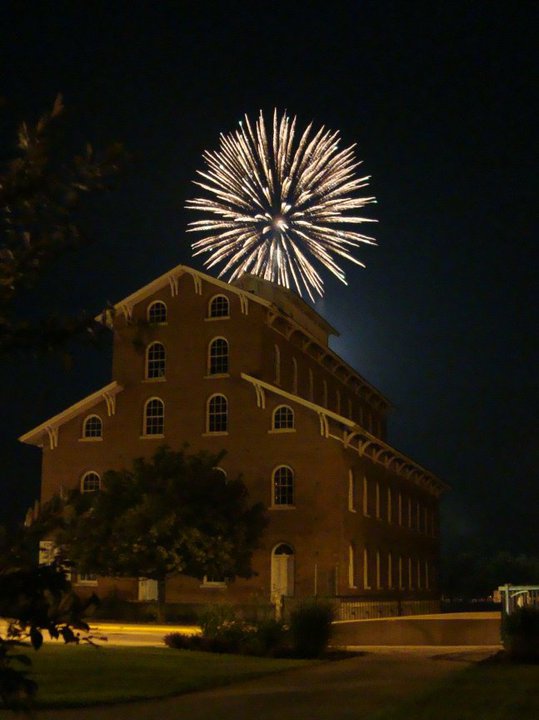
I spent this weekend with all the usual activities that we’ve come to associate with Independence Day: parades, getting sunburned, and fireworks. I did this all in Independence, where else? As we watched fireworks light up the night sky behind the city’s historic Wapsipinicon Mill [see photo by my wife] my mind drifted back to the many Independence Day fireworks displays I’d seen in my youth.

The Mill, dark and foreboding in the foreground, had silently observed about 140 such July 4th celebrations. I wondered how many more would it see? Would my children still celebrate the founding of a nation called “The United States of America” when they’re my age? This was the first Independence Day that I wondered if they would.

The nation whose birthday we celebrated is now $13.2 trillion in debt. To put that number in perspective, if you spent $1 per second it would take you 31,710 years to spend just one trillion dollars. We’re on track to add another $1.5 trillion on to that government debt this year alone, with similar sized deficits for years to come. Total spending by the entire federal government was only about $2 trillion in 1990 (in inflation-adjusted dollars), so our yearly budget deficit is now almost equal to the entire budget just 20 years ago. President Obama’s budget would double the national debt by 2020.

Add to that debt another $109 trillion in unfunded liabilities (promised benefits) for Social Security and Medicare. Add to that debt every “unforeseen” emergency expenditure, war, new entitlement and pork barrel project to come. You don’t need a crystal ball to see that that can’t go on forever.

Budget numbers aren’t the only alarming trends. Our society itself seems to be in a state of flux. The federal government has broken free of its Constitutional shackles and now tries to regulate every aspect of human existence. Some states are showing a rebelliousness against federal intrusion that we haven’t seen since before the Civil War. The people, too, seem to be awakening to the federal government’s usurpation. While I think that’s a good thing, if the feds respond with the jackboot, things could get ugly.

So will my boys one day become men in a free and prosperous land, as I did, or in a land torn by war and economic destitution? I don’t know. The best I could do was hold them close on the cool night grass and watch what my 4-year-old called the pretty “sizzles in the sky.”

I pray that these celebrations of our nation’s founding are the only “rockets’ red glare” that they will ever know.  I recall the words of Thomas Paine in The Crisis, December 23, 1776: “If there must be trouble, let it be in my day, that my child may have peace.”

Iowa Becomes "Shall-Issue" State

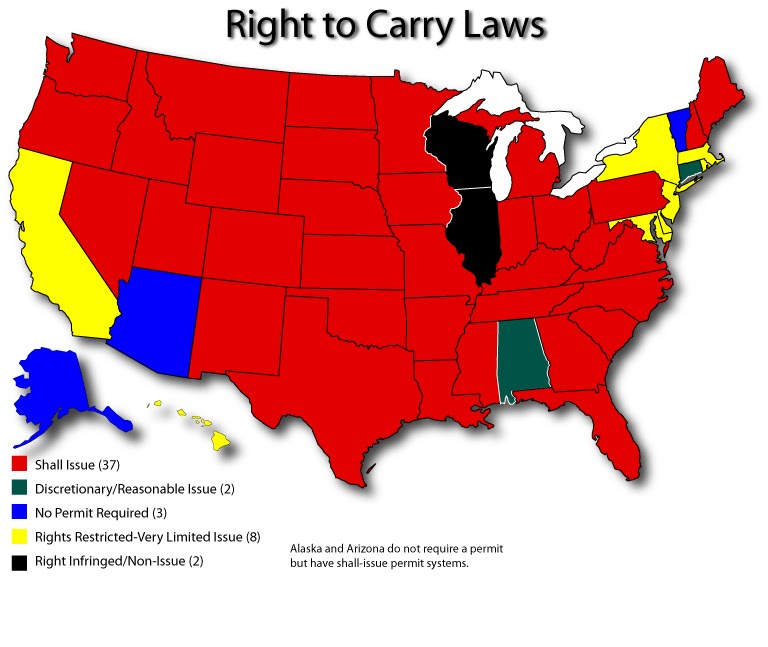
On Thurday, April 29th, Iowa Governor Chet Culver signed NRA-backed legislation making Iowa the 37th state that shall issue concealed weapons permits to qualified applicants. Prior to this, permits “may” have been issued by each county sheriff, but sheriffs were not required to do so.

“This bill strikes an appropriate balance, recognizing the rights of law-abiding Iowans guaranteed by the Second Amendment and the duty of local law enforcement officers,” said the big lug, Culver. “We all have a role to play in public safety. I believe this is a good bill that has the potential to keep Iowans safer.”

According to the NRA’s bullet points, in addition to changing from a “may-issue” to “shall-issue” process, the new law “will increase the term of a permit from one year to five years; narrow the disqualifying circumstances for a permit to the federal minimum in most cases, while at the same time further narrowing state-specific disqualifiers; prevent the issuing officer from placing limits on or restricting the scope of a carry permit; ensure that denials, suspensions and revocations of permits would be subject to both administrative and judicial review; grant recognition to all valid out-of-state permits; broaden the types of training that would fulfill the state-mandated training requirement for permit applicants; and remove other over-reaching restrictions on gun owners in the Hawkeye State.”

While I had some problems with this bill, it DOES set up a uniform state-wide standard for issuing permits. Since the Iowa Constitution mandates that laws have a “uniform operation,” this is important. I may have under-stated this importance in previous posts. The new “shall-issue” law will get rid of the 99 different issuance standards uses by each county, and will hopefully get rid of the arbitrary denials of permits by a handful of anti-Second Amendment sheriffs.

One of my beefs with the original bill introduced by the NRA was that it made it a crime to publicly carry your weapon if you were “under the influence of alcohol,” yet it gave no quantifiable standard as to what that meant. The version that passed says simply: “A permit issued under this chapter is invalid if the person to whom the permit is issued is intoxicated as provided in section 321J.2, subsection 1.” This means, I believe, a blood alcohol concentration over .08, the same to legally drive in Iowa.

Another problem was that the original bill spelled out most of the dreaded federal “Lautenberg Act” into state code. The passed version simply states that a permit can’t be issued to an applicant who “[i]s prohibited by federal law from shipping, transporting, possessing, or receiving a firearm.” Now if Lautenberg is repealed or struck down as unconstitutional, it would automatically be moot in the state law.

One provision that I liked in the original NRA version that I didn’t see in the new law was the section that protected the private information of permit applicants. Apparently the Iowa legislature had a fleeting interest in “sunshine and openness,” so long as it is just their constituents’ personal information being given out.

There are still philosophical reasons not to entirely like the new law. Even under a “shall-issue” system, supposedly free citizens must ask permission from the state to fully enjoy their God-given right to bear arms.

But, on the whole, I would say that this new law is a step in the right direction. We’ve seen in other states that once people (including law enforcement personnel) realize that the sky didn’t fall with shall-issue, there is a tendency to lessen restrictions on permit holders. Hopefully that trend will continue in Iowa.

Maybe someday Iowa will join Vermont, Alaska, and Arizona in requiring no permit at all. I hope I’m still around to see it.

[Right to Carry map courtesy of NRA-ILA]

Anti-Second Amendment Bill Passes Iowa Senate

Thursday the anti-gun and anti-due process Senate File 2357 easily passed in the Iowa Senate with only 11 Senators voting against it. I’m a bit late writing about this and the boys at Between Two Rivers and Iowa Patriots have covered it more thoroughly than I.

According to Iowa Gun Owners, the bill would:

  • Allow virtually anyone who knows you to apply to the court for a no-contact order – even if no physical contact has ever occurred between the two of you. As condition of this no-contact order you would be required to hand over all of your firearms and ammunition.
  • Not require that you even be present at the court hearing. This bill does not even ensure that you have the right to even have legal counsel present or a chance to confront your accusers in a court of law.
  • Allow an anti-gun court to decide who is qualified to take possession of your firearms should they decide to take them from you.
  • Allow this same court to decide that no one is qualified to take your guns and order the sheriff’s department to seize them, and make you pay the sheriff for the right to lose your guns! Yeah, you get to pay the government $50 per gun that they seize from you!
  • Declare you a felon, and unable to ever own guns again, if you fail to turn over so much as a single .22 cartridge.

All of this is done in the name of “combating domestic abuse.” Iowa Attorney General Tom Miller gleefully approved the Senate’s passage: “This law will help prevent women, men and children from being terrorized, maimed and killed by violent domestic abusers. It will only remove guns from domestic abusers. This is a big victory for public safety[.]”

I wouldn’t count on it “only remov[ing] guns from domestic abusers.” As I’ve written about the federal Lautenberg Amendment, feel-good legislation like this ensnares more innocuous parties than deranged stalkers.

I think that the blogger strandediniowa at Between Two Rivers summed it up best: “If the women’s groups that lobbied in favor of SF2357, could possibly put some effort into making it easier for women to purchase and carry firearms for their protection, maybe a few less abusers would be stalking their victims.”

Let’s hope we can kill this bill in the House of Representatives.

Honey Creek Resort: Taxpayers Stuck With Bill For Foreseeable Future

At a time when Iowa State Troopers and court officers are forced to take unpaid furloughs to save money, leaving citizens without those services, Iowa taxpayers will have to make payments on an indoor waterpark, 18-hole golf course and the other amenities at Iowa’s government-owned Honey Creek “luxury resort” for at least the next five years. So said representatives of the state’s Department of Natural Resources to Iowa lawmakers on Wednesday, according to a recent Des Moines Register article.

In 2006 the state issued $33.5 million in bonds (borrowed $33.5 million) to partially pay for the new $58 million resort. According to the Register article, the state planned to pay back that debt with revenues from the resort itself. Unfortunately, revenues have been much less than planned. In it’s first ten months of operation the resort lost $1.7 million.

Projections through 2014 show that Iowa taxpayers will be on the hook for $700,000 to $900,000 a year to cover the resort’s bond payments. (That could fund the yearly salaries of about 15 Troopers, by the way.) Since government officials tend to present the rosiest scenarios possible, the actual yearly amount borne by taxpayers actually may be much higher.

Let’s keep this example in mind the next time we hear a politician saying that any government project (such as healthcare “reform”) will “pay for itself.”

Related posts:
Honey Creek Money Pit (January 2010)
Privatize Honey Creek Resort (July 2009)