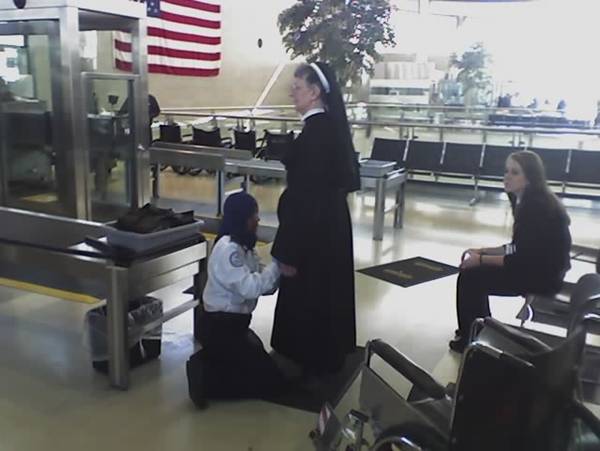
TSA Tyranny Update

Old Woman’s Diaper Raided By TSA Agents; No Weapons Found

In a move sure to make the founding fathers and the Almighty Himself beam with pride, TSA goons strip searched a 95-year-old woman in a wheelchair, going so far as to force the woman’s daughter to remove the woman’s adult diaper.  The elderly woman, Lena Reppert, is in the final stages of Leukemia and was trying to fly from Florida to Michigan to be with family during her final days.

“It’s something I couldn’t imagine happening on American soil,” said Jean Weber, the woman’s daughter. “Here is my mother, 95 years old, 105 pounds, barely able to stand, and then this.”  For something done in the name of security, I doubt that Jean and her mother feel more secure after the nerve-wracking encounter with TSA.

With the wisdom of an everyday American, Jean added: “I’m not one to make waves, but dadgummit, this is wrong. People need to know. Next time it could be you.”

Texas Fold’em

A Texas bill which would have banned invasive TSA searches such as the one that Lena Reppert endured has been quashed in that state’s legislature.  Calling the anti-groping bill a “publicity stunt,” Texas  House Speaker Joe Straus used parliamentary procedures to kill the bill in a special session.

The bill had previously passed in the Texas House during the regular session but was pulled from the state Senate when the TSA threatened to turn Texas into a “no-fly zone” if it passed.  Because of overwhelming popular and legislative support, the bill was later re-introduced in a special session where it seems to have met its ultimate demise.

State Representative David Simpson, who introduced the bill, had this to say on the floor of the Texas House, “The people in support of this bill have succeeded in shining the light on those who collaborate with the growing tyranny of our federal government…. Its’ defeat only propels the liberty movement in this state.  The people now know that it is possible to fight back.”

Let’s hope so.

4th Amendment Supporter Detained By, Then Sues TSA

According to a Wired.com article:

A 21-year-old Virginia man who wrote an abbreviated version of the Fourth Amendment on his body and stripped to his shorts at an airport security screening area is demanding $250,000 in damages for being detained on a disorderly conduct charge.

Aaron Tobey claims in a civil rights lawsuit that in December he was handcuffed and held for about 90 minutes by the Transportation Security Administration at the Richmond International Airport after he began removing his clothing to display on his chest a magic-marker protest of airport security measures.

“Amendment 4: The right of the people to be secure against unreasonable searches and seizures shall not be violated,” his chest and gut read.

According to the suit, while under interrogation on December 30, the authorities wanted to know “about his affiliation with, or knowledge of, any terrorist organizations, if he had been asked to do what he did by any third party, and what his intentions and goals were.”

Two weeks later, Henrico County prosecutors dropped the misdemeanor charge.

Apparently TSA agents were unable to decipher the strange alien symbols on the man’s chest, having never laid eyes upon a copy of the U.S. Constitution before.

TSA Tyranny Update

Former Miss USA Sexually Assaulted by TSA

TSA Not Just In Airports Anymore

According to a recent American Thinker article, the TSA is currently storming about 8,000 public places per year.   In one typical TSA operation, “[b]us travelers were shocked when jackbooted TSA officers in black SWAT-style uniforms descended unannounced upon the Tampa Greyhound bus station in April with local, state and federal law enforcement agencies and federal bureaucrats in tow.  A news report […] showed passengers being given the signature pat downs Americans are used to watching the Transportation Security Administration screeners perform at our airports. Canine teams sniffed their bags and the buses they rode.”  TSA conducted a similar operation at a Des Moines Greyhound bus depot this month.

Not impressive enough?  More spectacular was a recent operation where “the agency led dozens of federal and state law enforcement agencies in [an] exercise that covered three states and 5,000 square miles. According to the Marietta Times, the sweep used reconnaissance aircraft and ‘multiple airborne assets, including Blackhawk helicopters and fixed wing aircraft as well as waterborne and surface teams.'” 

As the TSA extends its reach well beyond airports, the apathetic masses might soon rephrase Pastor Martin Niemöller’s famous statement, “First they came for the air travellers, and I didn’t speak out because I wasn’t an air traveller.”

Texas/TSA Showdown Continues

Earlier in the year the Texas legislature introduced a bill banning the TSA’s intrusive “enhanced pat-downs” and one banning the TSA’s new nude body scanners in Texas airports.  (See “TSA Tyranny Update” March 20, 2011)  Support for the bills apparently crumbled after the Obama administration threatened to shut down air traffic in Texas if the bills passed.  Neither bill made it out of the regular legislative session.

Now, however, Texas governor Rick Perry has added the anti-groping bill to the agenda of legislative special session at the urging of state legislators.  According to the Texas Tribune, “The bill would criminalize any intentional, knowing or reckless touching of a person’s private parts during a security screening, including through clothing.”  It appears that the bill now has the necessary votes to pass.

Don’t mess with Texas!

TSA Tyranny Update

Groping Kids on the Taxpayers’ Dime

TSA: Making the world a safer place… one sobbing child at a time.

DHS: We Have the Authority to Routinely Strip-Search Air Travelers

According to the Electronic Privacy Information Center (EPIC):

The Department of Homeland Security told a federal court that the agency believes it has the legal authority to strip search every air traveler. The agency made the claim at oral argument in EPIC’s lawsuit to suspend the airport body scanner program. The agency also stated that it believed a mandatory strip search rule could be instituted without any public comment or rulemaking. EPIC President Marc Rotenberg urged the Washington, DC appeals court to suspend the body scanner program, noting that the devices are “uniquely intrusive” and ineffective. EPIC’s opening brief in the case states that the Department of Homeland Security “has initiated the most sweeping, the most invasive, and the most unaccountable suspicionless search of American travelers in history,” and that such a change in policy demands that the TSA conduct a notice-and-comment rule making process. The case is EPIC v. DHS, No. 10-1157.

TSA Agents Busted for Stealing From Checked Bags

According to the New York Post two TSA agents, Davon Webb and Couman Perad, were arrested in February for stealing $160,000 in cash from passenger luggage at JFK Airport.  According to the article, “Perad and Webb would screen bags looking for loot, then swipe the cash once the luggage was opened in a private screening room, sources said.”  These two got caught, but a lot of luggage goes missing every year.

John Locke philosophised that man has three basic rights: to life, liberty and property.  From their invasive searches and gropings, it’s clear that the TSA doesn’t care about the American people’s liberty.  When they’re stealing from us, they apparantly don’t care about our property.  Perhaps Congress should bring the TSA to heal before the other right on Locke’s list begins to fall victim to abuse by the TSA or its sister agencies.

TSA Tyranny Update

Ticket To Tyranny

Here’s text from a video-recorded exchange in November between a TSA supervisor and airline passenger John Tyner.

TSA: “If you’re not comfortable with that [groin check], we can escort you back out and you don’t have to fly today.”
Tyner: “OK, I don’t understand how a sexual assault can be made a condition of my flying.”
TSA: “This is not considered a sexual assault.”
Tyner: “It would be if you were not the government.”
TSA: “By buying your ticket you gave up a lot of rights.”

Tests of Body Scanners Show 10 Times The Expected Radiation

When the TSA recently tested its 500 new nude body scanners it found radiation levels much higher than expected.  TSA says it was a simple calculation error.  Others aren’t convinced.

The Association for Airline Passenger Rights says the TSA should stop using the machines until they can be retested.  “Airline passengers have enough concerns about flying — including numerous ones about how TSA conducts its haphazard security screenings,” said Brandon Macsata, executive director of the group. “So it is the TSA’s responsibility to ensure passengers are not being exposed to unhealthy amounts of radiation.”

Texas Bills Would Ban TSA Scanners/Enhanced Pat-Downs

A state legislator in Texas has introduced two bills to protect Texans’ rights from TSA violations.  One bill from Rep. David Simpson (R-Longview) would prohibit “body imaging scanning equipment” at any airport in the state and  provides penalties for any airport operator who installs them.  According to the Tenth Amendment Center, the second bill “criminalizes touching without consent and searches without probable cause.”

If passed, these laws would set up a legal showdown between Texas and the federal government.  Good!  Texas would have a little thing called the Constitution on its side.

AOL News: Are TSA Scanners Safe?

As long as I’m already making friends at Dept. of Homeland Security, I’ll stick with the TSA stuff for one more post.  An investigation by AOL news shows that the job of maintaining and calibrating the TSA’s funky new body scanners belongs to “somebody else,” although nobody is really sure who.

According to Aol.News.com:

The Transportation Security Administration says that when working properly, the backscatter Advance Imaging Technology X-ray scanners emit an infinitesimal, virtually harmless amount of radiation.

The problem is that the TSA offers no proof that anyone is checking to see if the machines are “working properly.”

The TSA ticks off a litany of groups that it says are involved with determining and ensuring the safety of the controversial devices, including:

•The Food and Drug Administration
•The U.S. Army Public Health Command
•Johns Hopkins Applied Physics Laboratory
•The Health Physics Society

However, AOL News has found that those organizations say they have no responsibility for the continuing safety of the alternative to TSA’s grope.

Why worry about maintaining the machines?

To assure that the doses are as low as they are billed to be, it is imperative to accurately calibrate the machines and carefully monitor their performance.

A spike in the intensity of the scanning beam, or a slowdown or pause in the timing of that beam’s sweep across a traveler’s body, could cause significant radiation damage, AOL News was told by a radiologist and two radiological health physicists, who are trained and certified to ensure the safety of those exposed to or working with radioactive material.

The FDA and many state radiation safety offices license, inspect and monitor almost all medical radiation devices everywhere they’re used. But even identical X-ray machines used in nonmedical government venues fall outside FDA scrutiny, the agency said last week.

Nevertheless, the TSA maintains that when it comes to the safety of the full-body scanners, “everything is working fine,” an agency spokesman told AOL News.

So who does verify the safety of these machines?

“The safety of our scanning systems are routinely and thoroughly tested by the manufacturer, FDA, the U.S. Army, the Health Physics Society, Johns Hopkins Applied Physics Laboratory and others,” the spokesman said when asked last month how the TSA knows if the scanning system is safe.

But in interviews with those same safety sentinels, AOL News found that none of the groups was doing any routine testing of operating scanners in airports. Further, they all said they have no responsibility to monitor the safety of those passing through the airport scanners.

For example, the FDA says it doesn’t do routine inspections of any nonmedical X-ray unit, including the ones operated by the TSA.

The FDA has not field-tested these scanners and hasn’t inspected the manufacturer. It has no legal authority to require owners of these devices — in this case, TSA — to provide access for routine testing on these products once they have been sold, FDA press officer said Karen Riley said.

You can read the entire article here.

New TSA Policies Not Protecting Us

Not long after a Canada Free Press article broke news that a leaked U.S. Department of Homeland Security memo supposedly called for creating an enemies list of people who agitated against the new enhanced TSA security screening procedures, I had a guest column in the Cedar Rapids (Iowa) Gazette agitating against those very TSA security screening procedures.  [Hat tip to Between Two Rivers blog, where I first read about the DHS/TSA enemies list.] 

My column in the paper (which appeared Monday Dec. 13th, with the above title) was edited for space and brevity, but I present here my original long-winded submission:

The Transportation Security Administration’s new procedures, which involve taking naked body images of or giving intense pat-downs to American citizens without reasonable suspicion or probable cause, would have been unfathomable to most Americans a decade ago. Now, however, many view them as a necessary trade off to make us safer against the terrorist threat. But how much safer do they make us?

The procedures are being justified as being in response to the 2009 “Underwear Bomber,” Umar Farouk Abdulmutallab. However a report from the Government Accountability Office, the auditing and evaluation arm of Congress, concluded that it was “unclear” whether the new scanners would have detected the materials used by Abdulmutallab. Ben Wallace, an ex British Army officer who later worked for a defense firm that made such scanners, says that it’s “unlikely” that they would.

The debate may be moot because Al Qaeda has already developed a way of eluding the scanners, as well as the pat-downs. In an assassination attempt against a Saudi prince in 2009, an Al Qaeda operative snuck a pound of explosives and a detonator through security in his rectum. A device hidden in this manner could only be detected by a full body cavity search. So it’s “unclear” to “unlikely” that the TSA’s new procedures would make us safer against an “underwear bomber” and are useless against cutting edge suicide bomber tactics.

If the scanners don’t make us much safer, then how did we end up with them? According to David Rittgers, an analyst at the Cato Institute: “An army of executives for scanner-producing corporations — mostly former high-ranking Homeland Security officials — successfully lobbied Congress into spending $300 million in stimulus money to buy the scanners. But running them will cost another $340 million each year. Operating them means 5,000 added TSA personnel, growing the screener workforce by 10 percent. This, when the federal debt commission is saying that we must cut federal employment rolls, including some FBI agents, just to keep spending sustainable.”

Borrowing more money to purchase marginal technology and increasing spending to employ it, at a time when the U.S. appears on the verge of economic collapse, does not make us safer.

Then there are privacy and Fourth Amendment concerns. According to one congressman, the scanners “offer a disturbingly accurate view of a person’s body[.]” British officials banned their use on people under 18, for fear of running afoul of child pornography laws. Documents obtained by Electronic Privacy Information Center show that the scanners “include the ability to store, record, and transfer images” and “include hard disk storage, USB integration, and Ethernet connectivity” that raise significant privacy concerns. Comparable scanners that more adequately address privacy concerns are available and used in Europe, but then former DHS officials don’t sell those scanners.

The Fourth Amendment states, “The right of the people to be secure in their persons […] against unreasonable searches and seizures, shall not be violated[.]” According to law professor Jeffrey Rosen, as an appeals court judge in 2006, Supreme Court Justice Samuel Alito said that to be constitutionally “reasonable” airport screening procedures must be both “effective” and “minimally intrusive” as well as “well-tailored to protect personal privacy.” The new TSA procedures seem to miss the mark.

Most Americans don’t need to hear legal opinions to know that the TSA searches are an affront to their liberties. As the millions of people lying in mass graves around the globe would surely attest if they were able, when a government begins to disregard the rights and dignity of its people and the people do nothing, we are all decidedly less safe.

Benjamin R. Cashner is a freelance writer from Monticello and a member of the Iowa Libertarian Party. He blogs at  http://coldhardcashner.blogspot.com/ and is a contributing writer at Iowa Freedom Report.com.

Four Minutes For Freedom

“All that is necessary for evil to triumph is for good men to do nothing.”
attributed to Edmund Burke
Americans have been asked to do a lot to secure the blessings of liberty over the years.  I hope that you’ll do two more things to that end.  They won’t involve suffering through a long winter at Valley Forge or getting tear gassed and billy clubbed at Selma.  They’ll only take a few minutes each and you can do them right over the computer before you now.  Let me explain why they’re important.
In the previous post I chronicled a few personal horror stories of the Transportation Security Administration’s (TSA) new enhanced security measures.  These involve expensive new “body scanners” that basically conduct a virtual stripsearch of air travellers and transmit the image to a TSA officer for viewing.  The naked image of the citizen can also be stored and transferred elsewhere.  Other technologies, that are equally effective yet raise fewer privacy concerns, already exist and are operation in European airports.  The only alternative the TSA offers for its body scanners is an even more intrusive full-body pat-down.
These searches are clearly in violation of the Fourth Amendment rights of U.S. citizens.  The Fourth Amendment says, “The right of the people to be secure in their persons, houses, papers, and effects, against unreasonable searches and seizures, shall not be violated, and no Warrants shall issue, but upon probable cause, supported by Oath or affirmation, and particularly describing the place to be searched, and the persons or things to be seized.” [Emphasis added.]
While the Supreme Court has not ruled on airport screening technology yet, lower courts have.  According to George Washington University law professor Jeffrey Rosen in a recent Washington Post article:
[T]he U.S. Court of Appeals for the 9th Circuit ruled in 2007, that “a particular airport security screening search is constitutionally reasonable provided that it ‘is no more extensive nor intensive than necessary, in the light of current technology, to detect the presence of weapons or explosives.’ “
In a 2006 opinion for the U.S. Court of Appeals for the 3rd Circuit, then-Judge Samuel Alito stressed that screening procedures must be both “minimally intrusive” and “effective” – in other words, they must be “well-tailored to protect personal privacy,” and they must deliver on their promise of discovering serious threats. Alito upheld the practices at an airport checkpoint where passengers were first screened with walk-through magnetometers and then, if they set off an alarm, with hand-held wands. He wrote that airport searches are reasonable if they escalate “in invasiveness only after a lower level of screening disclose[s] a reason to conduct a more probing search.”
As currently used in U.S. airports, the new full-body scanners fail all of Alito’s tests.

Most Americans don’t need these highfaluting legal opinions to tell us what our gut is already telling us, namely that there is something wrong with all this.  We know that the new TSA procedures look, sound, feel and stink like a police state.  So, what can we do about it?  I suggest two things for starters.

First, write your elected officials.  I know that seems trite and lame.  I’ve pretty well given up on that civics class pap, but this is important enough that it’s worth a try.  If we raise enough of an uproar perhaps even our representatives might have to awaken and do something.  If you go to the ACLU’s website you can send a pre-written message to DHS Secretary Napolitano, your U.S. Senators and U.S. Representative urging them to “rein in these invasive searches, and to implement security measures that respect passengers’ privacy rights.”  It only takes a few clicks and you can use the service even if you’re not a fan of the ACLU. 

CLICK HERE.

Secondly, please help out Electronic Privacy Information Center (EPIC).  Back in July, when the rest of us were thinking about barbecues and fireworks, EPIC was already slapping a lawsuit on the DHS to stop them from implementing the new scanner/pat-down procedures.  Unfortunately the wheels of the justice system turned too slowly to have it stopped before it started, but better late than never.  The on-going lawsuit alleges that the new procedures violate travelers’ Fourth Amendment rights, and violate both the Privacy Act and the Religious Freedom Restoration Act as well as a bunch of administrative regulations.
Legal battles aren’t cheap, especially when you’re going up against the federal government with it’s deep pockets (our pockets, that is).  According to its website, “EPIC is a public interest research center in Washington, D.C. It was established in 1994 to focus public attention on emerging civil liberties issues and to protect privacy, the First Amendment, and constitutional values.”  Contributions to EPIC are tax-deductible.  I know times are tight, but please try to send them whatever you can.  Even $5 would help, if enough of us do it.  You can DONATE ONLINE or send a check to:  “EPIC,” 1718 Connecticut Ave. NW, Suite 200, Washington, DC 20009.
So please, there are two small things we can do to defend freedom.  It will only take a few minutes and a few clicks.  The other option is to do nothing and allow evil to triumph.

TSA Travel Terror

Holiday travelers be on alert: An organized and determined group has launched a coordinated effort to disrupt airline travel and terrorize American citizens.  The “good” news is that the group is our own federal government.

No doubt you’ve already heard horror stories of the Transportation Security Administration’s new “enhanced pat-down” techniques and body scanners.  The new security measures are supposedly in response to the Christmas bomber Farouk Abdulmutallab who snuck explosives onto a plane in his underwear.

David Rittgers of the Cato Institute explains that the expensive new body scanners, “that look beneath clothing to perform virtual strip searches,” aren’t the panacea they’re made out to be.  “Despite what their proponents would have us believe, body scanners are not some magical tool to find all weapons and explosives that can be hidden on the human body,” writes Rittgers.  “Yes, the scanners work against high-density objects such as guns and knives — but so do traditional magnetometers.”

He continues: “And the scanners fare poorly against low-density materials such as thin plastics, gels and liquids. Care to guess what Abdulmutallab’s bomb was made of? The Government Accountability Office reported in March that it’s not clear that a scanner would’ve detected that device.”

Rittgers also explains how Al Qaeda in the Arabian Peninsula (AQAP) has already figured out a low-tech way of defeating the machines by inserting the explosives in their rectums.  Drug smugglers have been doing this for years with their product and AQAP has already tried this in an assassination attempt against a Saudi official.  A would-be terrorist could smuggle the explosive device on board a plane, then remove it from its “hiding place” during the flight in the plane’s lavatory.

What the scanners lack in effectiveness they make up for in expense.  According to Rittgers, “executives for scanner-producing corporations — mostly former high-ranking Homeland Security officials — successfully lobbied Congress into spending $300 million in stimulus money to buy the scanners. But running them will cost another $340 million each year. Operating them means 5,000 added TSA personnel, growing the screener workforce by 10 percent. This, when the federal debt commission is saying that we must cut federal employment rolls, including some FBI agents, just to keep spending sustainable.”

For airports that don’t yet have the expensive scanners, or for people who decline to be scanned by them (perhaps out of fear of the unknown long-term health effects), or for people on whom the scanners see something suspicious, an “enhanced pat-down” becomes necessary.  During this procedure TSA agents manually check passengers intimate areas for weapons or explosives.

This experience is traumatic enough for most travelers but especially for a rape survivor like “Celeste” in Minnesota who, despite public assurances that pat-downs will be performed only by same-sex agents, had hers performed by a male agent.  She recounts her encounter with the TSA here:  “He started at one leg and then ran his hand up to my crotch. He cupped and patted my crotch with his palm. Other flyers were watching this happen to me. At that point I closed my eyes and started praying[.]  He also cupped and then squeezed my breasts. That wasn’t the worst part. He touched my face, he touched my hair, stroking me. That’s when I started crying. It was so intimate, so horrible. I feel like I was being raped. There’s no way I can fly again. I can’t do it.”

Or there’s the story of 61 year old Thomas D. Sawyer of Lansing Michigan.  According to an msnbc.com article, “Sawyer is a bladder cancer survivor who now wears a urostomy bag, which collects his urine from a stoma, or opening in his stomach. ‘I have to wear special clothes and in order to mount the bag I have to seal a wafer to my stomach and then attach the bag. If the seal is broken, urine can leak all over my body and clothes.'”

When the scanners picked up Sawyer’s urostomy bag he was pulled aside for a pat-down procedure.  When Sawyer tried to explain his condition to the TSA agents they said they didn’t need to know about it.  Once Sawyer removed his sweatshirt and they spotted the bag they finally asked him about his medical condition.

“One agent watched as the other used his flat hand to go slowly down my chest. I tried to warn him that he would hit the bag and break the seal on my bag, but he ignored me. Sure enough, the seal was broken and urine started dribbling down my shirt and my leg and into my pants.”

The security officer finished the pat-down, tested the gloves for any trace of explosives and then, Sawyer said, “He told me I could go. They never apologized. They never offered to help. They acted like they hadn’t seen what happened. But I know they saw it because I had a wet mark.”

Humiliated, upset and wet, Sawyer said he had to walk through the airport soaked in urine, board his plane and wait until after takeoff before he could clean up.

These are just two examples, but a quick search of the internet will show more stories like this than you’d care to read.  These are all real Americans being treated like cattle by their government.  Thankfully the people appear to be fighting back.  Multiple lawsuits have been filed against the TSA and there has been a vocal public outcry against the new procedures.  Some local district attorneys have threatened to prosecute TSA agents who engage in inappropriate behavior.  Despite all this, TSA head John Pistole has said that they’re not going to change the policies.

Pistole and the rest of the federal security bureaucracy, as well as many fellow citizens, probably think that all of this is a perfectly acceptable trade-off to keep the American people “safe.”  However, as the government is diligently fondling Grandma’s labia in a vain attempt to prevent the previous terrorist attack, they will meanwhile be failing to “connect the dots” to prevent the next one.  When it hits, Homeland Security will treat the present level of intrusiveness as a floor, not a ceiling, and the current infringements upon our liberty and dignity will have all been for naught.  They will just demand more of our liberty the next time.

Perhaps the best summation of the situation comes from Thomas D. Sawyer, the traveler who had his urostomy bag ruptured by the probing fingers of an overreaching government.  “I am a good American and I want safety for all passengers as much as the next person.  But if this country is going to sacrifice treating people like human beings in the name of safety, then we have already lost the war.”  Wise words from someone whose dignity was a collateral casualty in the federal government’s “war on terror.”