
Here’s a video report at FOXNews.com detailing the widely repeated myth that 90% of Mexican crime guns come from U.S. sources. (There is a short commercial before the report.) You can read the accompanying article here.
Category: Second Amendment
Getting A Carry Permit
 The last Sunday in April I took my county’s class to get a permit to carry concealed weapons. I’m new to all this, so I thought maybe others who were thinking about getting an Iowa weapons permit (which according to a recent Cedar Rapids Gazette article, is an increasing number of you) might want to see what it’s all about, from the vantage point of a fellow newbie. You old pros, who have carried for years, will have to bear with me.
Firstly, In Iowa there are two types of civilian permits dealing with handguns: the “permit to acquire pistols and revolvers” and the “permit to carry weapons.” The names are self-explanatory.
The permit to acquire only requires that you fill out a form at your county sheriff’s office, pay a small fee and submit to a criminal background check. This will allow you to purchase handguns, but is not needed for long arms.
To carry a gun in public, you’ll need a permit to carry weapons. Although the law doesn’t say the weapon has to be concealed, it’s generally understood to be a good idea, to avoid “scaring the horses.” A permit to carry also functions as a permit to acquire.
Here’s where things get confusing because Iowa leaves each county sheriff with wide discretion as to how or even if permits to carry are issued to the citizens in each county. Essentially, Iowa has 99 different policies on carry permits. Efforts by gun rights advocates to establish a uniform statewide standard for carry permits have met with surprising resistance in the Iowa legislature.
So getting a carry permit in your county may well be different than it was for me. Some sheriffs refuse to issue them even to legally qualified applicants. Luckily, my sheriff in Jones County does.
I visited the sheriff’s office and filled out the requisite paperwork to allow a background check and paid $25 for the required class. In the short time I was there, there was an older married couple in line ahead of me, also signing up for the class, and one guy came in behind me to sign up. The 30 slots in the class filled up fast.
A few weeks later I arrived at the local shooting range where the class was held. I knew that there would be a written test as well as a live-fire proficiency test with my pistol. Besides that, I didn’t know what to expect.
First Sheriff Mark Denniston addressed the class, which was composed of a fairly diverse mix of young and old, male and female. The sheriff told the applicants what was expected of them if they got their permits. Then he turned the class over to the two professional firearms instructors who the sheriff’s department contracts with to teach the class: Mike and Ernie.
Mike Sieverding is CEO of Sieverding Engineering Enterprises and Chief Firearms Instructor for F.I.E.R.C.E. (Firearms Instruction for Every Responsible Citizen Everywhere). Ernie Traugh is an instructor and the owner of Cedar Valley Outfitters, a gun and shooting supply shop in Marion. Both men are also reserve police officers.
Most of the class dealt with the legal aspects of having the permit. Mike and Ernie did a good job on what could have been a rather dry subject. They also reminded the class what a truly grim situation a defensive shooting would be if, God-forbid, anyone did have to use their weapon. They really drove home the point that things don’t play out as they do in the movies. They also encouraged everyone to continue to practice with their own weapons and take further firearms instruction classes to increase proficiency.
After about 5 or so hours in the classroom and after completing the written test on the subjects addressed by Mike and Ernie, it was time for the range test. I have to admit, I was a little nervous about the shooting test. After pheasant and squirrel hunting growing up and 6 years in the infantry, I have spent much more trigger time with rifles and shotguns than with pistols.
It turned out I was sweating for nothing. I knew that the test was at 10 yards with FBI silhouette targets. I spent the month before the class practicing with my .45 (at the very shooting range where the class was held, coincidentally). Once I knew I could hit the target at 10 yards, I practiced at 15 and 20 yards as well, just for my own satisfaction.
I ended up getting 100% on the shooting test. Still, I would like to take some of Sieverding’s other pistol courses to break myself of some of the bad shooting habits that I have no doubt picked up from pistol plinking with “the guys.”
That was it. I waited a week then called the sheriff’s office. I’ll pay a $10 license fee when I pick it up tomorrow.
If the Second Amendment right to keep and bear arms is something you really believe in and being able to protect your family while away from home is truly important to you and if you’re comfortable with the idea, I encourage you to investigate what it takes to get a carry permit in your own county. The folks at the local gun shop or shooting range and IowaCarry.org can point you in the right direction. The rest is up to you.
If They Only Had Integrity
I’ve come to not expect much from coverage of firearms issues by the mainstream media, particularly television network news. However, even I was shocked by what a one-sided hatchet job the ABC News show “20/20” did with their special episode titled, “If I Only Had a Gun.” The program made absolutely no attempt to even feign balance or objectivity.
As I saw it, the three main points of the show were: 1)Guns can’t help you in an emergency. 2)Kids are drawn to unsecured guns like moths to a flame. 3)Guns are too easy to acquire.
To prove the first point, “20/20” staged one of many “experiments” on the program with all the scientific purity of six-year-old kid frying sidewalk ants with a magnifying glass. Reminiscent of Columbine or Virginia Tech, they placed a student volunteer armed with a training weapon in a classroom situation. Suddenly a gunman burst through the door, shoots the professor and turns the weapon on the class. The reporters then critiqued the actions of the untrained “armed student” with police instructors to show how ineffective they were.
Firstly, “20/20” picked the most extreme crime situation a person can be put in. So-called “multiple victim public shootings” (MVPS’s) or “active shooter” situations are statistically rare. A person carrying a weapon for self defense is vastly more likely to confront a mugger, wild animal, rapist or burglar (or nobody) than a psychotic school shooter. Of defensive uses against these more mundane threats, the defender usually doesn’t even fire a shot. Once the gun is brandished, the attacker usually retreats to find an easier victim.
In the “20/20” experiment there were other variables stacking the deck. The “deranged gunman” was actually a professional police firearms instructor, who just happened to know who the one person in the classroom with a gun was (each time that person was seated front and center in the classroom). The student volunteers only received a brief “show and tell” training session with their pistol before the show. The students had to wear long, weird peasant shirts that hung well past the pistol stashed in their waistband, which is not what most students carrying pistols (nor any student this side of Abu Dhabi) would wear and they also had to wear protective, yet restrictive, “space helmets“ as well. I could go on, but suffice it to say that “20/20” got the results it wanted.
In each experiment, the armed student responder was criticized for not properly taking cover, for nearly shooting the “frightened classmates” who made a point of running in front of them, and for only hitting the killer in the arms and thighs while the professional firearms instructor landed his rounds center-mass on the student. To further stack the deck, “20/20” added a second shooter to the side of the classroom, then criticized the student volunteer for only engaging the shooter directly in front.
In such a situation, “20/20” advised viewers to run, hide or play dead, and grab their cell phone (which they called an important “weapon” against active shooters). This is probably often sound advice, especially if someone is unarmed. However, it should be conceivable that armed resistance can help, since at least three school shootings have been cut short by armed bystanders (Appalachian Law School in Virginia, Pearl Mississippi High School, and Edinboro Pennslvania).
On the second point about children and guns, “20/20” recycled another “experiment” that they did ten years ago. In this one, they planted real, but inert, pistols into toy boxes at a daycare. To the surprise of the reporters, but no one else on Earth, the children played with them! I think that’s why God created adult supervision. They also showed a segment about a kid in Florida whose neighborhood is overrun with armed gang-bangers who already disobey numerous gun laws.
To illustrate their point about guns being too easy to acquire, they visited one of those despicable gun shows that we hear so much about. “20/20” brought in a guy whose sister had been killed at Virginia Tech. (The VT killer did NOT buy his gun at a gun show, “20/20” had to admit.) They gave him $5,000 and one hour to buy as many guns as he could. Again, to no one’s surprise, he walked out with a load of them. (If ABC wants to conduct this type of research here in Iowa, I would like to officially offer my services! Unlike this guy though, I will not be turning the guns over for destruction.)
Although “20/20” said that gun shows were a major supplier of crime guns, a 1997 study by the National Institute of Justice put that number at about 2% of guns used in crime. In 2001, the Bureau of Justice Statistics put the number at less than 1%. I guess it depends on what your definition of “major” is.
At the end of the show Diane Sawyer stated that they were unable to find a single “reliable” study that pointed toward the effectiveness of guns for self-defense. I guess a study is only considered “reliable” if it reaffirms the show’s preconceived thesis. Let me suggest the following to Ms. Sawyer:
- A 1997 study performed for Bill Clinton’s Justice Department, titled “Guns in America,” found that there are as many as 1.5 million defensive uses of firearms every year. The report was authored by two esteemed anti-gun criminologists, Philip Cook and Jens Ludwig.
- Two years earlier, the study “Armed Resistance to Crime: The Prevalence and Nature of Self-Defense With a Gun,” written by Dr. Gary Kleck and Marc Gertz, criminology professors at Florida State University, put that number at as many as 2.5 million defensive gun uses each year.
- According to the study “Crime, Deterrence, and Right-to-Carry Concealed Handguns,” (University of Chicago, 1996) by researchers John R. Lott, Jr. and David B. Mustard, states which implemented concealed carry laws (wherein private citizens are permitted to carry firearms) reduced their rate of murder by 8.5%, rape by 5%, aggravated assault by 7% and robbery by 3%.
- The U.S. Department of Justice, Law Enforcement Assistance Administration, reported in its 1979 report “Rape Victimization in 26 American Cities” (page 31) that about 32% of rapes are completed by the attacker. If the woman is armed with a gun or a knife, however, only 3% of attempted rapes are successful.
- According to “Multiple Victim Public Shootings” (2000) by professors John R. Lott, Jr. and William M. Landes, concealed carry laws reduced a states likelihood of having a MVPS by 60% and reduced deaths and injuries from MVPS’s by 78%. Their research also showed that the more restrictions that concealed carry states placed on where permit holders could carry their weapons (more “gun free zones”) the less of a reduction in MVPS’s the state experienced.
- Although it’s only anecdotal evidence, not scientific, publications such as Gun Week, the National Rifle Association’s monthly publications and KeepAndBearArms.com routinely publish stories of citizens using firearms in self-defense.
With all this evidence (and more), you would think that it might warrant at least a single solitary mention of a successful defensive use of a firearm on “If I Only Had a Gun.” The whole thing left me wishing, “If I only had the remote!”
When Good Bills Go Bad
HF 193’s fall from grace and it’s hoped redemption.
 German Chancellor Otto von Bismarck said, “There are two things you don’t want to see being made—sausage and legislation.” Watching the political tug-of-war going on in the Iowa legislature right now over Iowa’s concealed carry permit system, I can see what he meant. Sausage-making usually renders a usable product, however, while legislating might not.
Such is the fate of House File 193, a bill partially reforming Iowa’s weapons permit process. About two weeks ago I included HF193 in my “Funnel Week” report as one of the “good bills” to have survived. How quickly things change.
I reported at that time: “HF 193 would improve the licensing regime in several ways. First, if a sheriff denies a permit he has to give the applicant a written reason why it was denied. Secondly, a denial can be appealed to the Iowa commissioner of public safety (and then to a judge, if needed). Thirdly, it would standardize training requirements statewide. Fourthly, it would grant reciprocity, recognizing weapons permits from other states. Lastly, it would grant immunity to the issuing sheriff or commissioner of public safety for any unlikely harm done by a permit holder.”
That was how the bill read as it was originally introduced by pro-Second Amendment legislator Clel Baudler. However, it emerged from the Iowa House’s Public Safety Committee “sausage factory” much different than it went in. It even came out sporting a new name: HF 746.
HF 746 still leaves discretion on issuing permits to the county sheriff, meaning Iowa will retain its 99 different policies on issuance requirements. It would keep the appeals process from HF 193, but permit denials would be upheld so long as they were “uniformly applied to all nonprofessional permits issued pursuant to standards published by the sheriff[.]”
In other words, all that Iowa’s many anti-Second Amendment sheriffs would have to do is post a list of their “standards” for issuing permits, perhaps requiring applicants be blue-eyed Eskimo amputees who are native-speakers of Portuguese. (It doesn’t say how these standards would be disseminated. Presumably, an 8.5” X 11” photocopy hung in the sheriff’s personal restroom would suffice.) So long as these standards were “uniformly applied” to all applicants, the sheriff doesn’t even need to give you a written reason for the denial and the appeals process would be meaningless.
The new bill was so bad that Gun Owners of America (GOA) said it would consider a legislator’s vote for HF 746 as an “anti-gun” vote. According to GOA, the bill would also:
- Permanently ban you from getting a permit if you have been convicted of a simple misdemeanor assault or harassment charge (charges that can include such things as “pushing and shoving” cases);
- Raise the permit age from 18 to 21;
- Remove some of the confidentiality restrictions on psychiatric records(which means that military veterans suffering from Post Traumatic Stress Disorder could be unduly affected by [HF 746]);
- Require that an abused spouse attempting to get a permit to protect herself from her abusing husband pass a marksmanship test;
- Specify that the Lautenberg amendment be strictly enforced, even though strict enforcement of the Lautenberg amendment in other jurisdictions has interpreted its language to reach parents who spank their kids, wives who spit at their husbands, and even spouses who inflict “emotional abuse.”
Since anti-Second Amendment legislators trashed Baudler’s original bill, a few pro-Second Amendment legislators decided to try to return the favor. Representative Kent Sorenson (who had earlier seen his “Vermont Carry” bill go down in flames) and several others, introduced three new amendments to HF 746.
Again according to GOA, these amendments (labeled H 1184, H 1185, and H 1186) would “reaffirm[…] your right to carry a firearm without the gracious permission of the government” (Sorenson’s Vermont Carry), and include “‘Castle doctrine’ language which would allow you to defend yourself, your family, and others without retreating,” and “[l]anguage to move Iowa toward a ‘shall issue’ state in which your concealed carry permit could not be withheld for arbitrary reasons[.]”
The pro-Second Amendment group Iowa Carry reports that Speaker of the House Pat Murphy has stated that he will not allow HF 746 to come to a vote on the house floor with these amendments attached. Iowa Carry encourages concerned gun owners to contact Representative Murphy and tell him to allow a vote on HF 746 WITH the amendments H 1184, H 1185, and H 1186. (Remember, without the amendments this is a bad, bad bill. With the amendments, it’s okay.)
That’s where concealed carry reform in Iowa stands at the moment.
"Shall Issue" In Iowa?
 While the National Rifle Association dozes quietly on the sidelines (no doubt dreaming of new fundraising appeals), five separate “shall issue” concealed weapons bills have been introduced in the Iowa General Assembly. This fact alone shows that there is growing support for fixing Iowa’s concealed carry law.
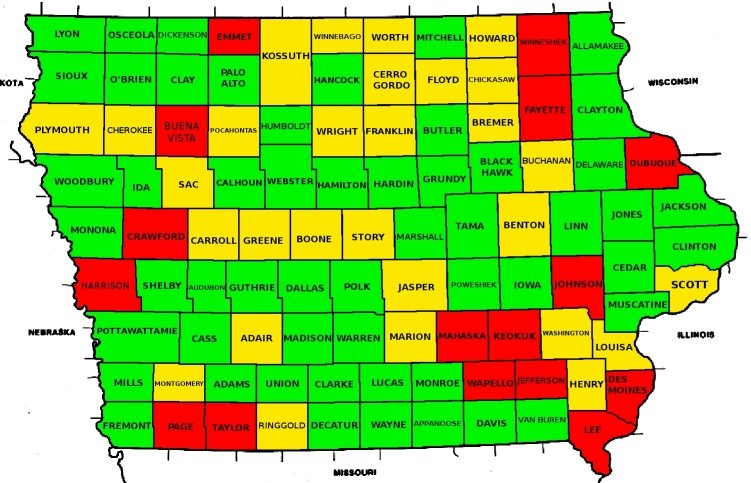
Concealed carry laws simply allow that citizens who have passed criminal background checks and firearms training courses can be issued a permit to carry a firearm concealed on their person. Thirty-six states have “shall issue” laws which declare that the issuing authority must issue a permit to qualified applicants. Iowa currently has what is called a “may issue” law. The decision whether or not to issue permits to qualified applicants (or at all) is left to each individual county sheriff. This means that there are 99 separate policies setting standards for proper training and issuance of permits in Iowa, although the permits themselves are valid statewide. [The Iowa map to the upper right shows the relative ease of getting a permit by county, with green being the easiest, yellow medium, and red the hardest. Map courtesy of IowaCarry.org ]
Why would Iowa, or any state, want private individuals to be able to carry guns? Concealed carry laws are partially responsible for the massive declines in crime rates that we’ve seen in America. States which passed concealed carry laws reduced their murder rate by 8.5%, rape by 5%, aggravated assault by 7% and robbery by 3%. Since 1991, 23 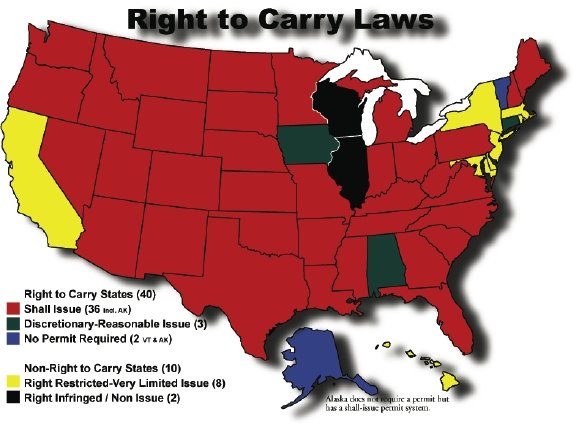 states have adopted some form of concealed carry law, the number of privately-owned guns has risen by almost 70 million, while violent crime has declined 38%. Every year, about 500,000 people defend themselves with a firearm while away from their home. [U.S. map to the left from NRA-ILA.]
Of the five bills introduced in the Iowa legislature, three do not fix all the problems of the current system. Some appear to be “shall issue” measures, but leave out important elements such as an appeals process or standardized statewide training requirements. Leaving training standards to local sheriffs allows anti-gun sheriffs to obstruct issuing permits by making the standards impossible to meet. The two best bills are HF 559 and HF 596.
HF 559 is the bill being championed by the pro-gun group Iowa Carry. This bill meets the four requirements that Iowa Carry has fought for: It states that the sheriff “shall issue” to qualified applicants, it standardizes training statewide, it allows for “reciprocity” (recognizing permits from other states), and although it allows sheriffs to deny permits for specified reasons, it allows for an appeals process for applicants who feel they were wrongly denied.
This bill is currently stuck in a three-man subcommittee, the chair of which has a reputation as being the ax man for bills that the Democrat majority wants to disappear. When asked about HF 559, another member of the subcommittee states that he is “[not] in favor of a bunch of idiots running around shooting each other.” The last representative on the committee, Clel Baudler, while a stalwart supporter of the Second Amendment, is the author of one of the other concealed carry bills (HF 193) and therefore might not go to the mat for this one.
HF 596 is a much more sweeping reform of Iowa‘s permit system (and therefore much less likely to pass). According to Gun Owners of America, which supports it, the bill would: Allow law-abiding citizens to carry firearms concealed or openly on their hip, without a permit. This is often called “Vermont Carry” after one of the two states that use this policy. (The other, more recent, one is Alaska.) It would allow people to be issued a permit, if they wished to carry in other states that recognize such. Moving beyond right-to-carry issues, this bill would eliminate Iowa’s requirement to get a special permit just to purchase a handgun. This requirement is redundant now that a federal law mandates that all commercial gun sales require a criminal background check.
Although it is good, HF 596 has only slightly better odds of passage than a resolution declaring that hog farmers and the Iowa Hawkeyes suck.
Of the five bills, only Baudler’s HF 193 (SF 258 in the Senate) seems to be going anywhere. This bill is a definite improvement as it would standardize training requirements statewide, grant reciprocity to other states and would establish an appeals process for denied applicants. However, it can’t be considered a true “shall issue” bill since it would still leave issuance criteria solely to the county sheriff.
With five bills floating around the statehouse, there’s a chance that at least one can pass and maybe modestly improve Iowa’s confused weapons permit system. Then again, maybe not.
3 Good Bills In Des Moines
 The Iowa legislature is now in session and there is the usual assortment of bills that will raise taxes and increase regulations on hapless Iowans. But amidst this tidal wave of bad bills are at least three good ones.
House File 74, the “Iowa Taxpayer Transparency Act of 2009,” would mandate that the state establish a website with a “searchable budget database website for the public to access the details of the expenditure of state tax revenues and a searchable tax rate database for the public to access the details of each tax rate for all taxing districts in the state.” In other words, you would be able to look up where the state is spending all its money and also figure up how much all the various levels of government are bilking you on taxes.
Modeled after one of President Obama’s few signature pieces of legislation while in the U.S. Senate, this bill was introduced by Republicans in the Iowa legislature (probably in the hopes that some of Obama’s mojo will rub off on them). Currently nine other states have followed Obama’s lead and set up state government transparency sites of their own. Interestingly it’s only a few Democrats opposing it here in Iowa, presumably because their fingerprints will be all over the wasteful spending that will be discovered because of the website.
The estimated cost would be about $40,000 for the website. (That’s a government estimate, so it will be higher.) But if it helps taxpayers and watchdog groups keep Iowa government on the fiscally straight and narrow path, it will quickly pay for itself.
Ed Falier Jr., President of Iowans for Tax Relief, had this to say about the new bill: “Iowans for Tax Relief agrees with President Obama and we endorse his call for change. The people are the consumer of government, and all Iowans should be able to find out exactly how their tax dollars are being spent. I want to thank the bill sponsors who are here today and ask all other Legislators to honor the agenda of our new President and support swift passage of this bill.”
House File 116 cleans up language in current law dealing with transporting firearms. Let’s say you’re one of the many new gun owners who went out and bought their first gun because you think the Obama Administration is going to ban them soon. You go to the local shooting range to practice. Knowing that it is illegal to transport a LOADED weapon in your vehicle, you pull the magazine of ammo out of the gun, put the gun in its case and into the trunk. You toss the magazine into your glove compartment and head home.
You just broke the law! According to the way it’s worded now, a loaded detachable-magazine is considered a loaded weapon, even if it’s not IN the weapon. HF 116 would change that, making it harder for recreational shooters to inadvertently become criminals.
Also dealing with firearms is House File 86, “An Act relating to the justifiable use of reasonable force.” Under current law, Iowans have a duty to flee from criminal attack before being “justified” to use deadly force outside their home. The proposed law would specify that “a person has no duty to retreat, and has the right to stand the person’s ground, and meet force with force, if the person believes reasonable force, including deadly force, is necessary under the circumstances to prevent death or serious injury to oneself or a third party, or to prevent the commission of a forcible felony.”
So good guys could legally stand their ground, and it would become the criminal’s “duty” to run like hell. Often called the “Castle Doctrine” (because “a man’s home is his castle”), it is an old concept based on English common law.
Despite cries from alarmists that such laws (which they cleverly call “Make My Day Laws”) will lead to constant bloodbaths, at least 19 other states have adopted Castle Doctrine laws of one sort or another without any problems.
Since these three bills only benefit taxpayers and common citizens, there is a risk that they will be pushed aside in favor of bills that are supported by powerful special interests. Please write your State Representative and ask him or her to support one or all of these bills. You can find your Rep here.
How To Deal With Pirates? More Freedom!
 Probably not the biggest threat to the republic, but a growing annoyance nonetheless, is the threat of piracy against commercial shipping. The International Maritime Bureau (IMB) reports a dramatic increase of pirate attacks in 2008. There were a total of 199 pirate attacks reported to the IMB during the first nine months of this year. “The increased frequency of piracy and heightening levels of violence are of significant concern to the shipping industry and all mariners. The types of attacks, the violence associated with the attacks, the number of hostages taken, and the amounts paid in ransoms for the release of the vessels have all increased considerably,” stated IMB Director Captain Pottengal Mukundan.
A lot of the increased pirate activity is off the coast of Somalia, particularly in the Gulf of Aden. This region accounts for almost a third of pirate attacks worldwide. Kenyan officials estimate that the Somali pirates have made at least $150 million in ransom money. That was before the pirates seized a Saudi oil tanker carrying $100 million worth of crude oil last week. They are demanding $25 million in ransom for the ship and crew.
Like good businessmen, the pirates are re-investing much of their ill-gotten booty (that’s the only movie-pirate terminology I’ll use, I promise me hearties!) back into their business. The pirates appear to be buying new and better speedboats, and more powerful weapons such as rocket-propelled grenade launchers (RPG’s) and 14.5 mm heavy machine-guns.
The growing threat has caused national governments and the U.N. to reluctantly say that they should probably do… something. Several nations already have a few warships patrolling the area. NATO has four vessels in the region, soon to be replaced with four from the European Union. The U.S. 5th Fleet also has several ships patrolling the area and the Yemeni Coast Guard is working hard.
However, U.N. rules restrict the ability of naval forces to respond to pirate attacks. NATO spokesman James Appathurai explains: “[Navy ships] can patrol. They can deter. They can even stop attacks that are happening, but what they do not do is then board the ship that has been hijacked elsewhere to try and free it.”
While global bureaucrats scratch their heads and try to figure out how to deal with pirates, the shipping industry is doing what it can. They have re-routed ships around dangerous areas, which may add thousands of extra miles to a trip, increasing costs. They have advised their crews of passive measures such as traveling at night without lights, to avoid detection and battening all hatches to avoid boarding. Private security companies, such as the now infamous Blackwater, have offered their own patrol boats to protect shipping for a price.
Lest we make this problem more complicated than what it is, let’s look at the facts. Pirates are just criminals, like seaborne muggers. Navy ships (like cops) cannot be everywhere and therefore cannot guarantee the safety of every civilian ship. The similarities to routine street crime are apparent. A partial solution to reducing piracy is therefore pretty similar to what has reduced violent crime domestically: reduce the number of unarmed victims.
While some ships have done so for years, arming civilian mariners faces several challenges. Firstly, squeamish trade groups such as the International Maritime Organization (IMO) oppose doing so because they believe it puts crews at greater risk. Instead, the IMO recommends that merchant ships take the passive measures listed above and post lookouts with high-pressure water hoses to ward off pirates. Spraying pirates who have rocket-launchers and heavy machine-guns with a water hose is the safe option? Sounds like ritualistic suicide. Spraying them with lead makes more sense to me. Since one cruise ship was able to scare away armed pirates with simulated machine-gun fire, it’s obvious that REAL guns would have a deterrent effect.
Second, arming civilian crews faces legal challenges. Mariners are bound by the national laws of the ports that they visit. Since most nations outlaw civilian gun ownership, crew members would risk arrest at most stops.
If everybody is so afraid of armed civilians, why not wave the federal magic wand over armed volunteers and turn them into “officials.” How about a program similar to the Federal Flight Deck Officer (FFDO) program, run by the Federal Air Marshall Service, implemented among civilian airline pilots after 9-11?
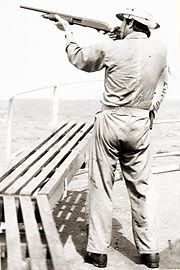
Willing crew members, employed by willing ship owners, could volunteer for the program. They would receive weapons training from the U.S. government and some type of official recognition, perhaps with special membership in the Navy or Coast Guard Reserves. Official status would no doubt allow the crew members to enter into more ports than they could as armed civilians, as well as allowing them weapons that they might not otherwise have access to. One or two crew members manning weapons such as the M2 .50 caliber machine-gun, M240 7.62mm machine-gun, Mk-19 automatic grenade launcher or even light weapons would not only deter pirate attacks but would give ships a fighting chance against them if they attack anyway. [The merchant seaman pictured above (circa 1984) is armed with a 12 gauge shotgun. While effective for repelling boarders close-in, it’s effective range of 50 yards would be outclassed by the heavy weapons used by today’s pirates.] The program could require that these weapons be securely stowed under lock and key until needed, as the FFDO program does.
This wouldn’t be the perfectly libertarian solution to the pirate problem. That solution would be the high-seas equivalent of “Vermont Carry,” wherein civilians carry whatever guns they want, no permit required. Unfortunately there’s no way other countries would recognize this right.
But a voluntary, government sanctioned program as described above, in addition to un-sanctioned arms bearing and passive security measures, would help to reduce piracy of American vessels. It would give civilians more flexibility in protecting their lives and their livelihood. That’s always a good thing.
NRA Endorses McCain- Part II
[For a more complete analysis of the NRA’s endorsement of presidential candidate John McCain, read the original post- Strange Bedfellows: NRA Endorses Its Enemy, directly below this post.]
Here’s McCain speaking about the NRA. This is the guy that the NRA endorsed?
http://blip.tv/play/Abf9DYeFGg
Here’s a commercial McCain did for “Americans For Gun Safety”(AGS) seeking to close a non-existent “gun show loophole” using bogus statistics. AGS was founded by Andrew McKelvey, a former member of the board of directors of Handgun Control Inc. and the primary founder of the Million Mom March (against gun rights). AGS received funding from anti-gun nuts George Soros and Teresa Heinz Kerry via the Tides Center.
Here’s a fact check for the senator: A 1997 study by the National Institute of Justice said only 2% of criminal guns came from gun shows. Hardly an epidemic. Of these few crime guns procured at gun shows, many were purchased by “straw buyers” who could pass a criminal background check (a practice that is already illegal), so additional background checks would do no good. All gun sales at gun shows are governed by the SAME legal requirements as they are anywhere else. There is no “loophole” specific to gun shows.
Gun owners should disregard the NRA sellout and support Bob Barr, who serves on the NRA’s board of directors and has an excellent Second Amendment record. (Bob’s NRA rating: A+, McCain’s NRA rating: C+, McCain’s Gun Owners of America rating: F-)
Strange Bedfellows: NRA Endorses Its Enemy
It’s official: the National Rifle Association (NRA) has endorsed Senator John McCain for President. That’s somewhat surprising considering that the NRA once labeled McCain as “one of the premier flag carriers for the enemies of the Second Amendment” [right to keep and bear arms], which the NRA supposedly defends. So, how did McCain gain the NRA’s ire, then, ultimately its endorsement?
How McCain got a bad name with gun owners is easy. He co-sponsored the McCain-Lieberman Gun Show Bill to close the supposed “gun show loophole.” While the bill didn’t technically outlaw gun shows, it did open gun show organizers up to so much potential legal trouble as to not make it worth the risk. It was a backdoor ban on gun shows. Thankfully this bill failed.
Later, the McCain-Feingold Act specifically sought to muzzle groups like the NRA from criticizing anti-gun candidates. NRA Executive V.P. Wayne LaPierre called it “the most significant change in the First Amendment since the Alien and Sedition Acts of 1798, which tried to make it a crime to criticize a member of Congress.” The NRA was literally first in line at the courthouse doors to file a lawsuit to stop McCain’s law after President Bush signed it. (The lawsuit failed and McCain-Feingold is still the law of the land.)
McCain did commercials for the moderate sounding, yet anti-Second Amendment, group Americans for Gun Safety. McCain voted in favor of both of Bill Clinton’s Supreme Court nominees who voted against the Second Amendment in DC vs Heller. These are just some of McCain’s transgressions against gun owners. For a complete reading check out “John McCain: Conservative or Gun-Grabber?”
Why did the NRA endorse candidate McCain? Because his challenger, Barack Obama, is worse. (For a complete rundown of Obama’s anti-gun record, click here.) But why they would endorse someone who is a proven enemy of the Second Amendment rather than just not endorsing either candidate (as they’ve done several times before) is puzzling. This is just the most recent example of the NRA placing political expediency above principle.
NRA Board Member Russ Howard resigned because the NRA kept giving A grades to anti-gun legislators in his home state of California.
The NRA brags about the recent victory for gun owners in the Supreme Court case of DC vs. Heller, but the group played a negligible role in the win and, fearing a lose, tried to squash the case. Robert A. Levy, the lawyer who helped create and personally financed the case that reaffirmed the Second Amendment as an individual right, said “The N.R.A.’s interference in this process set us back and almost killed the case. It was a very acrimonious relationship.”
In 2007 NRA actively supported the “NICS Improvement Amendments Act of 2007’’ which was dubbed “the Veteran’s Disarmament Act” by pro-gun critics. Written by Carolyn McCarthy (D-NY), arguably the most anti-gun member of Congress, the bill mandated that states turn over all types of personal information about their citizens, potentially including medical records, to the federal government to use in it’s “National Instant Criminal Background Check System” (NICS) for approving gun buyers. Wholly unnecessary, the bill could prevent veterans who have ever sought professional help for post traumatic stress disorder or depression from ever owning guns, even if they present no threat to themselves or others. (How’s that for a disincentive to get the help that some may need?) In addition to hurting gun owners, this bill is a nightmare for advocates of personal privacy rights and state rights.
In 2001 NRA pushed for and got “Project Safe Neighborhoods,” a national initiative supposedly aimed at reducing gun violence. As the libertarian-leaning Cato Institute explains it, “Project Safe Neighborhoods is the public-policy embodiment of the National Rifle Association sound bite ‘we don’t need any new gun control laws; we need to enforce the gun laws on the books.’ The program funds more than 800 new prosecutors (around 200 federal, 600 state level) who will do nothing but pursue gun-law violations full time.” It essentially makes every petty street crime involving a firearm into a federal crime, Tenth Amendment be damned. It is a program of zero-tolerance enforcement of the very gun laws that NRA often argues are unconstitutional and ineffective. Otherwise law-abiding gun owners who get caught in this web for regulatory infractions or accidental violations are acceptable “collateral damages” to the NRA.
The website NRAwol has volumes of examples of the NRA selling out the Second Amendment and America’s gun owners in the name of political expediency dating back to the National Firearms Act of 1934. [A link to this site will now be located in the “National Links” Section to the right.]
Despite all this, I’m not going to cancel my life-membership in the NRA. (I already paid for it after all.) They still do some good too. Their work with match shooting and firearms training is second to none. Politically I believe that they may still fight against the most egregious gun bans. I will just have to bear in mind that their endorsement of candidates and some legislation is meaningless. For all things political I will pay attention to what Gun Owners of America has to say, and continue to roll my eyes when the NRA sends me its usual panhandling fundraiser letters every other week.
 Cold Hard Cashner