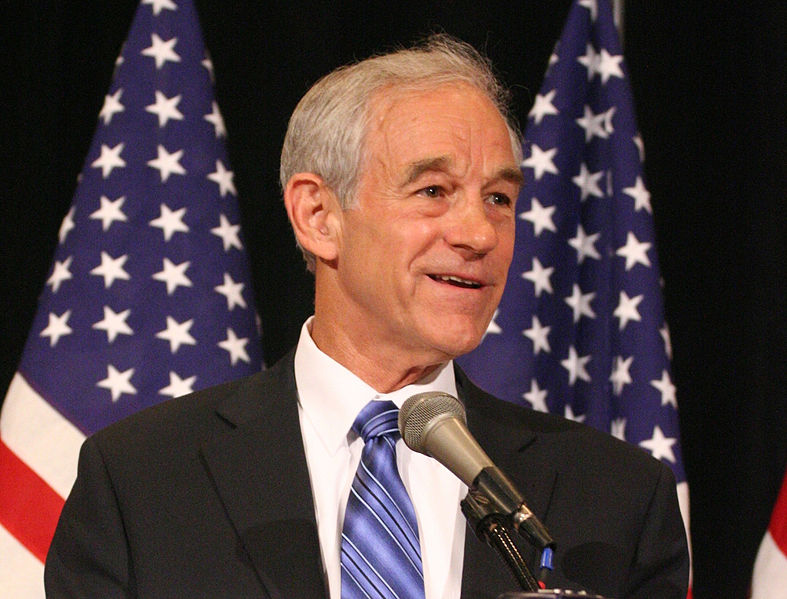
Vote Ron Paul At The Ames Straw Poll


 I’ll be supporting doctor and U.S. Representative Ron Paul at the Ames Straw Poll on August 13th.

At a time when the U.S. government is borrowing $3 million every minute, many Republicans have signed on to a supposedly “bold” plan that pretends to have unknown future politicians balance the budget 50 years from now. Ron Paul, however, supports balancing the budget while we still have a country. In his 21 years in Congress, Paul has never voted to raise taxes and has voted AGAINST every unbalanced budget. Imagine what he could do with a presidential veto pen.

He never votes for legislation unless it’s expressly authorized by the Constitution. His votes have earned him the derisive name “Dr. No” from his big-spending colleagues in Congress and “Taxpayers’ Best Friend” from the National Taxpayers’ Union. He realizes that we can no longer afford to fight war after endless war where we no longer even bother to define victory. Ron Paul is pro-life, pro-free market, and pro-Second Amendment.

If you want to support Dr. Paul in the Ames Straw Poll you can get your ticket at http://www.iowaforronpaul.com/. If you register before July 4th, you get roundtrip transportation to the event, a Ron Paul T-shirt, and food, drinks, and entertainment at the Ron Paul tent for only $10.

Ron Paul As Popular As Obama?

According to Rasmussen Reports, a hypothetical 2012 race between President Obama and Dr. Ron Paul would be a dead heat.

The report says: “A new Rasmussen Reports national telephone survey of likely voters finds Obama with 42% support and Paul with 41% of the vote. Eleven percent (11%) prefer some other candidate, and six percent (6%) are undecided.”

“Thirty-nine percent (39%) of all voters have a favorable opinion of Paul, while 30% view him unfavorably. This includes 10% with a very favorable opinion and 12% with a very unfavorable one. But nearly one-out-of-three voters (32%) are not sure what they think of Paul.”

I don’t think we can get that lucky, but if the GOP puts Dr. Paul at the top of the ticket in 2012, this blogger will gladly vote Republican.

Clean Sweep!

All 5 of Iowa’s U.S. Representatives Co-Sponsor Ron Paul’s “Audit the Fed” Bill.

On June 11, U.S. Representative Bruce Braley became the final member of Iowa’s U.S. House delegation to co-sponsor HR 1207, the “Federal Reserve Transparency Act of 2009.″ Iowa’s three Democrat and two Republican representatives have all now co-sponsored this important legislation.

The bill merely calls for the Comptroller General (America’s chief financial inspector and head of the Government Accountability Office [GAO]) to conduct an audit of the Federal Reserve System by the end of 2010 and report the findings to Congress.

The Federal Reserve (or “Fed”) is America’s central banking system. It is a a quasi-public and quasi-private organization (an unholy union of government and private interests). It was signed in 1913 by President Woodrow Wilson, who supposedly later lamented, “I am a most unhappy man. I have unwittingly ruined my country. […] The growth of the nation, therefore, and all our activities are in the hands of a few men. […] No longer a government by free opinion, no longer a government by conviction and the vote of the majority, but a government by the opinion and duress of a small group of dominant men.”

According to its website, the Federal Reserve’s duties fall into four general areas:

  1. Conducting the nation’s monetary policy by influencing the monetary and credit conditions in the economy in pursuit of maximum employment, stable prices, and moderate long-term interest rates.
  2. Supervising and regulating banking institutions to ensure the safety and soundness of the nation’s banking and financial system and to protect the credit rights of consumers.
  3. Maintaining the stability of the financial system and containing systemic risk that may arise in financial markets.
  4. Providing financial services to depository institutions, the U.S. government, and foreign official institutions, including playing a major role in operating the nation’s payments system.

You would think that an institution with so much responsibility to and power in the U.S. economy would be run openly and transparently. Not so. To understand why the audit of the Fed is necessary, here are the words of the bill’s author Congressman Ron Paul, when he arose to introduce the bill to Congress:

I rise to introduce the Federal Reserve Transparency Act. Throughout its nearly 100-year history, the Federal Reserve has presided over the near-complete destruction of the United States dollar. Since 1913 the dollar has lost over 95% of its purchasing power, aided and abetted by the Federal Reserve’s loose monetary policy. How long will we as a Congress stand idly by while hard-working Americans see their savings eaten away by inflation? Only big-spending politicians and politically favored bankers benefit from inflation. […]

Since its inception, the Federal Reserve has always operated in the shadows, without sufficient scrutiny or oversight of its operations. […] The Federal Reserve has, on the one hand, many of the privileges of government agencies, while retaining benefits of private organizations, such as being insulated from Freedom of Information Act requests.

The Federal Reserve can enter into agreements with foreign central banks and foreign governments, and the GAO is prohibited from auditing or even seeing these agreements. Why should a government-established agency, whose police force has federal law enforcement powers, and whose notes have legal tender status in this country, be allowed to enter into agreements with foreign powers and foreign banking institutions with no oversight? […]

More importantly, the Fed’s funding facilities and its agreements with the Treasury should be reviewed. The Treasury’s supplementary financing accounts that fund Fed facilities allow the Treasury to funnel money to Wall Street without GAO or Congressional oversight. […]

The Federal Reserve Transparency Act would eliminate restrictions on GAO audits of the Federal Reserve and open Fed operations to enhanced scrutiny. We hear officials constantly lauding the benefits of transparency and especially bemoaning the opacity of the Fed, its monetary policy, and its funding facilities. By opening all Fed operations to a GAO audit and calling for such an audit to be completed by the end of 2010, the Federal Reserve Transparency Act would achieve much-needed transparency of the Federal Reserve. I urge my colleagues to support this bill.”

And support it they have. HR 1207 currently has 223 co-sponsors in the House of Representatives, Republicans and Democrats alike. That is over half of all representatives. With that much support, it would appear likely that House leadership will allow the bill to be debated and voted on.

Attention now turns to the Senate where the bill’s companion bill, S.604 (Federal Reserve Sunshine Act) has already been introduced. The Fed intends to hire a veteran lobbyist to urge Congress to vote against the audit. The people, therefore, need to urge them to vote FOR the bill. Contact information for Iowa’s two U.S. Senators is below. Ask them to co-sponsor S.604.

Sen. Charles Grassley (R): Website Contact Page or Mail to 135 Hart Senate Office Building, District of Columbia 20510-1501 D.C. Office Phone: (202) 224-3744 Des Moines Office Phone: (515) 288-1145

Sen. Tom Harkin (D): Website Contact Page or Mail to 731 Hart Senate Office Building,District of Columbia 20510-1502 D.C. Office Phone: (202) 224-3254 Des Moines Office Phone: (515) 284-4574
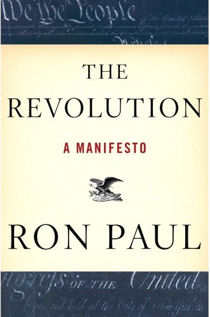
The Revolution: A Manifesto

Back in October I received a copy of Ron Paul’s book “The Revolution: A Manifesto.” I did something with it I had never done with a book before. No, not read it. I read it cover to cover twice in a row.

Usually books written in association with a presidential campaign aren’t very good. They tend to be just the written form of the meaningless sound bites that we expect from modern politics. Paul’s book is, unsurprisingly, different. Although Ron Paul sought the Republican nomination for president, philosophically he is a libertarian and has done more to advance that school of thought than any Libertarian Party candidate. The Revolution isn’t a campaign book at all, but a wide ranging dissertation on libertarian and paleo-conservative philosophy.

The first chapter is titled “The False Choices of American Politics.” Paul writes: “[E]very four years we are treated to the same tired, predictable routine: two candidates with few disagreements on fundamentals pretend that they represent dramatically different philosophies of government.” The false choice presented is, how should the government control something, not should the government control it. This chapter seemed particularly apropos after this election between statists Obama and McCain, and after a Republican president began nationalizing the banking industry like a Democrat on steroids.

Chapter 2 deals with “The Foreign Policy of the Founding Fathers.” Paul spends a good deal of time outlining the policy of “peace, commerce, and honest friendship with all nations, entangling alliances with none,” advocated by Thomas Jefferson and others. He chronicles how far we’ve strayed from that advice and how our intervention in other nations has made us a target for terrorists while draining our treasury.

The third chapter deals with the constitution and how much the federal government has slipped loose from its constraints. Paul again quotes Jefferson, who wrote in 1798, “Confidence is everywhere the parent of despotism. Free government is founded in jealousy, and not in confidence… In matters of Power, let no more be heard of confidence in man, but bind him down from mischief by the chains of the Constitution.” Paul urges us to “rally and recall our people to the Constitution, the rule of law, and our traditional American republic.”

Chapter 4 expounds upon “Economic Freedom.” He details his thoughts on government waste and spending (but I repeat myself), taxes, and regulation of private markets. In Chapter 5, “Civil Liberties and Personal Freedom,” he deals with privacy rights and other civil protections that have been buffeted by the “wars” on terror and drugs. Writes Paul: “Freedom means not only that our economic activity ought to be free and voluntary, but that government should stay out of our personal affairs as well. […] Economic freedom and personal liberty are not divisible.” This flies in the face of conservatives and liberals that want one but not the other, conservatives wanting only the former and liberals wanting only the latter.

The sixth chapter deals with Paul’s true passion: “Money: The Forbidden Issue in American Politics.” Here Paul chronicles America’s monetary policy and how it creates inflation, encourages debt and government spending, and causes the economic “bubbles” that seem to be bursting everywhere lately. Chief among Paul’s concerns is the Federal Reserve, which orchestrates all of the above. To remedy our problems, Paul advises abolishing the Federal Reserve and returning the dollar to the gold standard.

In the final chapter, “The Revolution,” Paul explains what can be done to peacefully implement the points he raised in the previous chapters.

If you’re at all interested in understanding libertarian ideas, you should read “The Revolution: A Manifesto.” It touches on just about every subject of importance and is an easy, enjoyable read. It’s available at the Campaign For Liberty Store online, amazon.com and anywhere else books are sold.

Ron Paul Gets It

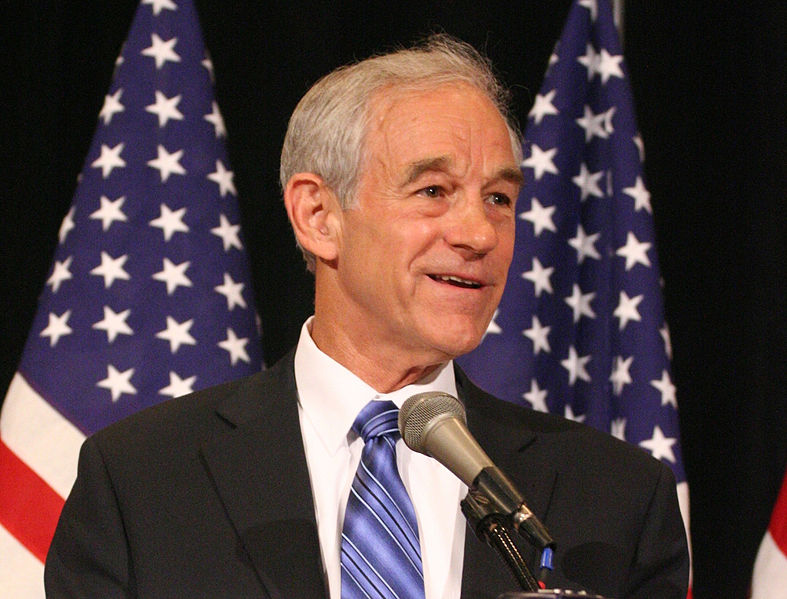
In this interview on CNN, Congressman Ron Paul (R-TX) raises many of the same points about the downfall of the GOP that I raised in my post “Cinders and Ashes!”

Ron Paul & Senator Coburn On Economic "Bailout"

I would be remiss in my duties if I didn’t write about the massive economic “bailout” that just passed through Congress. However, when I heard Senator Tom Coburn’s (R-OK) speech I knew that he had put it more elequantly than I could. Rather than try to reinvent the wheel, here is Senator Coburn’s speech:

Here is U.S. Representative Ron Paul’s (R-TX) comments in the House:

October 3, 2008

“Madame Speaker, only in Washington could a bill demonstrably worse than its predecessor be brought back for another vote and actually expect to gain votes. That this bailout was initially defeated was a welcome surprise, but the power-brokers in Washington and on Wall Street could not allow that defeat to be permanent. It was most unfortunate that this monstrosity of a bill, loaded up with even more pork, was able to pass.

“The Federal Reserve has already injected hundreds of billions of dollars into US and world credit markets. The adjusted monetary base is up sharply, bank reserves have exploded, and the national debt is up almost half a trillion dollars over the past two weeks. Yet, we are still told that after all this intervention, all this inflation, that we still need an additional $700 billion bailout, otherwise the credit markets will seize and the economy will collapse. This is the same excuse that preceded previous bailouts, and undoubtedly we will hear it again in the future after this bailout fails.

“One of the most dangerous effects of this bailout is the incredibly elevated risk of moral hazard in the future. The worst performing financial services firms, even those who have been taken over by the government or have filed for bankruptcy, will find all of their poor decision-making rewarded. What incentive do Wall Street firms or any other large concerns have to make sound financial decisions, now that they see the federal government bailing out private companies to the tune of trillions of dollars? As Congress did with the legislation authorizing the Fannie and Freddie bailout, it proposes a solution that exacerbates and encourages the problematic behavior that led to this crisis in the first place.

“With deposit insurance increasing to $250,000 and banks able to set their reserves to zero, we will undoubtedly see future increases in unsound lending. No one in our society seems to understand that wealth is not created by government fiat, is not created by banks, and is not created through the manipulation of interest rates and provision of easy credit. A debt-based society cannot prosper and is doomed to fail, as debts must either be defaulted on or repaid, neither resolution of which presents this country with a pleasant view of the future. True wealth can only come about through savings, the deferral of present consumption in order to provide for a higher level of future consumption. Instead, our government through its own behavior and through its policies encourages us to live beyond our means, reducing existing capital and mortgaging our future to pay for present consumption.

“The money for this bailout does not just materialize out of thin air. The entire burden will be borne by the taxpayers, not now, because that is politically unacceptable, but in the future. This bailout will be paid for through the issuance of debt which we can only hope will be purchased by foreign creditors. The interest payments on that debt, which already take up a sizeable portion of federal expenditures, will rise, and our children and grandchildren will be burdened with increased taxes in order to pay that increased debt.

“As usual, Congress has show itself to be reactive rather than proactive. For years, many people have been warning about the housing bubble and the inevitable bust. Congress ignored the impending storm, and responded to this crisis with a poorly thought-out piece of legislation that will only further harm the economy. We ought to be ashamed.”