

Sorry, I know this didn’t show up worth a hoot. I tried to make it clearer. You can see it better here on Facebook. It’s probably a sign from the computer gods that you should “like” Cold Hard Cashner on Facebook.
Category: religion
10 Questions with Corey D. Roberts (Part 2)

Continued from Part 1.
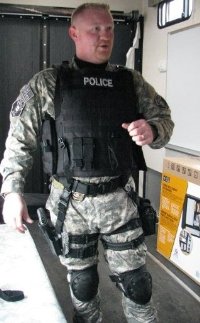
Corey D. Roberts is the founder of Tactical Insights L.L.C. in Monticello, Iowa, which provides “Christ-Centered Emergency Response Training” for churches and faith based organizations as well as tactical training for law enforcement and private citizens.
Roberts is currently a full-time patrol police officer with the Monticello P.D. and also serves on the multi-jurisdictional Jones County Emergency Response Team as Tactical Commander. He also serves in the Iowa Army National Guard (having served as an enlisted man, NCO and officer) and has been deployed several times.
Officer Roberts agreed to answer a few questions for me about guns, crime and freedom. The views expressed are those of Roberts and not necessarily those of any organization he may be affiliated with.
6. Sen. Dianne Feinstein, D-Calif., introduced a bill that would ban “assault weapons” and “high capacity” ammunition magazines. Says Feinstein, “Military-style assault weapons have but one purpose, and in my view that’s a military purpose, to hold at the hip, possibly, to spray fire to be able to kill large numbers.” You are intimately familiar with weapons like the AR-15 (which would be affected by the ban). What exactly is an “assault weapon?” Do you agree with Feinstein’s analysis of the purpose and proper employment (such as being designed to be “spray fired” from the hip) of weapons like the AR-15?
Sen. Feinstein watches too much television. I will begin by answering the basic question of “What is an Assault Weapon?” To be perfectly honest, as a firearms expert, I don’t know. The term “Assault Weapon” is not a gun term, it is a political term that is used to scare people. The term “AR” does not stand for assault rifle. It stands for Armalite, which is the company that produced the modern civilian model of the gas operated, magazine fed, semi-automatic sporting rifle. Armalite developed the AR-15. Having been in the military for 20 years I can say without question that no one is taught to “hold at the hip and spray,” certainly not with the black rifle that she is comparing to the civilian semi-automatic rifle. Currently our military is issuing an M4 which is similar in design to the civilian model, but functions differently. Even our military does not issue “spray and pray” weapons. The current issued M4 is not fully automatic and instead uses a 3 round burst mode.
This argument has nothing at all to do with banning a specific firearm. These terms such as “high capacity magazines” and “Military style assault weapons” are being used to divide the gun enthusiasts in this country. The liberals who wish to confiscate our firearms understand that they cannot simply say that they are going to ban firearms, they have to start slowly. If they can convince the hunters and collectors in the country that the only “bad guns” are the “assault weapons” it sounds reasonable, and people want to be reasonable. They are working to convince the guy with the shotgun that he has nothing to fear and that no one “needs” 30 rounds.
As an aside, I mentioned that we have begun to define all of our needs as rights, so why are we surprised when the government begins to infringe on our rights based on need? I disagree with the premise that our rights are defined by need. The argument that I have used is that if our rights are based on need, then please explain to me the need for Rosa Parks to sit in the front of the bus. It was her right, not her need.
Our government has developed a pattern that is easy to follow if we pay attention.
Step 1. Create a term that everyone can agree is bad.
Step 2. Refuse to define said term but continue to use it and enlist the media to join you in using it.
Step 3. Wait for a critical incident in which said term can be applied and the “people” cry out for government intervention.
Step 4: Create your own definition for the term.
For example, our government uses the term “assault weapon” and even uses the term “reasonable” when attempting to convince the American people that no one needs them. The media then splashes the term “assault weapon” only when describing a weapon used by a crazed gunman and never when used by anyone else. A great example of this was the Dorner case in California in which one media outlet used the term “assault weapon” when speaking of Dorner, but used the term “personal defense weapon” when talking about the exact same weapon used by law enforcement in the same article. When confronted about the definition of “assault weapon” the government uses another non-definable term to define it, “military style”. So, we have the media and the citizens agreeing that “assault weapons” are bad, but when the ban list comes out from Sen. Feinstein, we see that she is actually referring to any weapon with a detachable magazine and any weapon with a pistol grip. But by now the media frenzy has convinced the people that the government is only after “assault weapons”.
Some other examples of this government pattern is the use of the term “universal background check”. Again this term has been championed as “reasonable” but has yet to be defined. “Mental health assessment” has been spoken of as a “reasonable step” to curb gun crime, but has not been defined. Questions for those who support the Universal background check and Mental health assessments are as follows: Will the government maintain a record of every citizen who had a background check to pass family heirloom rifle to their children? What parts of the “background” is involved? Will this background check be compared to any “watch lists”? (The DOJ stated that combat veterans should be on a watch list.) Who will receive a “mental health assessment”? At what age will we begin to “classify” our citizens based on this assessment? (People are very different at 16, 22, and 35.) Who will be deciding what is mentally “fit”? Does marital counseling bring into question whether a person is mentally “fit? What about “sexual deviancy” (remember homosexuality was a diagnosable mental condition)? What is to be done with those “classified mentally unfit” persons?
Can you see where these questions are going? I follow the rule that anytime the government uses the term “reasonable”, I begin to question it right away, governments are anything but reasonable.
When we allow our government to infringe on our rights based on terms that sound scary such as “domestic terrorist,” we all agree that “terrorists are bad and should be killed.” The problem is that the government’s definition of “terrorist” can be re-defined to mean anyone who the government sees as a threat.
The 2nd Amendment was specifically put in place to ensure that the people had the power and the government did not. Those who believe that only the military and police should control the guns, or that only they should have the most recent technology in firearms must also agree that only the government should have control of the media and internet. Our government is very aware of the power of an armed populace and shows it by arming citizens all around the world to overthrow their own governments, such as Egypt, Lybia, Syria, Afghanistan, etc. I do not trust a government that wishes to disarm its own population.
Make no mistake, this gun legislation has never been about guns, it’s been about control and many in our government have been waiting for just the right catalyst to push the agenda.
Limiting “high capacity magazines” is another example of this erosion of rights. My first question to anyone advocating this is “Please tell about all the firefights that you have been in that led you to the conclusion that people only need 7 rounds?” Who does this “limit” hurt? An active shooter by statistics will bring multiple weapons, multiple magazines and lots of extra ammo. The free citizen who is carrying a firearm is the only one allowed a limited number of rounds.
This free citizen has not planned to be in a fight for his life today, the crazed gunman has a plan. The citizen is required to respond to a well-planned, prepared for attack with whatever he has on his person. Will the limit on magazines affect the preparedness of the crazed shooter? Of course not, it will simply make it harder for the citizen to defend him or herself.
7. Your website includes a statement of faith and says that you “felt a strong call of God to minister to the local church in matters of Emergency Preparation, Response and Training.” It’s obvious that your Christian faith is central to your life. Some Christians, however, wouldn’t touch a gun with a ten foot pole. They would cite Christ’s instruction to “turn the other cheek” or the Sixth Commandment. According to the National Council of Churches ofChrist, U.S.A., “Christian tradition insists that it is idolatry to trust in guns to make us secure, since that usually leads to mutual escalation while distracting us from the One whose love alone gives us security.” How do you square your Christian faith with the potential deadly force of firearms?
We believe that a Christ-Centered Security Team is a group of Christians who desire to apply a Tactical Mindset to serve God and their local church through preparedness and willingness to respond in event of an emergency. I have a lot of respect for the National Council of Churches of Christ but I tend to disagree with many of their stances on several issues.
Their stance based on “Christian tradition” is well meaning but does not address the realities of the Bible. Our security for our ministries should be based in faith and managed in action.
While we embrace the biblical teaching that God will provide our needs and we believe the Bible when it says in Matthew 6:25 “Take no thought for your life, what you shall eat, or what you should drink; nor yet for your body, what you should wear,” this faith and confidence does not remove us from participating in our own preservation. Christ was not telling us to stand around waiting for food to fall into our mouths, or water to just appear. We do not stand in our bedrooms in the morning and wait for clothes to float out of the sky and land on us. These require action on our part.
Nehemiah 4:9 “We prayed to our God and posted a guard…”
Isaiah 62:6- I have set Watchmen on your walls, O Jerusalem; They shall never hold their peace day or night.
Nehemiah 4:9-…because of them we set a watch against them day and night.
John 15:13 “Greater love hath no man than this, that a man lay down his life for his friends.”
Luke 10:19- Behold, I give you the authority to trample on serpents and scorpions, and over all the power of the enemy.
Luke 22:36-…and he who has no sword, let him sell his garment and buy one.
1 Peter 5:8- Be sober, be vigilant; because your adversary the devil walks about like a roaring lion, seeking whom he may devour.
Romans 13:4- For he is God’s minister to you for good. But if you do evil, be afraid; for he does not bear the sword in vain; for he is God’s minister, an avenger to execute wrath on him who practices evil.
In 2012 alone, there were 135 total deadly force incidents in churches and ministries alone and this number is increasing every year. We have taught Response to Active Shooters both armed and unarmed. This choice is as personal for a Christian as it is for any other citizen.
While I may disagree with many things that the National Council of Churches of Christ, U.S.A. believes I firmly stand with Philippians 1:15 “But what does it matter? The important thing is that in every way, whether from false motives or true, Christ is preached. And because of this I rejoice.”
8. If talking to someone who was new to guns and was looking to purchase, what weapons would be your top picks for concealed carry and for home defense and any other category you think relevant?
Rule 1: ignore the hype. Every “gun guy” out there will be more than willing to give you advice on the perfect weapon/caliber/cool guy gear out there. I would stick with a reputable manufacturer. Think simple, especially for a defensive weapon. If it requires buttons and switches and voodoo spells to fire…it’s too complicated.
Also don’t buy the hype of “knock down power” and buy a huge caliber. For one, it will be more expensive to shoot and two if it’s not easy to shoot, you won’t shoot. I use the analogy that if someone were to give me a 20,000 dollar set of golf clubs, I would chase that stupid little ball through the trees all day the same I would with a 60 dollar youth set from Wal-Mart.
Proficiency requires practice. A well placed set of rounds from a 9mm or .40 caliber will do the same as a .45…good guy wins, bad guy loses. With the current advancements in AMMO, the old argument of Big Caliber=One shot stop is gone. This isn’t TV, it’s not high noon and people don’t fly across the room when shot…even with a .45. I personally would not go smaller than 9mm but I really prefer the 9mm. Higher ammo count, less recoil, less weight, awesome power with good ammo.
On the other side of that argument, a .22LR that one is willing to carry is more effective than a hand cannon at home or in the glove box.
I would suggest getting an idea of what you are looking for:
Am I going to carry it every day?
Is it easy to operate?
Can I conceal it?
Is ammo easy to acquire for it?
How much do I want to spend?
Will I enjoy shooting it?- Only practice makes proficient
Will it work under the worst possible conditions?- Murphy’s Law.
Am I going to carry it every day?
Is it easy to operate?
Can I conceal it?
Is ammo easy to acquire for it?
How much do I want to spend?
Will I enjoy shooting it?- Only practice makes proficient
Will it work under the worst possible conditions?- Murphy’s Law.
I would suggest looking at the Glocks, Smith and Wesson M and P’s or Sig Saur. For small carry guns Khar makes some very nice pistols. One way is to hit up a local gun club and talk to people. 74% of law enforcement carry Glock and the majority carry one of the other two. The reason is simple…they are proven, no gimmicks, no “latest greatest”, just a solid combat pistol that will operate when needed.
There really isn’t a trick to it, which is why I offer people to shoot different stuff (anything I have) at my classes. Unfortunately there aren’t a lot of people that will allow that. I carry a Glock 22 .40 caliber on duty, a Sig 229 .40 caliber on the SWAT team and a Glock 26 9mm off duty. My wife Jeannine carries a Glock 19 9mm. We have been very happy with them. I also occasionally carry a .357 revolver and have no problem with it other than low round count.
Cost is going to be an issue because of the buying that is going on ahead of Congress making some possible moves. You should look to spend $350-$600 on a good quality handgun. For a convenient carry pistol, I would also suggest looking at the Beretta Nano (it’s a 9mm). I have just started carrying it so I can give other ideas for people who “don’t want a Glock” and I have been very happy with it. It runs about $360.00.
I have nothing personally against the big 1911. 45’s other than the ones manufactured today have a VERY strong emphasis on accuracy, which is why you see the competition shooters using them. The way they get this is by making the guns tolerances VERY tight. This leads to problems with functioning in a defensive “combat” pistol role. I have NEVER had a 1911 shooter make it through one of my classes without having malfunctions. When they get dirty, they begin to have issues. Not a problem on the range…BIG problem for defense. Of course, you also run into issues with concealability with the big 45s.
Choosing a handgun is as close to purse shopping as we can get. It has to work for you. Just because some “expert” says that some brand is the “best” or some caliber is the “must-have” does not make it true. You need to pick it up and hold it. If it feels wrong in your hand, you probably should keep looking. Ideally, you should shoot that make and model before buying it.
For home defense, I prefer the 12 Gauge shotgun with a “pirate grip” and a side saddle with extra rounds. Very little will discourage an intruder more than the sound of a pump action shotgun. If that is not enough to discourage them, the first round will certainly help convince them. Another reason I prefer it is that I can choose the round that I wish to have in it. I use target load as the first several rounds in order to eliminate over penetration in my own home. I have double 00 buck and slugs in the side saddle if needed. The home defense weapon should be part of a total home defense plan that includes physical security, phones in appropriate rooms and practiced drills.
The reality is that just because a gun is really cool and effective in Call of Duty does not make it a practical choice for self-defense.
9. You and I are about the same age. In addition to having a lovely family, you’ve amassed significant civilian, military and law enforcement training. You’ve authored a book and numerous articles. You’ve racked up real world experience on the streets at home as well as serving in Kosovo and Afghanistan and even fighting wildfires in Montana. In contrast, aside from two wonderful sons, my only accomplishment has been to collect all five seasons of “Quantum Leap” on DVD. What is your secret for accumulating such a wide breadth of experience before you’re even forty?
I distinctly remember a conversation with my Dad that night before I left for Army Basic Training at the age of 17. During this conversation my Dad told me to ignore those who lived by the rule “Don’t volunteer for anything” and to take every opportunity for a new experience. I have followed that advice in every area of my life. While there were times that volunteering caused me to do tasks that I did not enjoy, more often it afforded me the chance to do something amazing.
Colossians 3:23 says “Whatever you do, work at it with all your heart, as working for the Lord, not for men…” I don’t know the trick to being driven. I do credit my upbringing and the example of my father. Were I to give a young man advice, I would simply say, “Volunteer for everything. In every task you have, work to be the best at it. Learn from those who have gone before. Accept responsibilities that are given to you and do them to the best of your ability.”
Years ago during Army Officer Candidate School, I was selected as the “Kai-Bo Commander”. For those that do not know what a Kai-Bo is, they are also called Port-a-Johns or any other inappropriate names that one can think of. I was in charge of the plastic toilets just like the ones at construction sites. To say the least, I was not impressed with my assignment. My job was to ensure that the toilets were reserved, delivered and placed at the various training sites where we would be conducting field operations. The position I felt I deserved was that of Class Commander, or at least a Platoon Leader, but no, I was Candidate Roberts, “Kai-Bo Commander”. This was obviously not my proudest moment.
I decided that if someone had to do it, then I would be the best Kai-Bo Commander the Army had ever seen. Don’t be fooled, this didn’t make my job any less demeaning, or any more glamorous. What it did do was show my superiors that I was willing to take the task and do it to the best of my abilities. The happy ending to the story is that after a short time, I was taken off of Kai-Bo duty and given a position that I felt was much more in line with my desires.
When you are given a task, do it to the best of your ability every time. Even if it is not the duty you want, take the small steps. The Bible has a parable of a rich man who was traveling and left his servants with some money. To one servant he gave ten, to another five and to the final two. When he returned, he asked the servants what they had done with the money and the one with ten said, I invested it and made ten more. The rich man gave him control of ten cities. The servant with five said I invested and made five more. The rich man gave him control of five cities. The final servant said, I kept the money and did nothing with it. The rich man called him a wicked and slothful servant and took the two away from him and gave it to the one with ten. ~Matthew 25:14-30
The simple point to his story is that when given more, more is expected. Prove that you can handle the little things and you will be given greater and greater responsibility. When you are put in charge of small tasks, do them as though they are the most important task that can be had. Show your willingness and ability to accept those challenges and you will be given more responsibilities. Fail in the small tasks, and it will be understood that you will fail at the big tasks.
10. Lastly, who do you think would win in a gunfight, the overzealous Sgt. Eugene Tackleberry from the movie “Police Academy” or survivalist gun nut Burt Gummer from “Tremors?”
I would have to go with Burt. While I love Tackleberry’s drive and his affinity for guns, Burt has spent his life preparing. A fight is always won before the first punch is thrown, before the first shot is fired. Those who have developed a strong Tactical Mindset have a marked advantage. I believe that all of us can and should have a Tactical Mindset. We begin to develop this the day we realize that we are being hunted. When we can understand the threats around us we can begin to develop the “when this-then what” preparedness that life requires. Burt was prepared for giant worms in the ground, which tells me, he is prepared for pretty much anything
10 Questions with Corey D. Roberts (Part 1)
Corey D. Roberts is the founder of Tactical Insights L.L.C. in Monticello, Iowa, which provides “Christ-Centered Emergency Response Training” for churches and faith based organizations as well as tactical training for law enforcement and private citizens.
Roberts is currently a full-time patrol police officer with the Monticello P.D. and also serves on the multi-jurisdictional Jones County Emergency Response Team as Tactical Commander. He also serves in the Iowa Army National Guard (having served as an enlisted man, NCO and officer) and has been deployed several times.
Officer Roberts agreed to answer a few questions for me about guns, crime and freedom. The views expressed are those of Roberts and not necessarily those of any organization he may be affiliated with.
1. What is Tactical Insights L.L.C. and what inspired you to start it?
In 2010, I was deployed to Afghanistan and I tell you that to tell you this; the one thing war movies never show adequately is the sheer, mind-numbing boredom that accompanies service in a war zone. While we love to talk about the firefights and explosions, the hours of boredom seldom are mentioned. During a soldier’s “down time” there is very little to do. Running down to the store or going out with your friends is not an option, so soldiers find other ways to keep themselves occupied. While deployed, there was a lot going on at home that we were able to catch glimpses of on Armed Forces Network television. One of the things that was big news was the Union fights going on in Wisconsin.
Since several of the other soldiers I was deployed with were fellow Police Officers, this of course became a topic of conversation. During our conversations, we discussed what we viewed as some of the problems with Law Enforcement today based on the issues that we were seeing in Wisconsin. I had been writing some articles for a website called PoliceCrunch.com and chose to write an article on police leadership titled The Pack Mentality and the Leadership Lessons of Ike. I found that this writing became my escape and my simple article became my first book. When I finished the first book I began another titled Be a Man, for God’s Sake which is still unpublished.
While writing this second book I was writing a chapter called, “Be a Man at Church” and was working on a section called “A real man knows how to serve others”. The Bible verse that I chose to use was:
1 Peter 4:10 As each has received a gift, use it to serve one another, as good stewards of God’s varied grace:.
I was waxing eloquent about our duty as men to serve others using the gifts that God has given us. The focus I used was that God has not called all of us to feed the poor in India, or to be the pastor of a mega-church, instead, what He has called us to do is use the gifts that He has given each of us. If a man is a great electrician, use it for Him. If a man is a great speaker, use it for Him.
As I was feeling pretty good about myself I began to search my own heart and the question came to me, “What am I doing with my gifts?” Of course I told myself that I was a soldier and a police officer so I was doing pretty well, but that answer was not enough. I shared this with my wife on one of our Skype conversations and we began to pray for direction for our lives.
It would seem to be an easy task to find one’s gifts and simply apply them to His kingdom, but what does one do when his gifts are a Tactical Mind, and the ability to hurt other people?
At this time, I had been a member of our church for close to 10 years and had been on our church’s security team for several of those years. During that time, I spoke to and trained the security team on requested topics in which I had knowledge, including Active Shooter Response. Through prayer, I felt the calling of God very strongly to use this acquired knowledge and to offer this type of training to other churches and ministries as well.
Tactical Insights L.L.C. was built out of a desire to follow His leading and we currently offer a complete training seminar to churches and ministries at no cost. We feel that our responsibility is to ensure that the local church is prepared to respond to emergency situations ranging from natural disasters to threats from man. Our churches should be a haven of hope to a hurting world and must be a place of safety for our communities.
We have grown quickly as we have found other avenues in which my skill set can be used, such as Firearms training and self-defense training, but our primary focus remains on the security of our churches and ministries.
2. As a police officer, what do you believe is the biggest criminal threat to the safety of Iowans today?
I struggled with this question as I could think of crime after crime that impacts our lives, even if we don’t see the direct effects. I believe that the biggest criminal threats to the safety of Iowans are not the crimes themselves but the root of them.
1. Apathy. One of Webster’s definitions of apathy is indifference, lack of feeling of emotion or lack of interest. Our society has become so involved in their own interests that the only thing that will pry them away from the television for 2 minute is a tragedy. And even when a tragedy occurs, we really only care if it impacts us directly. We see images of murder, rape, assaults, drug use, child abuse and all the evil that man can do to one another and we shrug our shoulders and change the channel. When a tragedy finally impacts us and we miss the finale of American Idol because someone stole our television, we demand that something be done immediately. When it is the neighbor’s house, we shrug our shoulders.
2. Sense of Entitlement. If we combine the apathy of our society with an ingrained sense of entitlement, we have the recipe for disaster. Our children are taught that everyone wins, everyone gets a trophy and anyone who has more than you is evil. We have raised a generation who believe that all of their needs have become rights and those “rights” must be met. We see examples of this all around us. From the Occupy Wall Street movement who demanded that they get more free stuff, to those who steal from businesses and justify their actions because the business is “the man” and an “evil corporation”. When we begin to define our “needs” as “rights”, we should not be surprised that a certain segment of our population will be willing to break the laws to ensure that they get what they believe they deserve. This leads to my last point:
3. No defined right or wrong. The first thing I hear is; “But Corey, we do have defined right and wrong in our society”. But, do we? We have developed a set of laws that govern how we live in our society. We have hired people to “enforce” these laws. Every citizen of this state violates some “law” almost every day. Our law books have become so large and complex that it would be impossible for anyone to even understand all the laws, let alone ensure that they don’t break one. So our response is that we as citizens pick and choose which laws WE believe are relevant. “I only smoke pot, it’s not like I’m killing people,” and “I only drive 5 mph over the limit.”
So, why do we need so many laws? We have thrown away our common moral compass and traded it for what makes us “feel good.” The only way that a free society can operate is with a common moral understanding of right and wrong. If we cannot live under this common moral compass, the society will need to be controlled by laws, enforced by men and women with the power to force compliance. Welcome to America today.
Our nation was founded on Biblical principles of right and wrong which were understood by all, whether religious or not. God’s laws were very simple and easily understood. We as a society decided that God’s laws were old fashioned and irrelevant and replaced them with what made us feel good. For example: homosexuality is not “wrong”, it’s a lifestyle choice. Abortion is not “wrong”, it’s a choice. Pedophilia is not “wrong”, it’s a sexual orientation. Looting is not “wrong”, it’s people showing frustration. Adultery is not “wrong”, it’s a natural choice.
So why are we surprised when a crazy person enters an elementary school and shoots children? We Christians have been told that we are not allowed to “judge” anyone for any reason. How about now? Can we say he was wrong, or was this just his “choice” and we need to respect his decisions?
3. Since that monster committed the atrocity at Sandy Hook Elementary, school security has been in the forefront of many Americans minds (especially those of us with children in school). You are a member of the tactical response team that would be called into a school shooting in your county. You recently attended an Active Shooter Response Instructor Course. Based on your knowledge of active shooter scenarios, what are our schools doing wrong and what are they doing right to keep our kids safe?
As a member of a Tactical Team, I can first tell you that the cops aren’t coming. I know that this statement raises eyebrows and it certainly is not what people want to hear, but it is the truth. Law Enforcement will respond and they will do the best they can, but it will not be enough. The average active shooter scenario lasts 8 ½ minutes. The most recent numbers for the national average response time to a 911 call is 8.7 minutes. I cannot verify this number and I am still working to verify the data, but I can say from experience that it is fairly accurate. The shooter at Virginia Tech was able to kill 30 people and wound 17. What most people don’t know is that there was a SWAT team ready to deploy, 800 meters away from the building when the shooting started in the classrooms. From 800 meters away, the SWAT team was unable to stop the shooting in time. What about your school? How far away is your local SWAT team and how long will it take them to get ready to respond? It took the SWAT team at Virginia Tech over 15 minutes to get into the building from 800 meters away and in that time the shooter killed 30 and wounded 17.
This takes us back to personal responsibility. I recently wrote an article titled “We are killing our own kids” and I think the information must be shared with parents, school administrators and students alike.
The schools are really considering 3 things when they look at the issues of active shooters and develop safety plans: Survivability, Accountability, and Liability. But which of these are we putting first?
Liability is always looking to avoid being sued…guess what, you are going to get sued. Sandy Hook elementary already has a $100 Million lawsuit. Deal with that now.
Accountability is really there to address liability. “If we don’t know where the kids are then we increase our liability.” But is this really true?
Accountability is really there to address liability. “If we don’t know where the kids are then we increase our liability.” But is this really true?
Survivability is here to keep our kids and staff alive.
So which of these 3 are our schools and businesses putting first? Which of these is most important to you??? In ANY situation that we MANDATE a single response to a critical incident WE INCREASE LIABILITY and DECREASE SURVIVABILITY, all for the sake of accountability. If your child’s school was on fire and your child was in the classroom but his or her planned escape route went directly through the fire…would you agree that they MUST follow the MANDATED response? What if the mandated response was that they hide under their desks?
Our kids will have one of 3 natural responses to fear: FIGHT-FLIGHT-or FREEZE. Which of these three responses is almost guaranteed to get them killed in an active school shooter response? Which one of these 3 are our schools and businesses MANDATING we do? If you haven’t figured it out…it’s FREEZE. If you ask MY kids today what they should do if a crazy person comes into their school they would tell you RUN-HIDE-FIGHT!!! They know to RUN if they can, out a window, out a door, and they even know where to go. I and my girls have driven to their Rally Points (a few blocks away at a safe location). Your schools are already MANDATED to have Rally Points…find out where they are and make sure your kids know them. If they can’t RUN, because the shooter is in the way or it’s too late, they know to HIDE. Now within hide is barricade the doors, etc. or in what I teach businesses and churches “disrupt”.
When all else fails they know that they have to FIGHT. My girls know how to use distractions in order to provide themselves an opportunity to go back to RUN. They know to FIGHT until they can’t fight anymore. My kids will not “hide under a desk” and wait for the cops WHO WILL NEVER GET THERE IN TIME!!! My kids are taught to survive and lead others to safety. Start talking to your kids today!! RUN-HIDE-FIGHT!!!!!! Does this sound radical to you? Why? What do we teach our kids about Stranger Danger??? Do we tell them to turn off the lights and hide under the desk? I didn’t think so.
I have always been an advocate of ALLOWING teachers, administrators and staff to be armed in our schools. The only way to stop a bad guy with a gun (or knife, or machete, or baseball bat) is for someone to stop them with force. Stopping a bad guy with a gun practically requires a good guy with a gun. That’s why we give guns to cops. A good example of this is one of my staff members who I will not name, but works fulltime in the schools. He is a shooter, well trained, highly skilled and tactically minded. He carries a firearm for self-defense at all times and I feel safer when he is around. He is not allowed by law to carry within the schools. Were there to be a shooter, he would be as defenseless as the rest. Why is he not allowed to be armed? I do not believe that we should REQUIRE teachers to be armed, but refusing to give our teachers the ability to defend themselves and our children is insanity at its core.
I do not advocate “a cop in every school”. It is impractical, expensive and again is an example of us placing the responsibility of our own security in the hands of the government. There are very few problems in our country that will be solved with more government. Columbine had a School Resource Officer at the school on the day of the shooting.
Gun free zones don’t work and anyone who believes they do is naïve at best. There is a reason that the crazed gunmen choose these areas.
4. While on duty have you had any problems with civilians with permits to carry weapons?
I am a supporter of the right to carry and as such I have had no issues. I conducted a traffic stop recently where a man had his legal firearm on the passenger seat of his vehicle. He was much more nervous than I. As I approached the vehicle, he had both of his hands on the steering wheel and informed me right away that he had a permit for the handgun and that he had taken it out of the holster because it was digging into his back. I told him I understood and just asked that he not reach for it. We concluded our business and I told him to drive safely. I believe that he was surprised by my reaction. I believe that the citizen who is carrying his or her firearm legally is more likely to be of help to me than a threat.
With that being said, there is a certain group who purposely carry firearms openly and entice Law Enforcement to approach them. This is done in an attempt to “catch” officers violating their rights. These individuals are trying to make a political point and fail to understand some very basic information. I will take a minute and hopefully help them. First, carrying your firearm openly is tactically the worst possible thing you can do. This is not high noon and you are not a quick draw artist. I recently stood behind a man in the Wal-Mart checkout line who was carrying a Glock 17 in an open carry holster. I know it was a Glock 17 because at one point I actually reached down and put my finger on the weapon and took a picture of my hand on his firearm. Had I chosen to I could have easily disarmed him and used his own weapon on him. I did not take that opportunity to embarrass him but I easily could have. He had absolutely no business carrying a firearm openly, legal or not, he did not have the situational awareness needed. The first time I want a bad guy to know I am armed is when everything goes black, period.
Second, the officers that you are trying to “catch” are more than likely on your side. The vast majority of police officers believe in your rights and have dedicated their lives to defending them. Yes, there are some who believe differently, but “picking a fight” with the police to prove a point is making the wrong point, unless the point you are trying to make is that you want your ten minutes of fame.
5. Some people say that citizens getting a PTC should have to pass a shooting test to the same standards as active duty police. Do you think this is necessary?
Active duty police officers are required to pass a formal qualification annually that is designed around the most likely police firefight scenarios. This qualification requires shooting from 25 yards to 7 yards and requires multiple magazine exchanges and several different positions. While I believe strongly that for a citizen who decides to carry a firearm for self-defense, it is vital that they have a certain level of competence with said firearm, I don’t believe that the standard is the same.
I teach the National Rifle Association Basic Pistol Shooting Course for individuals who wish to acquire a permit to carry weapons. In my course, the students are required to display the ability to handle their firearm and to hit what they are aiming at. My qualification standard is based on the most likely self-defense firefight scenario. The idea that a citizen will be taking a self-defense shot from 25 yards is impractical at best and legally problematic at worst. I encourage my students to shoot from those distances, but for a different reason. The basic shooting fundamentals do not change as distance increases, but the mistakes made in the fundamentals become more critical at further distances. Shooting a little high at 10 yards can cause some serious problems at 25 yards.
I believe that your self-defense is your personal responsibility and if you choose to carry a firearm, you should feel strongly about ensuring that you have the proper skills, confidence and attitude. I don’t believe that it would be practical or prudent to require citizens to meet the same requirements as active law enforcement. I do believe that those who choose to carry should work to ensure that they are adequately prepared to meet the challenges of self-defense. One of the ways I encourage this is to teach a Tactical Shooting for the Private Citizen course in which we teach students to move from target shooting to practical firearm use such as positional shooting, shooting on the move etc.
Continued HERE.
Belated Merry Christmas
As I was flipping around the channels this Christmas vacation I came upon a movie where Santa Claus and a talking dog were in a cavern beneath the North Pole observing the giant magical icicle which gives Santa his powers. It seemed the damned thing was melting because people were forgetting the true meaning of Christmas. Let me say that again: Santa Claus and a talking dog were lamenting the loss of the true meaning of Christmas.
I didn’t watch the rest of the movie, but in the short bit of the conversation between Santa and the talking dog that I did catch, the birth of Christ never came up, and I doubt it did in the rest of the movie either. So to put Santa’s mind at ease (and to keep the old boy’s magical icicle from melting), here’s a bit from the holiday’s original source code to remind folks (including any movie producers) of the true meaning of Christmas.
Matthew 1:18-25 (Today’s New Internat’l Version)
This is how the birth of Jesus the Messiah came about: His mother Mary was pledged to be married to Joseph, but before they came together, she was found to be pregnant through the Holy Spirit. Because Joseph her husband was a righteous man and did not want to expose her to public disgrace, he had in mind to divorce her quietly.
But after he had considered this, an angel of the Lord appeared to him in a dream and said, “Joseph son of David, do not be afraid to take Mary home as your wife, because what is conceived in her is from the Holy Spirit. She will give birth to a son, and you are to give him the name Jesus, because he will save his people from their sins.”
All this took place to fulfill what the Lord had said through the prophet: “The virgin will conceive and give birth to a son, and they will call him Immanuel” (which means “God with us”).
When Joseph woke up, he did what the angel of the Lord had commanded him and took Mary home as his wife. But he had no union with her until she gave birth to a son. And he gave him the name Jesus.
Luke 2: 1-20
In those days Caesar Augustus issued a decree that a census should be taken of the entire Roman world. (This was the first census that took place while Quirinius was governor of Syria.) And everyone went to their own town to register.
So Joseph also went up from the town of Nazareth in Galilee to Judea, to Bethlehem the town of David, because he belonged to the house and line of David. He went there to register with Mary, who was pledged to be married to him and was expecting a child. While they were there, the time came for the baby to be born, and she gave birth to her firstborn, a son. She wrapped him in cloths and placed him in a manger, because there was no guest room available for them.
And there were shepherds living out in the fields nearby, keeping watch over their flocks at night. An angel of the Lord appeared to them, and the glory of the Lord shone around them, and they were terrified. But the angel said to them, “Do not be afraid. I bring you good news of great joy that will be for all the people. Today in the town of David a Savior has been born to you; he is the Messiah, the Lord. This will be a sign to you: You will find a baby wrapped in cloths and lying in a manger.”
Suddenly a great company of the heavenly host appeared with the angel, praising God and saying, “Glory to God in the highest heaven, and on earth peace to those on whom his favor rests.”
When the angels had left them and gone into heaven, the shepherds said to one another, “Let’s go to Bethlehem and see this thing that has happened, which the Lord has told us about.”
So they hurried off and found Mary and Joseph, and the baby, who was lying in the manger. When they had seen him, they spread the word concerning what had been told them about this child, and all who heard it were amazed at what the shepherds said to them. But Mary treasured up all these things and pondered them in her heart. The shepherds returned, glorifying and praising God for all the things they had heard and seen, which were just as they had been told.
Merry Christmas to all!

How About A Little Separation Of Church And State?
Christian conservatives and the ACLU get along almost as famously as the Hatfields and McCoys. However, it appears the two may have to grit their teeth and work together to oppose a legislative bill here in Iowa.
The religion clause of the First Amendment reads: “Congress shall make no law respecting an establishment of religion, or prohibiting the free exercise thereof[…].” The ACLU focuses on the first part of the clause, the religious right focuses on the second part. (Libertarians like to focus on both parts.)
The ACLU often defends the First Amendment’s supposed “wall of separation” between church and state. The Christian right likes to point out that the First Amendment mentions no such wall and concludes that the ACLU is merely trying to keep Christians from participating fully in the public realm. Now however, Christians may be willing to step into a breach in that wall of separation with the ACLU to fight House File 179.
HF 179, “An Act including members of the clergy as mandatory reporters of child abuse, and making penalties applicable,” was introduced into the Iowa legislature by a Republican and a Democrat. The sponsors are supposedly an evangelical Christian and a Baptist, respectively. The bill would require members of the clergy to be mandatory reporters of child abuse, just like doctors, teachers and cops are now. There is an exception for information obtained during religious confession.
Nobody wants children in Iowa to be abused, so what can the problem be with this proposed law? The ACLU of Iowa lists several.
For one, ACLU-IA explains, the bill makes an exception for “penitential communication”, which means “confession.” Since the Catholic Church is the only one that has formal rules about seeking penitence through a clergy member, religious counseling in other religions would be open game. (This may be why the Catholic Conference is the only religious group to have endorsed the legislation so far.)
Since Iowa is always shorthanded on psychiatrists and family counselors, the minister is often a small town’s first responder for family crises. Do we really want to discourage people from talking to their minister for fear of immediate police involvement?
Another problem is, what is “a member of the clergy?” The bill defines it as “a person authorized by ordination, licensing, or other form of entitlement of the religious group or sect with which the person is affiliated to provide pastoral care and counseling to the group, sect, or others.” Huh?
Some churches have more formal training and accreditation procedures for their clergy than do others. In some churches all members are considered “ministers.” In the end, the state would have to issue some kind of standards on who is and who is not clergy, if the law is to be enforceable. See the wall crumbling?
All in all, the bill would open up a huge can of First Amendment worms regardless of what clause your group likes to focus on. Let’s hope that these two unlikely allies, conservative Christians and the ACLU, like Churchill and Stalin, can crush the common threat. Then they can get back to clobbering each other.
O Come All Ye Faithful
Why evangelical Christians should rally to the libertarian cause.
As we wind down our celebration of the birth of Christ and prepare for the new year, I hope that “conservative” Christians, who are wondering where to go after the Republican train wreck of late, will give the Libertarian Party (L.P.) a second look.
If you’ve heard anything about us, you’ve probably heard that we want to legalize pot, gay marriage and all sorts of other things that no doubt turn your gut. Before you let that scare you off, let me explain our take on some of these issues. (Keep in mind that I hold no official position with the party, so if I muck it up, don‘t blame them.)
The L.P. is generally about freedom. The L.P.’s national platform states it fairly well: “We, the members of the Libertarian Party, challenge the cult of the omnipotent state and defend the rights of the individual. We hold that all individuals have the right to exercise sole dominion over their own lives, and have the right to live in whatever manner they choose, so long as they do not forcibly interfere with the equal right of others to live in whatever manner they choose.” How does this effect issues supposedly important to evangelicals?
Let’s get right to the most contentious issue first: Abortion. I’m not going to lie to you, most Libertarians are probably pro-choice. Wait, come back! Not all of us. There are enough of us pro-life Libertarians for the National Committee to recognize that good Libertarians fall on both sides of the issue. The L.P.’s National Platform says: “Recognizing that abortion is a sensitive issue and that people can hold good-faith views on all sides, we believe that government should be kept out of the matter, leaving the question to each person for their conscientious consideration.”
Yeah, I know that’s a cop-out, but there really is no middle ground here. Since Libertarians support individual rights (life, liberty, and property), there’s somewhat of a conundrum with this issue. Libertarians like me, who believe that life begins at conception, see abortion as the ultimate violation of an unborn person’s right to life. Libertarians who believe that life begins at birth see banning abortion as a violation of the mother’s liberty. To some degree, both sides are right. (Of course, I believe my side is MORE right!)
So where would a nation run by Libertarians leave us pro-lifers? We would be free to speak out against abortion in any manner that we chose (provided we didn’t harm or threaten to harm anyone else). With less money being taken from us in taxes we would be freer to contribute our money to pro-life groups, making them more effective. Since Libertarians support Constitutional restraints on the federal government and recognize that this is NOT a subject that the federal government has authority over, the people of each State would be allowed to decide whether or not abortion should be legal. That might be the best that pro-lifers can hope for, regardless of who’s in power.
Another benefit that a libertarian society would bring is that your church would be vastly more important in the community. Since Libertarians would get rid of government-run “welfare,” private charities and churches would become that much more vital. Religious charities have a long and proud history of helping people. They also generally do so much more efficiently and effectively than wasteful, values-neutral government programs. With lower taxes, more money would be flowing into church coffers and religious institutions could reclaim their historical role as society’s true safety net.
Another power that a libertarian society would give back to the people (and their collective representations, the churches) would be that of educating our children. Many evangelicals hate the fact that they have to send their kids to (or at least fund) government-run schools that teach their children that the basic tenants of their religion are a lot of bunk. Under a Libertarian government, parents would be free to send their kids to whatever school they chose, and they would be able to afford to so. Private and/or religious schools would become the norm, as would home-schooling.
The L.P. platform puts it thusly: “Education, like any other service, is best provided by the free market, achieving greater quality and efficiency with more diversity of choice. Schools should be managed locally to achieve greater accountability and parental involvement. Recognizing that the education of children is inextricably linked to moral values, we would return authority to parents to determine the education of their children, without interference from government. In particular, parents should have control of and responsibility for all funds expended for their children’s education.” [Emphasis added.]
This is not just a pie in the sky idea. There are small, practical steps we can take in this direction already, such as education tax credits. Groups like Iowa Advocates for Choice in Education are already working on “expanding educational options to all Iowa families.”
All in all, Libertarian policies would reduce government coercion of everyone, including evangelical Christians. So while, yes, others would be freer to do things that you might find sinful, you would be freer to worship as you choose, choose how your money is spent and instruct your children on right and wrong. If the only way to get the government off your back is to get it off everyone’s back, that sounds like a good deal to me.
Reformation: Then and Now
As I attended my niece’s confirmation into the Lutheran Church (yes, they had confirmation in October) the minister spoke about the Protestant Reformation, which celebrates its anniversary this month. It was a good history review, as my own confirmation classes were many moons ago.
In the middle ages the Catholic Church had grown bloated and corrupt. (This is not an indictment of my many friends and family who are members of the modern Catholic Church, just a review.) In 1517 a German monk named Martin Luther challenged the church’s systemic corruption by posting his “95 Theses.” Chief among the grievances listed was the church’s sale of indulgences, the forgiveness of sin based upon monetary payments to the church.
Luther’s protest sparked a backlash against the Church that spread across Northern Europe. Many religious reformers followed in Luther’s footsteps: such as Zwingli in Switzerland and Calvin in France (before he partnered with Hobbes). The message of these men was aided immensely by a new invention, the movable type printing press.
The printing press was invented in Europe (the Asians invented it first) by Johannes Gutenberg around 1450. Just as significant as the mass production aspects was the fact that Gutenberg began printing the Bible in German. Prior to this the Bible was only available in Latin, which could be read only by the well-educated minority of priests and scholars. No longer did the people have to rely on the learned few to interpret the word of God. The people could now do it themselves.
Fast forward 500 years and we can see similarities with the tremors of change that the “Information Age” (or the “Third Wave” of human progress as Alvin Toffler calls it) is promising to bring to the entrenched power structure. In their book “The Sovereign Individual” authors James Dale Davidson and Lord William Rees-Mogg posit the theory that, just as the printing press was the wrecking ball to the all-powerful medieval church, the internet promises to be a wrecking ball to the big government nation-state (also bloated and corrupt).
In addition to allowing the rapid transfer of money between nations, keeping it one step ahead of the tax collector, the internet allows the people unfiltered access to all kinds of information (and plenty of crap too, as readers of this blog are no doubt aware). Just as early Protestants could suddenly read the Bible in their own language, we no longer require any “learned few” to interpret our news and information for us.
I remember when the McCain-Feingold campaign finance bill was being debated, many people declared it to be an unconstitutional violation of the First Amendment right to political speech. I recall a letter in the Cedar Rapids (Iowa) Gazette stating that the bill should be passed, because it was up to the Supreme Court, not the people or even Congress, to decide what is and what is not constitutional. Imagine: only nine philosopher kings (or queens) in black robes being allowed to interpret the framework for a government supposedly of the people, by the people, and for the people. Probably not an uncommon belief these days.
I encourage everyone to read the Constitution for themselves and make up your own minds about what it means. Don’t rely upon the interpretation of people who want to control you. (That goes for everything else too, not just the Constitution.)
Here are a few links:
[These links will now also be located in the “Important Documents” section at the right of the page.]
And you thought this post was going to be about my niece’s confirmation!
 Cold Hard Cashner