

Man vs. Meat

One of the last official Republican functions that I attended, when I still had any hope for that party, was a county convention here in Iowa. To my surprise, the target of most of the ire from the assembled delegates was not Al Qaeda, illegal immigrants or even monogamous gays, it was Iowa’s deer herd. There was even a platform plank proposed to make a continuous open season for deer in Iowa. (I don’t think it made it onto the state platform though.)

The growing resentment for the horned pests is understandable. The Iowa Department of Natural Resources (DNR) estimated a deer population of about 380,000 after the 2007 hunting season. That many deer cause massive damage to Iowa crops and massive headaches for Iowa drivers.

Statistics on DeerCrash.com show that there are usually 7,000 to over 8,000 deer-vehicle collisions in Iowa each year. The Iowa Department of Transportation reports that 12 people were killed in deer-related accidents in 2007, double the previous five-year average. According to data from State Farm Insurance, the number of deer-vehicle collisions in Iowa has risen 12.2 percent over the past five years. Iowans now have a one in 105 chance of hitting a deer every time they drive, the fourth highest likelihood in the nation behind West Virginia, Michigan and Pennsylvania.

Besides all this, these animals taste great and their heads make attractive wall furnishings. Although I’ve never been deer hunting, even I can recognize the fact that if ever God made an animal crying out to be killed, eaten and stuffed, it is the Iowa whitetail!

Luckily, the Iowa DNR allows ample opportunities to hunt them. For deer, Iowa now has a youth season, a disabled hunter season, two archery seasons, two muzzleloader seasons, two shotgun seasons, two antlerless seasons and a nonresident holiday season. My problem comes with some of the regulations that the DNR places on deer hunters.

The most glaring one is the ban on “two-way mobile radio transmitters,” (which includes cell phones) during deer hunting. According to the DNR regs: “You cannot use a two-way mobile radio transmitter to communicate the location or direction of game or furbearing animals, or to coordinate the movement of other hunters.” [Emphasis added.] To me, this would seem to be a safety issue.

My wife and I can’t walk around Wal-mart without coordinating our efforts over the cell phone. It would seem that diverging groups of armed men walking about in the woods should be afforded the same level of coordination. One team in a hunting party should be able to find out EXACTLY where their other team is before they start shooting.

Perhaps the Iowa DNR should revisit some of its regulations. Some of them probably made sense when Iowa’s relatively small deer herd needed a “sporting chance” against hunters. Now deer are everywhere and hunting basically amounts to pest control, so its time for some of these rules to go, especially rules that place the safety of some soon-to-be-sausage over hunters. Hunting accidents are statistically rare in Iowa. Let’s keep it that way.
How To Deal With Pirates? More Freedom!

Probably not the biggest threat to the republic, but a growing annoyance nonetheless, is the threat of piracy against commercial shipping. The International Maritime Bureau (IMB) reports a dramatic increase of pirate attacks in 2008. There were a total of 199 pirate attacks reported to the IMB during the first nine months of this year. “The increased frequency of piracy and heightening levels of violence are of significant concern to the shipping industry and all mariners. The types of attacks, the violence associated with the attacks, the number of hostages taken, and the amounts paid in ransoms for the release of the vessels have all increased considerably,” stated IMB Director Captain Pottengal Mukundan.

A lot of the increased pirate activity is off the coast of Somalia, particularly in the Gulf of Aden. This region accounts for almost a third of pirate attacks worldwide. Kenyan officials estimate that the Somali pirates have made at least $150 million in ransom money. That was before the pirates seized a Saudi oil tanker carrying $100 million worth of crude oil last week. They are demanding $25 million in ransom for the ship and crew.

Like good businessmen, the pirates are re-investing much of their ill-gotten booty (that’s the only movie-pirate terminology I’ll use, I promise me hearties!) back into their business. The pirates appear to be buying new and better speedboats, and more powerful weapons such as rocket-propelled grenade launchers (RPG’s) and 14.5 mm heavy machine-guns.

The growing threat has caused national governments and the U.N. to reluctantly say that they should probably do… something. Several nations already have a few warships patrolling the area. NATO has four vessels in the region, soon to be replaced with four from the European Union. The U.S. 5th Fleet also has several ships patrolling the area and the Yemeni Coast Guard is working hard.

However, U.N. rules restrict the ability of naval forces to respond to pirate attacks. NATO spokesman James Appathurai explains: “[Navy ships] can patrol. They can deter. They can even stop attacks that are happening, but what they do not do is then board the ship that has been hijacked elsewhere to try and free it.”

While global bureaucrats scratch their heads and try to figure out how to deal with pirates, the shipping industry is doing what it can. They have re-routed ships around dangerous areas, which may add thousands of extra miles to a trip, increasing costs. They have advised their crews of passive measures such as traveling at night without lights, to avoid detection and battening all hatches to avoid boarding. Private security companies, such as the now infamous Blackwater, have offered their own patrol boats to protect shipping for a price.

Lest we make this problem more complicated than what it is, let’s look at the facts. Pirates are just criminals, like seaborne muggers. Navy ships (like cops) cannot be everywhere and therefore cannot guarantee the safety of every civilian ship. The similarities to routine street crime are apparent. A partial solution to reducing piracy is therefore pretty similar to what has reduced violent crime domestically: reduce the number of unarmed victims.

While some ships have done so for years, arming civilian mariners faces several challenges. Firstly, squeamish trade groups such as the International Maritime Organization (IMO) oppose doing so because they believe it puts crews at greater risk. Instead, the IMO recommends that merchant ships take the passive measures listed above and post lookouts with high-pressure water hoses to ward off pirates. Spraying pirates who have rocket-launchers and heavy machine-guns with a water hose is the safe option? Sounds like ritualistic suicide. Spraying them with lead makes more sense to me. Since one cruise ship was able to scare away armed pirates with simulated machine-gun fire, it’s obvious that REAL guns would have a deterrent effect.

Second, arming civilian crews faces legal challenges. Mariners are bound by the national laws of the ports that they visit. Since most nations outlaw civilian gun ownership, crew members would risk arrest at most stops.

If everybody is so afraid of armed civilians, why not wave the federal magic wand over armed volunteers and turn them into “officials.” How about a program similar to the Federal Flight Deck Officer (FFDO) program, run by the Federal Air Marshall Service, implemented among civilian airline pilots after 9-11?

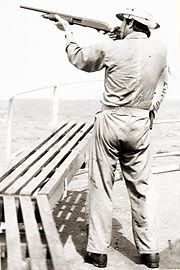
Willing crew members, employed by willing ship owners, could volunteer for the program. They would receive weapons training from the U.S. government and some type of official recognition, perhaps with special membership in the Navy or Coast Guard Reserves. Official status would no doubt allow the crew members to enter into more ports than they could as armed civilians, as well as allowing them weapons that they might not otherwise have access to. One or two crew members manning weapons such as the M2 .50 caliber machine-gun, M240 7.62mm machine-gun, Mk-19 automatic grenade launcher or even light weapons would not only deter pirate attacks but would give ships a fighting chance against them if they attack anyway. [The merchant seaman pictured above (circa 1984) is armed with a 12 gauge shotgun. While effective for repelling boarders close-in, it’s effective range of 50 yards would be outclassed by the heavy weapons used by today’s pirates.] The program could require that these weapons be securely stowed under lock and key until needed, as the FFDO program does.

This wouldn’t be the perfectly libertarian solution to the pirate problem. That solution would be the high-seas equivalent of “Vermont Carry,” wherein civilians carry whatever guns they want, no permit required. Unfortunately there’s no way other countries would recognize this right.

But a voluntary, government sanctioned program as described above, in addition to un-sanctioned arms bearing and passive security measures, would help to reduce piracy of American vessels. It would give civilians more flexibility in protecting their lives and their livelihood. That’s always a good thing.

National Servitude

There’s a visceral buzz in the country, or at least on tv, in anticipation of the “Change” coming in January when Obama will take the nation’s helm. What sort of change will he bring? I perused his official website http://www.change.gov/ to see.

On thing that caught my eye was the “America Serves” section of the site. This details Obama’s plan to help the citizenry to “serve” their country. Although it has been scrubbed of the specifics that were posted on it briefly (Obama wasn’t elected on specifics after all), the section still gives the bare-bones of his plan.

In “America Serves” the president-elect promises that “[t]he Obama Administration will call on Americans to serve in order to meet the nation’s challenges.” Obama not only plans to expand the national service programs AmeriCorps and Peace Corps, but will also conjure up several new service programs. A Classroom Corps will work in “underserved” schools. There will also be a new Health Corps, Clean Energy Corps and Veteran Corps.

Kids as young as middle school will be expected to perform 50 hours of community service per year. The federal government would withhold funds from local schools that don’t put their students to work the requisite number of hours (a fact missing from the newly sanitized site). College students will be expected to perform 100 hours per year. For their servitude, the older kids will be given a $4,000 tax credit toward college tuition.

If you think that a lifetime of hard work (wherein the average American works about 113 days per year to earn enough to pay their tax bill, essentially working involuntarily for the government during that period) might get you off the hook for continued “service,” think again. “Obama will encourage retiring Americans to serve” their community too, his site explains.

To be fair to Obama, the guy he beat also supports expanding national service. Among other programs, McCain praised the example of “City Year,” an AmeriCorps program that serves 18 cities. “City Year members wear uniforms, work in teams, [..] and gather together for daily calisthenics, often in highly public places such as in front of city hall,” wrote McCain. He enthusiastically explained that in another program, The National Civilian Community Corps, members “not only wear uniforms and work in teams… but actually live together in barracks on former military bases[.]” This idea is no doubt the authoritarian equivalent of Viagra for the militaristic McCain.

Since “national service” started out meaning compulsory military service, it’s ironic that the military has moved toward a more freedom-friendly volunteer force (as it should), while the politicians in DC seem determined to push compulsory service into new areas of civilian society.

Proponents claim that young participants will learn responsibility and a sense of duty. I would argue that the young will learn that they are mere vassals of the government, which holds preemptive claim over their very lives, rather than free citizens with unalienable rights and lives with intrinsic worth.

Perhaps President-elect Obama (and Senator McCain, who will no doubt vote for any Democrat national service proposal in Congress) should reread the 13th Amendment which states, “Neither slavery nor involuntary servitude, except as a punishment for crime whereof the party shall have been duly convicted, shall exist within the United States, or any place subject to their jurisdiction.” (Emphasis added.) It contains no provision exempting the federal government from it’s prohibition.

In my own day, our high school had already implemented an annual “Community Service Day” in which students did various odd jobs around the three small, rural towns that comprised our district. (And it didn’t even require goading from the federal government to do so.) Like compulsory service supporters contend, I DID learn valuable life-lessons from this. In fact, I learned two: 1)Spending hours trying to rake tiny bits of gravel up a steep, grassy incline with a widely-spaced leaf rake is a pointless, Sisyphus-like task. 2)People in positions of authority aren’t necessarily smart.

Global Warming

Lorne Gunter had a good article today about global warming at the National Post website. The article is titled “Thirty years of warmer temperatures go poof.” It contains several of the latest studies that are casting doubt on the whole theory of man made global warming. Among them:

“[I]n September, American Craig Loehle, a scientist who conducts computer modelling on global climate change, confirmed his earlier findings that the so-called Medieval Warm Period (MWP) of about 1,000 years ago did in fact exist and was even warmer than 20th-century temperatures.

“Prior to the past decade of climate hysteria and Kyoto hype, the MWP was a given in the scientific community. Several hundred studies of tree rings, lake and ocean floor sediment, ice cores and early written records of weather — even harvest totals and censuses –confirmed that the period from 800 AD to 1300 AD was unusually warm, particularly in Northern Europe.

“But in order to prove the climate scaremongers’ claim that 20th-century warming had been dangerous and unprecedented — a result of human, not natural factors — the MWP had to be made to disappear. So studies such as Michael Mann’s “hockey stick,” in which there is no MWP and global temperatures rise gradually until they jump up in the industrial age, have been adopted by the UN as proof that recent climate change necessitates a reordering of human economies and societies.

“Dr. Loehle’s work helps end this deception.”

I’m no scientist, so I won’t say for certain whether or not man made global warming is a serious threat. But given that just about every “fix” for it involves a heavy dose of socialism, loss of individual liberty and abandonment of the capitalist system that led to some of the greatest standards of living in human history, we better be darned sure about it before we start down that road.

Read Gunter’s full article here.

Should the Drinking Age Be Re-Examined?

On August 19th the Associated Press reported that University of Iowa President Sally Mason announced that “she won’t support an initiative to study lowering the drinking age.” This plan, called the Amethyst Initiative, already has the support of 129 chancellors and presidents of universities and colleges from across the country, who hope to stem binge drinking by young adults.

According to the Amethyst Initiative’s website the group “supports informed and unimpeded debate on the 21 year-old drinking age. Amethyst Initiative presidents and chancellors call upon elected officials to weigh all the consequences of current alcohol policies and to invite new ideas on how best to prepare young adults to make responsible decisions about alcohol use.”

One of the “current alcohol policies” referred to is the 1984 “National Minimum Drinking Age Act” which withholds 10% of federal highway funds from any state that sets its drinking age lower than 21. This flies in the face of 10th Amendment federalism, the idea that jobs not specifically assigned to the U.S. government by the Constitution belong to the individual states and to the people themselves. Regardless of what the drinking age should be, it’s really not the federal government’s call. [Libertarian presidential candidate Bob Barr addresses this very issue in his August 22 press release, which I read after I finished writing this post.]

It should be noted that signatories of the Amethyst Initiative don’t necessarily support lowering the drinking age, just “informed and unimpeded debate” about it. That makes President Mason’s refusal to sign even more puzzling. What head of a research university dedicated to the pursuit of intellectual truth could be opposed to THAT?

According to the AP article, President Mason says that she wouldn’t support the initiative because 19- and 20-year-olds can enter Iowa City bars and many underage patrons are drinking alcohol and getting drunk. What head of an institution with the previously mentioned attributes would use anecdotal evidence like that to justify unquestioning acceptance of an arbitrary (and arguably unconstitutional) national law. Even if her evidence wasn’t anecdotal, I can’t follow her logic that noncompliance with the current law is proof positive of its effectiveness and necessity. Of course I’m not as well educated as she is.

With or without President Mason, there seems to be growing interest in revisiting the drinking age debate. This is probably partially fueled by the ongoing war in Iraq. Most people see the inherent unfairness of sending legal-adults away to fight in dangerous foreign lands but denying them the ability to enjoy a cold beer if they make it home alive.

This has led several states to discuss allowing young adults serving in the military to drink before they turn 21. Another novel idea that’s been proposed would allow 18 year-olds to apply for a state-issued “drinking permit.” Any infraction by the permit holder would result in the permit immediately being revoked, leaving the young adult high and dry until he or she becomes 21. That would seem to be a good compromise between those who support lowering the drinking age and those who don’t. I know that if I’d have had a “license to drink” when I was 18, I would have jumped through all kinds of hoops to keep it.

Would it work? I don’t know. The point is, new and inventive ideas like these will never even be explored so long as the federal government tries to maintain its chokehold on the innovation of our nation’s 50 laboratories of democracy, the states. As long as leaders like President Mason unthinkingly support the status quo, the federal government has little incentive to release its death grip.

Less Smoke, Less Freedom In Iowa

On July 1st a statewide smoking ban went into effect here in Iowa. All so-called “public” places such as bars and restaurants are affected. The state’s casinos remain exempt from the ban proving that, even when the government does something as supposedly noble as protecting our health, special favors will go to those with the best political connections. The Iowa Bar Owners Coalition has sued to block the law. Their core argument is that the ban is bad for business.

It may indeed be bad for business, but Libertarians realize that there is another issue at stake. This ban (like most bans) is bad for freedom. It limits the freedom of business owners and patrons alike. Business owners should be free to run their businesses as they like and patrons should be free to light up, so long as it’s with the property owner’s blessing.

The argument that employees don’t enjoy the same choice as patrons on whether or not to enter a smoking establishment is invalid, unless the owner is utilizing slave labor. Employees must weigh the potential health risks of working around smoke against their economic circumstances, but the choice is indeed theirs to make. Life is a constant cost-benefit analysis.

The right to NOT enter smoking facilities was one that my wife and I exercised often when deciding where to dine with our young son. Apparently we aren’t the only ones who prefer smoke-free environments. One public poll showed that 70% of Iowans approved of some type of smoking ban. That is a significant share of the market. If more of these consumers had voted with their wallets, rather than seeking the coercive force of government to impose their will on others, then smoke-free bars and restaurants would already abound and a blanket smoking ban would be unnecessary.

Unfortunately, that’s not the situation we find ourselves in now. Some Libertarians choose to smoke. Some Libertarians choose not to. But all Libertarians want to live where everyone can breathe free.