Commission Says: "Regulate, Don’t Ban Everclear"

In my post Everclear and Present Danger I wrote that the Iowa Alcoholic Beverages Commission was mulling over whether to ban or increase regulations on the sale of highly concentrated alcohol (HCA), such as Everclear, after a Drake University student was hospitalized for alcohol poisoning from overindulging on it. Thursday the commission announced its recommendations. Although they did not recommend an outright ban on HCA, their recommendations can hardly be seen as a victory for those who support freedom of choice for Iowa consumers.

IABC’s website lists the commission’s four recommendations as follows:

  1. Limit products over 100 proof to one listed size [750 ml for Everclear]
  2. Look into drafting a rule to require registration (similar to pseudoephedrine) for products over 100 proof
  3. Education – investigate opportunities for education on HCA in college communities, as well as design educational materials to be applied to bottles for distribution.
  4. Limit products to no higher than 151 proof

Since the recommendations all increase government regulation, no doubt they will be pencil-whipped through and adopted quickly. (In contrast, any deregulation would require an uphill, tooth and nail battle.)

Supporters of regulating Everclear and other HCA’s no doubt would argue that the state has a compelling interest in doing so since the state often has to assist those who injure themselves or others or ruin their own lives abusing the stuff. That is another perfect example of how government “assistance” always begets government intrusion into our lives. (In order to get rid of the intrusion, we must get rid of the assistance as well.)

Another troubling aspect of such regulation, if we follow the government’s logic to its ultimate conclusion: If the state of Iowa can’t trust its adult citizens with such a mundane decision as what size bottle of booze to buy, how can they trust us with self-governance, arms bearing, child rearing or any other activity upon which a free society depends?

Everclear and Present Danger

In its never-ending quest to keep its citizens safe from their own actions, by treating them all like idiot children, the state of Iowa is investigating whether to ban or severely regulate the sale of Everclear, a highly concentrated alcohol (HCA) beverage. In other states Everclear is available up to 95% alcohol (190 proof), but last year Iowa officials limited Everclear sold in this state to 75.5% alcohol (151 proof).

The Iowa Alcoholic Beverages Commission recently held a meeting at Drake University to hear public opinion on the topic. In November 2009 a Drake student was rushed to the hospital for alcohol poisoning after consuming copious amounts of Everclear, creating the massive debate about the drink in Iowa. Since one young college punk got sick on the stuff, obviously the state needs to make new regulations to restrict the freedom of three million other Iowans. After all, it wasn’t that kid’s fault, the other kids “made” him do it.

Holding its hearing at any college campus, much less one recently rocked by the near-death of one of its students, is probably not the best place to hear dispassionate and well-reasoned arguments calling for government restraint. The Commission probably doesn’t want to hear those anyway.

If you would like the Commission to hear some, you can email comments on the topic to dusold@iowaabd and read public comments for and against increased regulation of HCA’s at the Iowa Alcoholic Beverages Commission’s website.

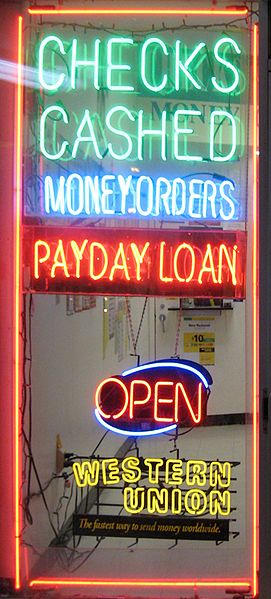
Business Bogeyman Du Jour: Payday Lenders

There appears to be some momentum in the upcoming Iowa legislative session to restrict payday loans in the state. Sometimes called a “payday advance,” payday loans are short-term (usually two-week) loans where the borrower issues a post-dated check to the lender.

According to the Community Financial Services Association of America (CFSA), the industry organization for payday lenders, the typical fee charged by payday lenders is $15 per $100 borrowed. So a customer wishing to borrow $100 would write a check to the lender for $115. The lender would then give the borrower $100 cash. Two weeks later the lender would cash the customer’s check, keeping the extra $15.

This simple arrangement has managed to stir the ire of legislators across the country, including Iowa. State Senator Joe Bolkcom, D-Iowa City, head of the Senate Ways and Means Committee, said, “The payday loan industry is our local counterpart to the crooks on Wall Street.” Other critics, such as Tom Chapman, executive director of the Iowa Catholic Conference, point out that interest rates on payday loans can run as high 400 percent. “We believe these types of interest rates are unjust and should be outlawed,” said Chapman. “Instead of promoting the financial stability of consumers, the system actually creates a financial incentive in the failure of Iowa families rather than their success.”

But CFSA’s website points out: “The typical fee charged by payday lenders is $15 per $100 borrowed, or a simple 15 percent for a two-week duration. The only way to reach the triple digit APRs [annual percentage rates] quoted by critics is to roll the two-week loan over 26 times (a full year). This is unrealistic considering that many states do not even allow one rollover. In states that do permit rollovers, CFSA members limit rollovers to four or the state limit—whichever is less.”

If a payday loan customer somehow did carry his loan for a whole year, how would that APR compare to other alternatives to low-income consumers? Again from the CFSA:

$100 payday advance with a $15 fee = 391% APR
$100 bounced check with $54 NSF/merchant fees = 1,409% APR
$100 credit card balance with a $37 late fee = 965% APR
$100 utility bill with $46 late/reconnect fees = 1,203% APR.

So compared to these and other “quick cash” alternatives, like pawn shops, payday loans are not terribly out of line. If consumers with poor credit ratings could get small, quick loans elsewhere (such as conventional banks) they no doubt would. Since the payday lenders offer an apparently popular service that consumers can’t get elsewhere, why shouldn’t they be able to charge a premium price for it?

So, what is the problem? The words of State Representative Janet Petersen, D-Des Moines, head of the House Commerce Committee, who favors new restrictions on payday lenders, offer some clues. Petersen says that, by restricting payday loans, “lenders will be forced to take some responsibility for ensuring that Iowans don’t end up in a vicious debt cycle.” [Emphasis added.]

In the minds of people like Peterson, consumers are ignorant sacks of meat that mindlessly throw their money to greedy, unscrupulous businessmen (in this instance payday lenders). Without smart and benevolent legislators like Peterson and Bolkom to protect them every moment of the day, the people they represent are little more than sheep to be shorn by capitalist predators. If anyone is to “take some responsibility” for the lives of Iowans, it must be the lenders (and the legislators) who apparently draw from a more intelligent gene pool than mere citizens.

Experience in other states has shown that restrictions on payday lenders result in fewer of those lenders. This would obviously mean fewer payday loans available to Iowans. Therefore, restricting payday lenders might allow liberal lawmakers to slap each other on the back for helping the “little guy,” but without reducing the NEED for or providing some new alternative to payday loans, they have only succeeded in worsening the little guys’ circumstances.

State Cuts 10%; Culver Fiddles

I couldn’t help but notice the irony in the title of O. Kay Henderson’s Radio Iowa report titled, “Agencies submit cuts; governor rides rails.” That sounds pretty similar to “Rome burns; Nero fiddles.”

I’m not saying that the current state budget cuts are as bad as Rome burning, of course. As far as I’m concerned they should cut the budget even more. But I do appreciate the irony in the fact that as current state services are being cut, Governor Culver is joyriding on a train, showing where he wants to dump even more taxpayer money to feed his railroad fetish.

Not wanting to prioritize, Culver made the 10% cut across-the-board. Cuts would include laying off 44 law enforcement officers (including 20 State Troopers, whose manpower was already at a 45 year low) and a fire inspector at the Dept. of Public Safety. The Quad City Times reports that the cuts will also have a “devastating impact” on the function of Iowa’s court system.

In terms of layoffs, the Department of Corrections will be the hardest hit with 515 jobs lost. “The impact will affect all departments in every level of service,” said corrections officials. “A reduced workforce will create serious safety concerns for the public, staff and offenders within the maximum security facility. In line with the security concern is the closing of four towers.”

Cops, courts and corrections sound like legitimate core functions of the state government to me. Should they really be cut at the exact same percentage as, say, the Department of Cultural Affairs or Iowa Public Television?

“The other neat thing we’re doing is we’ll be able to invest in the depots and modernize them,” Culver states in the Radio Iowa article. One such depot is the one in Osceola which is currently undergoing a $600,000 renovation. “And they’re bringing that historic place, you know, back to life,” said Culver.

Play your fiddle, Sir. Do you know “I’ve Been Working On the Railroad?”

Time To Wrap Iowa’s Show Biz Giveaway

Just about everyone in Iowa knows that the Iowa Film Office (IFO) has been embroiled in scandal lately. The office issues tax credits to filmmakers who film in Iowa. By August, IFO had issued more than $31 million in such credits. Unfortunately, some filmmakers have used their money to buy themselves fancy cars, rather than hire Iowans, and the whole operation is shot through with accounting irregularities and poor record keeping.

The whole mess got so bad that Governor Culver actually had to put down his paddleball, amble over and fire somebody. Of course, Culver’s political rivals in the Republican Party are capitalizing on the scandal. They could run the IFO better, they contend. Other critics say that the IFO needs stricter oversight. But should IFO and other similar incentive programs exist at all?

There are nut-and-bolts reasons that indicate that they shouldn’t. A study by New Mexico State University found that for every dollar that N.M. spent on it’s film program, it got back 14 cents in tax revenue. (The state of N.M. claims it gets $1.50 back.) The Wisconsin Dept. of Commerce found that for every dollar that it invests in it’s film program, it gets back $1.70. For other economic development programs, the return on each dollar invested was said to be $161.

Victor Elias with the nonpartisan Child and Family Policy Center has studied Iowa’s film tax credit. He says that there is little evidence that the program does much of anything. “I couldn’t even figure out how many jobs this creates,” said Elias. “Whether they were full-time jobs or part-time jobs. And a film shoot only lasts for so long, so we’re not talking about permanent jobs.” $31 million is a lot of hard-earned taxpayer dollars to invest on hope alone.

Even if the incentive program was well-run and got a return on the investment, it (and special incentive programs for other industries) don’t really make sense. While it may now be customary for state and local governments to offer special goodies to get targeted businesses to relocate here, it comes at the expense of people and businesses who have already invested their time and money here.

According to Iowa’s Tax Education Foundation, Iowa has the highest corporate and personal income taxes among it’s neighboring states. Some have ranked Iowa as one of the worst states to start a business. Does it make sense to offer monetary incentives to get businesses to locate here, while simultaneously driving established businesses out?

It would make more sense to implement policies making the state attractive to new businesses and existing ones as well. Lowering state taxes and red tape would be conducive to all commerce in Iowa.

The bottom line is that there is no cash incentive that government can offer to new business that it didn’t first take away from the people and industry already here. The state needs to forget the bribes and just get out of the way.

Iowa Getting Railroaded?

My three-year-old boy loves his Thomas the Tank Engine train set. I think that all kids (or at least all the boys) go through “the train stage,” but they grow out of it. Those who don’t outgrow it go into politics.

Iowa Governor Chet Culver, for instance, has been riding around in his own special choo-choo to promote expanded passenger rail service in Iowa. (Republican blogger Krusy Konservative points out that Iowa Interstate Railroad [IAIS] is letting Culver use their train and Culver’s I-Jobs program is funding two railroad bridges for IAIS. Quid pro quo?)

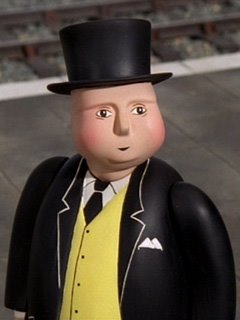
Perhaps Culver foresees a future for himself as Iowa’s own Sir Topham Hatt [pictured], Thomas’ railroad controller. (The resemblance is uncanny.) But unlike the railways on the fictional Isle of Sodor, Culver’s railroad plans will cost Iowa taxpayers some very real cash.

Spurring the current interest in rail travel is some $8 billion in federal “stimulus” funds slated to go toward high-speed and intercity passenger rail projects. Governors, at one time proud leaders of sovereign states, are fighting each other to snap up these scraps of borrowed money from beneath the federal table.

The purpose of these funds, according to Obama’s Transportation Secretary Ray Lahood, is “to coerce people out of their cars,” presumably lowering demand for those cars. This at a time when American automakers are being propped up with taxpayer money because their failure would have supposedly catastrophic effects on the U.S. economy. Does Obama’s left hand know what the right one is doing?

Another reason is the supposed environmental benefits of rail travel. For the money, however, other means of public transportation are better. Buses average 206.6 passenger-miles per gallon of fuel, while intercity rail (Amtrak) gets 67 passenger-miles per gallon. Buses put out 50 grams of CO2 per passenger-mile while intercity rail puts out 186 grams per passenger-mile. Buses also would not require costly upgrades to the road system.

But back to Culver. He recently signed an agreement with Illinois Governor Pat Quinn to coordinate efforts to create passenger rail service from Chicago to Iowa City and Chicago to Dubuque. The necessary track improvements for the Iowa City route alone (not counting station construction) are estimated to cost Iowa about $32.5 million.

But this is an official estimate, which history shows is usually artificially low in order to garner public support for a project (and ridership estimates are usually inflated). Research by Public Interest Institute shows that urban passenger rail projects have averaged about 40% higher than the projected cost. That would put the price about $45.5 million.

It’s unclear if the feds will give Iowa that much. Whatever wasn’t paid with federal funds would probably be financed with state bonds (debt). There would be even more ongoing costs to Iowa taxpayers. The rail service would be run by that model of efficiency, Amtrak. On the East Coast (where Amtrak “works”), for instance, Amtrack’s Boston to DC line LOSES $2.30 per passenger. Its Chicago to Detroit line loses $72 per passenger. States are expected to cover these loses in regional corridors.

The Iowa taxpayer would be adopting Amtrak and subsidizing its riders. According to Public Interest Institute, “the main patrons of high-speed trains will be the wealthy and downtown workers, such as bankers, lawyers, and government officials[…].” The working class will be paying for some affluent suburbanites to feel trendy and eco-friendly while spending their weekend in Chicago.

I have nothing against rail travel per se. If some smart entrepreneurs can figure out a way to provide affordable passenger rail service in Iowa, without hooking the taxpayer up to the milking-machine or putting my unborn grandchildren further in debt to the Chinese, I’d be all for it.

But in the mean time, if Governor Culver feels like joyriding on a train I suggest he head up to Boone Iowa, where he can ride on the Boone & Scenic Valley Railroad. A non-profit, this railroad is supported by voluntary contributions from Iowans, not taxation and public debt. And if he feels he absolutely must have his own railroad, for just a fraction of that $45.5 million I bet my son would sell him a Thomas & Friends Trackmaster set, slightly used.

Privatize Honey Creek Resort

We libertarians are sometimes criticized as having all these “big ideas” about limited government and personal freedom but lacking small, practical steps to implement them. Here’s one idea that I think fits the bill: Privatize Iowa’s Honey Creek Resort State Park.

Billed as Iowa’s first “destination park,” Honey Creek Resort opened for business last September. The luxury resort, located on Iowa’s Rathun Lake, was built and is owned by the Iowa Dept. of Natural Resources. The resort boasts 105 spacious rooms in its “great lodge,” 28 resort cabins, a pirate-themed indoor water park, an 18-hole golf course, 50-boat slips, boat launch, fishing pier, conference center, RV park, and a full-service restaurant and lounge. Whew!

The resort park has about 138 employees, making it one of Appanoose Countys largest employers, impacting the economy of southern Iowa. This is of course why the state government built the place, for the economic impact.

But what is this impact? Economist Henry Hazlitt teaches: “The art of economics consists in looking not merely at the immediate but at the longer effects of any act or policy; it consists in tracing the consequences of that policy not merely for one group but for all groups.” We need to look beyond 138 employed persons in southern Iowa and any immediate tax revenues of the resort.

What is the resort’s impact on other similar businesses in the area? A quick Google search identified 10 hotels, 4 golf courses, 3 RV parks and 4 private campgrounds near Moravia Iowa (where the resort was built). The state has created a tax-payer subsidized business to compete directly with them.

This impact stretches much further since the resort obviously hopes to draw tourists from all over the state as well as from out of state. A day a family stays at the resort is a day that they don’t stay in a bed and breakfast in Dubuque or a day they don’t spend shopping at Coral Ridge Mall or enjoying Arnold’s Park or Adventureland Park, making those enterprises less profitable. The state has not “created” 138 jobs and a new revenue stream, it has merely borrowed them from private businesses throughout the state.

This is only the direct impact. More jobs and money will be sucked from elsewhere in the state via taxes. The state of Iowa has pumped atleast $8 million directly into the project. In 2008, Senator Chuck Grassley requested an additional $7.1 million in federal funds for projects around Rathbun Lake. In true government fashion, delays and cost overruns were frequent. Construction of the golf course alone went 150% over budget.

The project also racked up about $33 million in public revenue bonds to pay for construction. These will have to be paid back. Early projections from 2007 (before the economy tanked) showed that the resort should be showing a small profit by the third year of operation (2011). Since the resort will make the bond payments out of it’s net income, every year that the resort doesn’t break even the Iowa taxpayer will have to make the bond payments.

All this tax money is perhaps diverted from more needful government projects at a time when the state is having difficulty paying the bills. But the money was originally diverted from its rightful owners: the people of Iowa. Every dollar taken from us to fund frivolous projects is a dollar not spent or invested in our own communities to create jobs and build dreams.

So when we see the “massive mosaic fireplace” of Honey Creek’s “great lodge,” before we marvel at its grandeur, let us take Hazlitt’s advice and use our mind’s eye to see “the possibilities that have never been allowed to come into existence. [Let us] see the unbuilt homes, the unmade cars and washing machines, the unmade dresses and coats, perhaps the ungrown and unsold foodstuffs. […] What has happened is merely that one thing has been created instead of others.”

Honey Creek Resort is already built. Iowa should sell it to private investors. Let them assume the debt and compete against Iowa’s other businesses on equal footing, without the coercive and confiscatory power of government tipping the scales in the resort’s favor.

Armed Mariners Bill Introduced In U.S. House

In November of 2008 (before the merchant vessel Maersk Alabama was captured by pirates), I suggested that the Federal Government could aid in arming ship crews. I stated that while shipping companies certainly had the right to arm their crews themselves, many foreign ports were hostile to the idea of armed civilians. I suggested that sanctioning of certain armed sailors by the American government might ease the fears of some squeamish governments and provide legal cover for armed seaman.

In a similar vein, U.S. Representative Frank LoBiondo (R-NJ) has recently introduced H.R. 2984, the “United States Mariner and Vessel Protection Act of 2009.” The stated purpose of the bill is “to assist in the defense of United States-flag vessels against piracy and to ensure the traditional right of self-defense of those vessels against piracy.”

Rep. LoBiondo, who is on the U.S. House of Representatives Coast Guard and Maritime Transportation subcommittee, said of his bill, “Our merchant marine fleet is increasingly under attack from unlawful individuals and rogue groups that seek to disrupt commerce, seize U.S. and foreign crews, and instill fear on international waters. It is only appropriate that our fleets be legally allowed to defend themselves from these violent encounters. This common-sense legislation is a necessary step in empowering U.S.-flagged vessels to protect their crews and cargo.”

The bill would direct the appropriate U.S. Secretary to “issue regulations establishing standards and circumstances under which an individual is authorized to use force (including lethal force) against an individual in the defense of a vessel against piracy.”

It would also limit the liability of ship owners, operators, and individuals for damages arising during the defense of a vessel (except in cases of gross negligence or willful misconduct). To achieve this automatic limited liability when using firearms, a mariner would have to have “completed training certified by the Coast Guard for use of firearms aboard vessels.” This would help calm the fears of shipping companies that are reluctant to arm their crews for fear of future lawsuits.

The bill would also allow the U.S. Coast Guard to deploy “maritime safety and security team[s] on a temporary basis, […] to deter, protect against, and rapidly respond to acts of piracy against vessels […] in international waters.”

Perhaps most importantly, the bill would authorize the appropriate U.S. Secretary to “work through the International Maritime Organization to establish agreements to promote coordinated action among flag and port states to deter, protect against, and rapidly respond to acts of piracy against the vessels of, and in the waters under the jurisdiction of, those nations, and to ensure limitations on liability similar to those established by […] this Act.” [Emphasis added.] In other words, the U.S. government would try to win legal protections for armed crews even from foreign governments.

I believe this law would be authorized by the U.S. Constitution under Article 1, Section 8, which gives Congress power “To define and punish Piracies and Felonies committed on the high Seas,” and “To provide for organizing, arming, and disciplining, the Militia,” and “To regulate Commerce with foreign Nations[.]”

So long as it doesn’t become the ONLY way that ship owners are allowed to arm their crews, I think this bill is a good bill that would help reduce piracy against U.S. merchant vessels.

This Land Is Your Land, But Now It’s OUR Land

Eminent domain abuse in Iowa?

The fact that Iowa passed a law affording property owners additional protections, in response to the landmark Kelo decision by the U.S. Supreme Court, may be of little comfort to about two-dozen Iowa families who may soon be forced off their own land.

The high court’s ruling in Kelo v. City of New London was handed down June 23, 2005. In it’s decision the court ruled that local governments could take land from one private property owner, just to give it to another, who may generate more tax revenue with the property. The court ruled that it was permissible under the “takings clause” of the Fifth Amendment.

That clause reads, “nor shall private property be taken for public use, without just compensation.” Before the Kelo decision, “public use” was generally understood to mean something open for the use of the general public, such as roads or schools. After Kelo, local governments could take private land from one owner (a farmer for instance) and give it to another (a real estate developer perhaps). The decision caused considerable public backlash across the country.

Here in Iowa, the Legislature responded by passing an anti-Kelo law in 2006 which tightened the state’s laws protecting landowners. Then-governor Tom Vilsack vetoed the bill, but the Legislature overrode his veto by wide margins. (After sticking his thumb in the eye of Iowa’s farmers and property owners on his way out of office, Vilsack now serves as Obama’s Secretary of Agriculture.) Three years later, Iowa’s eminent domain law may face it’s first real test.

Recently the Clarke County Reservoir Commission voted to condemn farmland in order to build a new 900-acre reservoir north of Osceola. Osceola City Administrator Bill Kelly said that the area’s current reservoir has about 7 percent capacity remaining. When that’s completely tapped, it may hamper efforts to develop a new hotel and upscale subdivision that the town wants. The reservoir would also have a 300-foot beach, boat ramp and campsites, which supporters hope would help draw tourists to the area.

It sounds like a nice idea, but Clarke County has the same dilemma that Harvey Corman’s character did in “Blazing Saddles” when he said, “Unfortunately there is one thing standing between me and that property: the rightful owners.” About two-dozen rightful owners actually.

The landowners (many of whom live on the soon-to-be-submerged land) and their friends don’t plan on going down without a fight. Opponents of the lake allege that supporters have exaggerated the area’s water needs. Either way, the project puts the needs of future development over the welfare of current tax-paying property owners.

Representative Jodi Tymeson, a Winterset Republican and reservoir opponent, points out that many members of the Clarke County Reservoir Commission are unelected representatives of local developers and a local water association, who stand to gain from the project. “Iowans understand eminent domain for real public uses, but private property ownership is just basic to our individual liberties,” said Tymeson.

The project sidesteps Iowa’s anti-Kelo law since it does not take land and give it directly to private developers. Instead it takes the land and uses it for the direct benefit of those developers, at the expense of the rightful owners. “This is a deliberate attempt to get around our law,” said Rep. Jeff Kaufmann, R-Wilton, who helped pass the 2006 law.

The county government has deeper pockets than the rural residents that it seeks to dispossess, leaving Kaufmann hoping that an attorney might provide pro bono legal services for the group. If this lake project proceeds, opponents fear that it may encourage the use of eminent domain for other development and recreation projects. “I’m not sure anyone in Iowa is safe,” Representative Tymeson said.

This project may not be as an egregious case of eminent domain abuse as that which is now enshrined by the Kelo decision, but that doesn’t mean it’s fair.

Clean Sweep!

All 5 of Iowa’s U.S. Representatives Co-Sponsor Ron Paul’s “Audit the Fed” Bill.

On June 11, U.S. Representative Bruce Braley became the final member of Iowa’s U.S. House delegation to co-sponsor HR 1207, the “Federal Reserve Transparency Act of 2009.″ Iowa’s three Democrat and two Republican representatives have all now co-sponsored this important legislation.

The bill merely calls for the Comptroller General (America’s chief financial inspector and head of the Government Accountability Office [GAO]) to conduct an audit of the Federal Reserve System by the end of 2010 and report the findings to Congress.

The Federal Reserve (or “Fed”) is America’s central banking system. It is a a quasi-public and quasi-private organization (an unholy union of government and private interests). It was signed in 1913 by President Woodrow Wilson, who supposedly later lamented, “I am a most unhappy man. I have unwittingly ruined my country. […] The growth of the nation, therefore, and all our activities are in the hands of a few men. […] No longer a government by free opinion, no longer a government by conviction and the vote of the majority, but a government by the opinion and duress of a small group of dominant men.”

According to its website, the Federal Reserve’s duties fall into four general areas:

  1. Conducting the nation’s monetary policy by influencing the monetary and credit conditions in the economy in pursuit of maximum employment, stable prices, and moderate long-term interest rates.
  2. Supervising and regulating banking institutions to ensure the safety and soundness of the nation’s banking and financial system and to protect the credit rights of consumers.
  3. Maintaining the stability of the financial system and containing systemic risk that may arise in financial markets.
  4. Providing financial services to depository institutions, the U.S. government, and foreign official institutions, including playing a major role in operating the nation’s payments system.

You would think that an institution with so much responsibility to and power in the U.S. economy would be run openly and transparently. Not so. To understand why the audit of the Fed is necessary, here are the words of the bill’s author Congressman Ron Paul, when he arose to introduce the bill to Congress:

I rise to introduce the Federal Reserve Transparency Act. Throughout its nearly 100-year history, the Federal Reserve has presided over the near-complete destruction of the United States dollar. Since 1913 the dollar has lost over 95% of its purchasing power, aided and abetted by the Federal Reserve’s loose monetary policy. How long will we as a Congress stand idly by while hard-working Americans see their savings eaten away by inflation? Only big-spending politicians and politically favored bankers benefit from inflation. […]

Since its inception, the Federal Reserve has always operated in the shadows, without sufficient scrutiny or oversight of its operations. […] The Federal Reserve has, on the one hand, many of the privileges of government agencies, while retaining benefits of private organizations, such as being insulated from Freedom of Information Act requests.

The Federal Reserve can enter into agreements with foreign central banks and foreign governments, and the GAO is prohibited from auditing or even seeing these agreements. Why should a government-established agency, whose police force has federal law enforcement powers, and whose notes have legal tender status in this country, be allowed to enter into agreements with foreign powers and foreign banking institutions with no oversight? […]

More importantly, the Fed’s funding facilities and its agreements with the Treasury should be reviewed. The Treasury’s supplementary financing accounts that fund Fed facilities allow the Treasury to funnel money to Wall Street without GAO or Congressional oversight. […]

The Federal Reserve Transparency Act would eliminate restrictions on GAO audits of the Federal Reserve and open Fed operations to enhanced scrutiny. We hear officials constantly lauding the benefits of transparency and especially bemoaning the opacity of the Fed, its monetary policy, and its funding facilities. By opening all Fed operations to a GAO audit and calling for such an audit to be completed by the end of 2010, the Federal Reserve Transparency Act would achieve much-needed transparency of the Federal Reserve. I urge my colleagues to support this bill.”

And support it they have. HR 1207 currently has 223 co-sponsors in the House of Representatives, Republicans and Democrats alike. That is over half of all representatives. With that much support, it would appear likely that House leadership will allow the bill to be debated and voted on.

Attention now turns to the Senate where the bill’s companion bill, S.604 (Federal Reserve Sunshine Act) has already been introduced. The Fed intends to hire a veteran lobbyist to urge Congress to vote against the audit. The people, therefore, need to urge them to vote FOR the bill. Contact information for Iowa’s two U.S. Senators is below. Ask them to co-sponsor S.604.

Sen. Charles Grassley (R): Website Contact Page or Mail to 135 Hart Senate Office Building, District of Columbia 20510-1501 D.C. Office Phone: (202) 224-3744 Des Moines Office Phone: (515) 288-1145

Sen. Tom Harkin (D): Website Contact Page or Mail to 731 Hart Senate Office Building,District of Columbia 20510-1502 D.C. Office Phone: (202) 224-3254 Des Moines Office Phone: (515) 284-4574