Review: "The Soviet Story"

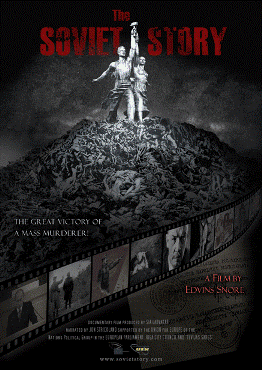
At the Libertarian Party of Iowa’s state convention in March the keynote speaker, Dr. Yuri N. Maltsev, recommended watching the 2008 documentary “The Soviet Story.” The film studies the fascinating relationship and similarities between the Soviet Union (USSR) and Nazi Germany. I just watched it and I too highly recommend the film. If you watch it, you will learn a lot about communism and our World War Two ally that they didn’t teach you in school. It is available on Amazon video, YouTube and probably elsewhere.

The film first spends some time illustrating that communism and Nazism are not as different as many think. It shows how both are largely based on the writings of Marx & Engels. You’ll see early Nazi symbology with the swastika literally between the hammer and sickle.

The film highlights the many mass extermination atrocities committed by the Soviet Union including The Holodomor, the deliberate starvation of 7 million Ukrainians in one year alone. The film attributes some 20 million total murders to Soviet communism over the course of its history. In his book “The Great Terror,” researcher Robert Conquest puts that number at about 15 million. Whichever, it’s a lot.

It’s important that we remember and understand this bloody history, lest we repeat it. While the crimes of the Nazis have rightly been widely denounced and their ideology discredited as a result, the same can’t be said for the communists. You can say, “Soviet communists made mistakes and had some excesses, but they were mostly right,” among Western intelligentsia today, whereas saying the same thing about the Nazis would get you booed out of the room. While modern Germany condemns the Nazi regime, Vladimir Putin, current ruler of Russia, calls the collapse of the Soviet Union “the greatest geopolitical catastrophe of the [20th] century.” Most American millennials wouldn’t know to disagree with him.

The film also spends significant time on the wartime collaboration between the USSR and Nazi Germany. I was aware the two countries had a non-aggression pact with each other initially, but was unaware of the degree that the two regimes actively aided each other. There were plans on which country would get to consume which smaller countries, Poland was split between the two, the Soviets let the Nazis use their naval base to stage their invasion of Norway, the Soviet NKVD (secret police) taught the Nazi Gestapo torture techniques and how to set up concentration camps, and the Soviets provided food and materials to the Nazi war machine. When many Jews fled to the USSR to escape the Nazis, the NKVD rounded them up and turned them over to the Gestapo.

It’s obvious that Stalin and Hitler were planning on carving up Europe for themselves before the two monsters began quarreling. This is not the image of our wonderful World War Two ally that we are often presented with in the West.

Please check out this film! You’ll learn a lot. This is a Latvian film (Latvia being one of the three “Baltic states” that didn’t appreciate their time under the boot of Soviet oppression) and there are several different versions of the film out there in different languages. Make sure you grab one in English.

Book Review: "The FN FAL Battle Rifle"

When I received a signed copy of my brother Bob’s latest book “The FN FAL Battle Rifle,” a book about the Cold War rifle known as the “right arm of the Free World,” of course I was excited to read it.  Bob is a former active duty Cavalry Scout, Desert Storm vet, forestry worker, and still an avid shooter and gun collector living in Montana. Suffice it to say he has a passion for firearms and military history.

Since I’m not quite the firearms technician nor military historian that my brother is, part of me was a little worried I might find parts of a “biography” of a rifle a little dry. However Bob kept the book quite interesting and accessible to us laypersons while still providing plenty of detail for gun wonks.

For many American gunnies the Cold War was a face-off between the American M16 and the Soviet AK-47. However the 7.62x51mm NATO Fabrique Nationale (FN) Fusil Automatique Léger (FAL) eventually equipped over 90 Western nations around the world, earning it the aforementioned nickname. The history of the FAL is a history of every bushfire war that popped up during the Cold War. The FAL showed up in most of them, officially or not. The FAL’s storied history reaches a crescendo during the 1982 Falklands War where both sides (the British and the Argentinians) used the FAL against each other. Bob’s book chronicles the whole history.

First Bob walks us through the development of the FAL right after WW2. Besides the technical aspects of developing the new weapon there was the political quarreling behind adopting a new NATO standard rifle round. The book then provides a brief rundown of the adoption and modifications made by each of the major nations issuing the new FAL. There is a section running down the major accessories adopted for the FAL including magazines, optics, rifle grenades and bayonets.

In the next section Bob points out that although the FAL was (thankfully) never used for its intended role of repelling a Soviet invasion of Western Europe, “[i]t did, however, give excellent service in battle around the world in many smaller wars and numerous insurgencies.” Bob gives a brief history of the FAL’s major use in combat by the British army from the 1948 Malayan Emergency to the 1991 Persian Gulf War and by other nations in African and Latin American bush wars, the Arab-Israeli Wars, the Indo-Pakistani Wars, and Vietnam. The FAL still pops up in combat zones today.

The book then has a breakdown of the capabilities of the FAL’s 7.62x51mm NATO cartridge as well as an analysis of the strengths and weaknesses of the FAL system itself. Bob also compares and contrasts the FAL with its two a main contemporary rival battle rifles the German G3 and American M14. The book is chock full of historical photographs, graphs, as well as several original historical battlescene paintings created specially for the book by British artist Steve Noon.

I thoroughly enjoyed taking the stroll down Cold War “memory lane” that “The FN FAL Battle Rifle” provided. I think anyone with a bit of interest in weapons and/or military history will enjoy it as well. I recommend you check it out.

1941

1941
by Benjamin R. Cashner

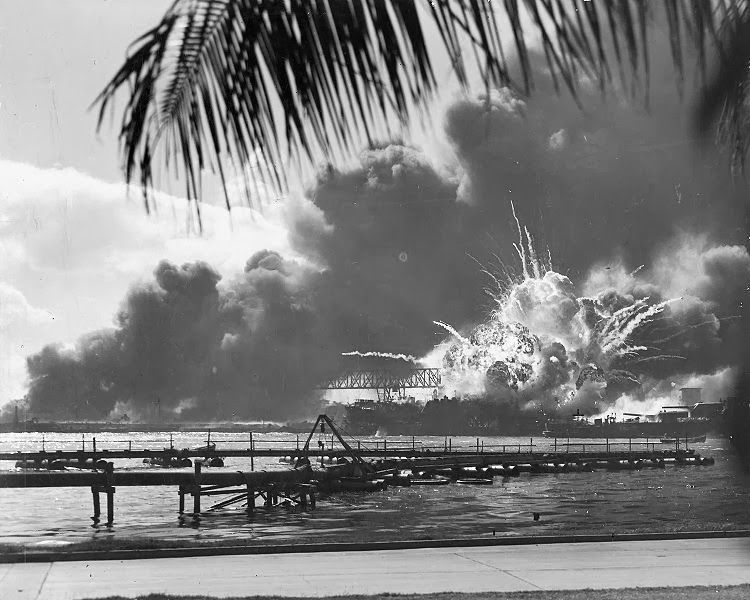
It was December seventh, he remembered well.
It brought the world to the brink of hell.
They came in low and dropped their bulk,
they reduced his ship to a burning hulk.

He says he can still here the sirens blare
on the whistling winds of winter’s air.
But that was a long time ago, that fateful day,
so long ago it seems like yesterday.