Pro-Freedom Bills In Des Moines- Feb. 2015

Iowa State House; Des Moines, Iowa; June 30, 2013.JPG
There are some good bills floating around in the Iowa legislature this year that could use our support.
Gun Rights Bills
First up are four pro-gun owner bills and the synopsis for each one provided by the Iowa Firearms Coalition (IFC).
House File 45 – Emergency Powers This bill guarantees that Iowan’s Second Amendment rights remain intact during times of public emergencies, when the ability to protect ourselves and our loved ones is needed most. In short it would keep Hurricane Katrina style confiscations from happening here in Iowa.

House File 59 – Preemption Clarification
HF59 amends IA Code 724.28 which says local municipalities and governing bodies shall not preempt or supersede state firearms law. Iowa has had a preemption law for almost 25 years, but every year many local municipalities continue to try to work around this law and illegally in fringe on Iowan’s rights. This bill would strengthen the current code and provide citizen’s rights greater protections from over zealous governing bodies.

House File 92 – Stand Your Ground
This legislation would remove a person’s “duty to retreat” from an attacker in any location.  This would allow law-abiding citizens to protect themselves or their family anywhere they are lawfully present.  This legislation would also expressly enhance the protections against criminal prosecution and civil lawsuits when justifiable force is used.

House File 99 – Repeal the Youth Shooting Ban 
Currently anyone under the age of 14 is strictly prohibited from holding or shooting a handgun in Iowa – regardless of whether or not that minor is under parental supervision. HF99 would amend the state code to allow a person under 14 to lawfully shoot a handgun, with proper supervision, as long as their parent, guardian, or spouse who is 21 years of age or older has provided consent.

IFC maintains an Legislative Action Center site where you can send a pre-written message to your Iowa representatives urging them to support these bills.
Contraband Bills
If polls are right, about 38% of you reading these words have tried marijuana. Most of you did NOT end up living in a van down by the river or murdering your parents with a pitchfork as pot alarmists would have everyone believe. And although fireworks have been illegal in Iowa since the 1930’s, many Iowans bootleg them in and light them off.
There are three bills that seek to lessen the nanny state’s grasp on these relatively harmless, yet illegal activities. Reducing penalties for pot would free up jail space for violent bad guys, saving the state money. Legalizing fireworks would supply the state with an additional source of tax revenue.

Reduces marijuana possession penalties involving up to 28.5 grams of marijuana from a criminal misdemeanor (punishable by up to six-months in jail and a $1,000 fine) to a simple misdemeanor punishable by a $300 fine. 
 Reduces marijuana possession penalties involving up to 5 grams of cannabis. Members of the Senate Judiciary Committee voted 13 to 1 in favor of this legislation, which now moves on to the full Senate for debate.
You can go to the NORML website to send a pre-written message of support for these bills to your Iowa legislators here.
This would legalize certain retail fireworks for purchase by Iowa consumers.
Freedom of Movement
This bill would raise the speed limit to 75 on some of Iowa’s rural interstate highways.
This bill would prevent Iowa counties and cities from adopting ordinances barring 19- and 20-year-old adults from bars. This would most notably shoot down Iowa City’s 21-ordinance. I wrote about why denying these legal adults their rights to liberty, peaceable assembly and pursuit of happiness was fundamentally wrong here.
Be sure to let your Iowa State Representative or Senator know how you feel about any of these potential  laws above.


Floods of 2008 Revisited

It was 5 years ago today that flood waters crested in Cedar Rapids Iowa during the historic flood of ’08. Here were my thoughts at the time. Originally posted a month later on 8-13-08.

A winter of near-record snowfalls here in Iowa, gave way to a spring in which we had our biggest tornado since 1976, wiping one town off the map and killing 7 people. Then, in July, Iowa saw its worst flooding since the Genesis deluge. This year’s immoderate weather has given me ample reminder of why I hate Iowa. The response of Iowans has reminded me why I love it.

Flood waters on the Cedar River first hit the cities of Waterloo and Cedar Falls, knocking down bridges and flooding downtown areas. It then hit smaller towns like Vinton and Palo, flooding nearly the entire town, and lumbered onward toward the population center of Cedar Rapids.

Not to be outdone by rising flood waters, an Iowa twister suddenly lashed out, tearing through a Boy Scout camp, killing 4 young scouts and sending many more to the hospital.

Flood waters crept up on downtown Cedar Rapids engulfing first the “100 year flood plain,” then the “500 year flood plain.” Sandbagging the downtown area quickly proved to be futile and it was surrendered to the river. More than 3,900 homes had to be evacuated, creating over 24,000 homeless evacuees. Over 1300 city blocks were submerged under a river crest of 31.8 feet. (Flood stage is 12 feet.)

Damage to Iowa’s lifeblood of crops was estimated at $2.7 billion. Property damages in Cedar Rapids alone were estimated at $736 million. Many talking heads on TV compared the Iowa floods to Hurricane Katrina.

There is one big difference between the two disasters though: Unlike New Orleans Mayor Ray Nagin, Louisiana Governor Kathleen Blanco and their ilk, our local officials didn’t stand there wringing their hands, wondering what George Bush was going to do about it. When the flood waters came, local officials, non-profit organizations and private citizens alike all rolled up their sleeves and did what they could.

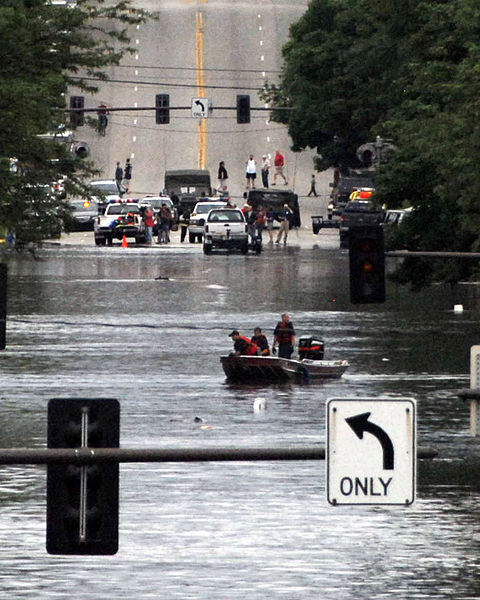
When Cedar Rapids’ last remaining fresh-water pumping station was in danger of being engulfed the city asked for volunteer sandbaggers through the local media. 600 to 1000 volunteers arrived en-mass, so many that most had to be turned away. (Actually they were sent to help evacuate the hospital.) On the news, I saw people being rescued from flood waters in private bassboats and motorized duck blinds. People were so busy helping their neighbors that they plumb forgot to loot.

In my own small town, the municipal water-treatment plant was nearly swamped. City leaders asked for help sandbagging. I took off work early and when I arrived at the fire station at 1 p.m. the work was already done and the numerous volunteers had been sent home.

Many of the small towns affected called out their biggest asset: unpaid, volunteer firefighters, who quickly changed their job description to floodfighters. Local police and county emergency personnel served admirably, as did the Iowa National Guard. Churches and non-profit groups like the Salvation Army sprang into action, setting up shelters for evacuees and feeding the masses.

FEMA was on hand, to be sure, offering whatever assistance it could, and U.S. Coast Guard rescue crews helped survivors. But it was clear that LOCAL officials were running the show. It’s called federalism, Mayor Nagin. Look into it.

All in all I’m pretty proud of how my fellow Iowans handled the worst of times. Iowa may not have mountains or oceans, we may not have celebrity or diversity, we may not have Broadway lights or the Vegas Strip, and we may not have the French Quarter, but we’ve got good folks in these parts. That’s good enough.

Help Our Okie Friends

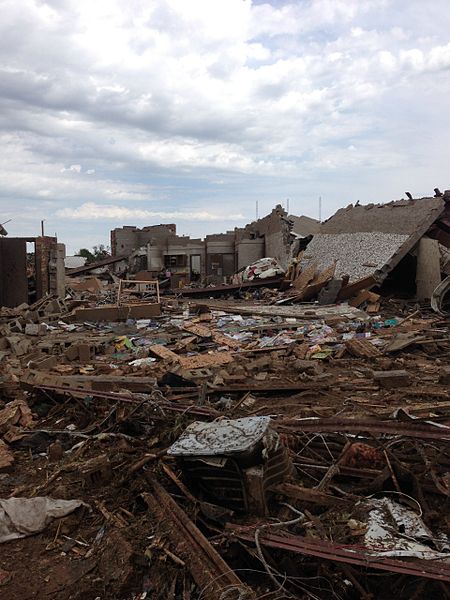
As most everyone knows by now, an EF5 tornado tore through several central Oklahoma counties and wreaked particular destruction on the town of Moore. The tornado was up to 1.3 miles wide at its largest point. The twister killed at least 24 people, including 9 children, and injured as many as 300 others. Early estimates put damages at up to $3 billion.

If you’re wondering where you can donate to help, I suggest Oklahoma Baptist Disaster Relief. They’re already in Oklahoma and know exactly what is needed after a tornado.

They were able to have teams in Moore the day after the tornado struck. To help all Oklahomans effected by the storms they’ve already deployed a mobile command center, a mobile kitchen and feeding units, chainsaw teams to help residents clear trees and debris, and chaplains to help victims with emotional trauma. Their volunteers also can provide water purification, mobile showers and laundry, mud-out, ash-out, child care, and medical assistance.

As a single-state nonprofit charity, Oklahoma Baptist Disaster Relief doesn’t have the deep pockets of the national relief agencies that will (hopefully) begin to arrive in Oklahoma soon. They can use your help. Donations to them are fully tax deductible and 100% of your donation goes directly to helping the victims (not to salaries and bureaucracy).

You can donate online HERE or mail a check to:

BGCO
Attn: Disaster Relief
3800 N. May Ave.
Oklahoma City, OK 73112

In case anyone’s wondering, I’m not advocating for these guys out of brand loyalty. I’m not a Baptist. They’re just a good group.

Reflections On The Floods of 2008

A winter of near-record snowfalls here in Iowa, gave way to a spring in which we had our biggest tornado since 1976, wiping one town off the map and killing 7 people. Then, in July, Iowa saw its worst flooding since the Genesis deluge. This year’s immoderate weather has given me ample reminder of why I hate Iowa. The response of Iowans has reminded me why I love it.

Flood waters on the Cedar River first hit the cities of Waterloo and Cedar Falls, knocking down bridges and flooding downtown areas. It then hit smaller towns like Vinton and Palo, flooding nearly the entire town, and lumbered onward toward the population center of Cedar Rapids.

Not to be outdone by rising flood waters, an Iowa twister suddenly lashed out, tearing through a Boy Scout camp, killing 4 young scouts and sending many more to the hospital.

Flood waters crept up on downtown Cedar Rapids engulfing first the “100 year flood plain,” then the “500 year flood plain.” Sandbagging the downtown area quickly proved to be futile and it was surrendered to the river. More than 3,900 homes had to be evacuated, creating over 24,000 homeless evacuees. Over 1300 city blocks were submerged under a river crest of 31.8 feet. (Flood stage is 12 feet.)

Damage to Iowa’s lifeblood of crops was estimated at $2.7 billion. Property damages in Cedar Rapids alone were estimated at $736 million. Many talking heads on TV compared the Iowa floods to Hurricane Katrina.

There is one big difference between the two disasters though: Unlike New Orleans Mayor Ray Nagin, Louisiana Governor Kathleen Blanco and their ilk, our local officials didn’t stand there wringing their hands, wondering what George Bush was going to do about it. When the flood waters came, local officials, non-profit organizations and private citizens alike all rolled up their sleeves and did what they could.

When Cedar Rapids’ last remaining fresh-water pumping station was in danger of being engulfed the city asked for volunteer sandbaggers through the local media. 600 to 1000 volunteers arrived en-mass, so many that most had to be turned away. (Actually they were sent to help evacuate the hospital.) On the news, I saw people being rescued from flood waters in private bassboats and motorized duck blinds. People were so busy helping their neighbors that they plumb forgot to loot.

In my own small town, the municipal water-treatment plant was nearly swamped. City leaders asked for help sandbagging. I took off work early and when I arrived at the fire station at 1 p.m. the work was already done and the numerous volunteers had been sent home.

Many of the small towns affected called out their biggest asset: unpaid, volunteer firefighters, who quickly changed their job description to floodfighters. Local police and county emergency personnel served admirably, as did the Iowa National Guard. Churches and non-profit groups like the Salvation Army sprang into action, setting up shelters for evacuees and feeding the masses.

FEMA was on hand, to be sure, offering whatever assistance it could, and U.S. Coast Guard rescue crews helped survivors. But it was clear that LOCAL officials were running the show. It’s called federalism, Mayor Nagin. Look into it.

All in all I’m pretty proud of how my fellow Iowans handled the worst of times. Iowa may not have mountains or oceans, we may not have celebrity or diversity, we may not have Broadway lights or the Vegas Strip, and we may not have the French Quarter, but we’ve got good folks in these parts. That’s good enough.
[Anyone who would like to donate to the continuing recovery can go to Embrace Iowa – 2008 Iowa Disaster Fund.]