Judge Napolitano: "Everything the Gov’t Runs is Bankrupt!"

Teaching the Constitution

The Public Interest Institute (PII) recently released a new policy study entitled “A Republic If You Can Keep It: Failing To Teach First Principles,” which highlights America and Iowa’s failure to ground young citizens in “civic education.” The Public Interest Institute is an independent, non-profit organization located on the campus of Iowa Wesleyan College in Mt. Pleasant. It is committed to doing research “on principles and methods to promote and encourage human rights, economic freedom, economic growth, and the creation of jobs here in Iowa.”

The report essentially says that, when it comes to American history and institutions, many American’s are like the people on The Tonight Show’s popular “Jay Walking” segments, in which Jay Leno would ask questions to random people on the street whose answers were often woefully ignorant.

Some statistics cited by the report, from various studies:

  • 52.1% of undergraduate seniors could not recognize that the line “We hold these truths to be self-evident, that all men are created equal,” is from the Declaration of Independence.
  • 52% of college graduates believe that the phrase “wall of separation” is found in the Constitution.
  • Less than 50% of average Americans can name all three branches of government.
  • Only 27% understand that the Bill of Rights prohibits the establishment of an official state religion for the United States.

Why does civic education matter? Because, the report states, “Americans have a citizenship responsibility that requires an informed patriotism based on our history and institutions.” This lack of “informed patriotism” has left the nation “facing a national emergency of losing not only its identity, but also history and values.”

The PII report also analyzes the core curriculum of Iowa’s institutes of higher learning and finds them lacking on civic education. It points to the curriculum of Hillsdale College (Michigan) and Patrick Henry College (Virginia) as examples of good grounding in civics.

To remedy the situation, the PII study recommends that governors and legislators should push for higher required standards on civics education. It also suggests that citizens should lobby their elected officials and hold education institutions “accountable” (whatever that means).

A warning missing from the PII study is that we need to be wary of how this new civics would be taught and who teaches it. “Civics education” can easily be perverted by a usurping government into political propaganda, or more likely just a sloppy and inaccurate presentation of the subject.

For instance, worrying about the lack of “civics education” caused the U.S. Congress to want to establish “Presidential Academies” to help teach the subject. Ironically, the U.S. Constitution gives Congress ZERO authority dealing with education ( and the 10th Amendment reminds “powers not delegated to the United States [government] by the Constitution, […] are reserved to the States respectively, or to the people”). Can institutions chartered in violation of the Constitution be reliable teachers of constitutional principles?

Another cautionary tale on civics education comes from “We the People: The Citizen and the Constitution,” a widely-used high school civics textbook. An analysis done by Gun Owners of America discovered some interesting points in the textbook.

Firstly, the aforementioned 10th Amendment is not even mentioned in the section dealing with the Bill of Rights. Not even once! When the book discusses federalism it “treats the federal government as the octopus head which can dictate to the tentacles (the states) what they must do,” (in GOA’s words).

The Second Amendment is discussed in an historical context, but is presented as hopelessly out of date. Students are asked: “Do you think the Second Amendment is as important today as it was in the eighteenth century? Explain your answer.” and “What limitations, if any, do you think should be placed on the right to bear arms? How would you justify those limits? ” Students are not asked to similarly question the relevance of any part of the U.N.’s Universal Declaration of Human Rights, but are asked how it might be expanded in this country.

Although I agree with PII that state governments could push for higher standards in civic education, I believe that the primary responsibility belongs to the people themselves. We must first teach ourselves. (I’m still learning too.) We and our civic groups must teach our children and our fellow citizens on America’s history, identity and values. The reason civic education is in such sorry shape is because we have already given so much of the task to the state.

We must read the Declaration and Constitution. When they are old enough, my kids will be receiving handsomely bound copies (after they get their Bibles, of course). We should read our state constitutions as well.

There are many fine books out there dealing with Constitutional principles. On everyone’s short list are “The Federalist Papers” and “Democracy In America” by Alexis DeTocqueville. I would also recommend “The Anti-Federalist Papers and the Constitutional Convention Debates” by Ralph Ketcham and “The Bill of Rights Primer” by Akhil Reed Amar. For middle-school age kids and up, I recommend “The U.S.Constitution for Everyone” by Jerome Agel. Also try “Revolution: A Manifesto” by Ron Paul. [Some of these are located in the “Important Documents” section at the right side of this blog.]

At the end of the day, only we the people can instill the “informed patriotism,” that the PII study speaks of, in our fellow citizens and future generations. We HAVE to if we want “America” to mean anything more than a mere geographic location on the map.

Iowa Senate Studies "Tyranny of the Majority"

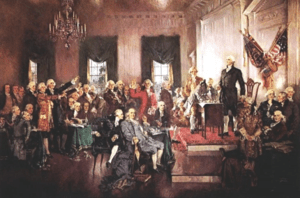
When the Constitutional Convention met in 1787 there was almost immediate conflict between delegates from the large, heavily populated states and the smaller, less populous ones.

How should the national legislature be constituted? The big states proposed The Virginia Plan which assigned Congressional representation based upon population. The smaller states favored The New Jersey Plan, which assigned an equal number of representatives to each state. Ultimately, both sides accepted the “Connecticut Compromise,” wherein there would be two houses of Congress. In the Senate, each state would get an equal number of Senators and the House of Representatives would be allocated by a state’s population.

Another (somewhat cobbled together) compromise was the “Electoral College” for electing the president. Some delegates thought the president should be elected by Congress, others preferred a popular election. In the end, the Constitution allowed each state to assign a number of “electors” equal to that state’s Congressional delegation, to vote for the president.

Most people don’t really understand the electoral college (myself included). As it is now practiced, each state still gets one elector for each representative and Senator it has in Congress. All but two states instruct their electors to vote for whichever presidential candidate got the most votes in that state. These 48 states, Iowa included, are “winner-take-all,” giving all of their elector votes to the highest vote getter in that state.

It seems unduly complicated and a lot of people don’t like it. That may be why the Iowa State Senate is currently studying a bill that would alter Iowa’s participation in the electoral college.

Pushed by a national group called “National Popular Vote,” Senate Study Bill 1128 would change the instructions that Iowa would give to it’s electors. They would be instructed to vote for whichever candidate got the most votes NATION-WIDE. The new law would be an interstate compact, an agreement, with other states who pledge to do the same thing. It would go into effect as soon as enough states to collectively field 270 electoral votes have signed into the agreement. So far only Maryland, New Jersey, Illinois and Hawaii have signed into the pact.

Critics charge that such a system would create an “urban-centric” presidency. Candidates would focus their time and energy on areas where they could rack up the most popular votes quickly, places such as New York and California, rather than having to focus on winning in various sectors of the country. Once elected, the President would tailor all policies toward appeasing these areas, often at the expense of less populated states.

“National Popular Vote” (NPV) responds to allegations that their plan is an “end run” around the Constitution by correctly pointing out that the Constitution allows states to appoint electors “in such Manner as the Legislature thereof may direct[.]” NPV might want to read the rest of the Constitution, however, particularly Article One, Section 10, Clause 3 which says, “No State shall, without the Consent of Congress […] enter into any Agreement or Compact with another State, or with a foreign Power[.]”

Let’s look at NPV’s plan using Iowa as our model. Iowa has 7 electoral votes, one for each of our five Congressional districts and two Senators. Suppose Candidate A gets 60% of the popular vote here in Iowa. However, Candidate B sweeps LA, New York, Chicago, etc… and gets 51% of the popular vote nation-wide. All of Iowa’s electoral votes would go to Candidate B, who voters in Iowa soundly rejected. If we take this example to the extreme, it would be possible for all 7 of Iowa’s electoral votes to go to a candidate who did not get a single person in Iowa to vote for him.

It’s easy to see how less populous states like Iowa would quickly become mere spectators of presidential elections, allowing other, more populated states to vote FOR us. No thank you. If the electoral college needs reformed, perhaps, like our forefathers in 1787, we can find a mutually-equitable compromise.

I think a better plan would be to adopt the “Congressional District Method” currently used by Maine and Nebraska. Rather than award all of the state’s electors to one candidate, an electoral vote is given to the popular winner in each Congressional district. The two remaining electoral votes, representing the state’s two Senators, are given to whichever candidate had the most votes statewide.

It is a “winner-takes-most” system, rather than the current “winner-takes-all” system. This would ensure that voters in a conservative district of liberal California, for instance, would not be wasting their votes. Nor voters in a liberal district of conservative Texas. In 2008, John McCain carried conservative Nebraska, but Barack Obama still got one electoral vote from the state for winning in it’s 2nd Congressional District.

The “Maine-Nebraska Method” would be more democratic than the current system without completely relegating rural states to political irrelevance. Also, since it would be implemented individually by respective states, it would not run afoul of the Constitution’s “Compact Clause,” mentioned above. Perhaps history books will call the adoption of this plan “The Iowa Compromise.”

Reformation: Then and Now

As I attended my niece’s confirmation into the Lutheran Church (yes, they had confirmation in October) the minister spoke about the Protestant Reformation, which celebrates its anniversary this month. It was a good history review, as my own confirmation classes were many moons ago.

In the middle ages the Catholic Church had grown bloated and corrupt. (This is not an indictment of my many friends and family who are members of the modern Catholic Church, just a review.) In 1517 a German monk named Martin Luther challenged the church’s systemic corruption by posting his “95 Theses.” Chief among the grievances listed was the church’s sale of indulgences, the forgiveness of sin based upon monetary payments to the church.

Luther’s protest sparked a backlash against the Church that spread across Northern Europe. Many religious reformers followed in Luther’s footsteps: such as Zwingli in Switzerland and Calvin in France (before he partnered with Hobbes). The message of these men was aided immensely by a new invention, the movable type printing press.

The printing press was invented in Europe (the Asians invented it first) by Johannes Gutenberg around 1450. Just as significant as the mass production aspects was the fact that Gutenberg began printing the Bible in German. Prior to this the Bible was only available in Latin, which could be read only by the well-educated minority of priests and scholars. No longer did the people have to rely on the learned few to interpret the word of God. The people could now do it themselves.

Fast forward 500 years and we can see similarities with the tremors of change that the “Information Age” (or the “Third Wave” of human progress as Alvin Toffler calls it) is promising to bring to the entrenched power structure. In their book “The Sovereign Individual” authors James Dale Davidson and Lord William Rees-Mogg posit the theory that, just as the printing press was the wrecking ball to the all-powerful medieval church, the internet promises to be a wrecking ball to the big government nation-state (also bloated and corrupt).

In addition to allowing the rapid transfer of money between nations, keeping it one step ahead of the tax collector, the internet allows the people unfiltered access to all kinds of information (and plenty of crap too, as readers of this blog are no doubt aware). Just as early Protestants could suddenly read the Bible in their own language, we no longer require any “learned few” to interpret our news and information for us.

I remember when the McCain-Feingold campaign finance bill was being debated, many people declared it to be an unconstitutional violation of the First Amendment right to political speech. I recall a letter in the Cedar Rapids (Iowa) Gazette stating that the bill should be passed, because it was up to the Supreme Court, not the people or even Congress, to decide what is and what is not constitutional. Imagine: only nine philosopher kings (or queens) in black robes being allowed to interpret the framework for a government supposedly of the people, by the people, and for the people. Probably not an uncommon belief these days.

I encourage everyone to read the Constitution for themselves and make up your own minds about what it means. Don’t rely upon the interpretation of people who want to control you. (That goes for everything else too, not just the Constitution.)

Here are a few links:
[These links will now also be located in the “Important Documents” section at the right of the page.]

And you thought this post was going to be about my niece’s confirmation!