
A Dam Dilemma

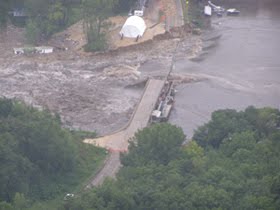
Delhi Dam during July flood (Iowa State Patrol photo)

In my last post I mentioned the Delhi Dam which ruptured during recent flooding.  Whether or not to rebuild it (and how) has become somewhat of hot button issue here in Iowa.  The dam is owned and maintained by the Lake Delhi Recreation Association.  Homeowners on the lake paid dues to the association.   Since the dam was a privately owned structure, should taxpayer funds be used to rebuild it? 

Some citizens and politicians, like Governor Culver and U.S. Representative Bruce Braley, say yes.  On the day after the dam failed, Governor Culver assured, “We’re going to throw everything we have at it, in terms of federal and state resources.”  Others disagree.  Ed Failor Jr. of Iowans For Tax Relief said, “It isn’t the obligation of taxpayers to alleviate risk from our society.  By having private ownership of that dam, they assumed risk.”  I’m inclined to agree with the second camp. 

That’s not to say that I don’t think that Lake Delhi should be rebuilt.  I love Lake Delhi.  For all the talk of this being a “private” lake, it was very much a public asset.  I didn’t own a cabin on the lake, yet I spent many hours fishing and pleasure boating with friends there in my youth. I frolicked at Freddy’s Beach.   I dined at the Pizza Place and Camp-O.  I camped along its shores at Turtle Creek County Park.  I hope to do so again someday with my kids.  I just hope that the dam will be rebuilt in a responsible manner.  (My friend strandediniowa over at Between Two Rivers blog stole some of my thunder on this, but I’ll soldier on.  His post, too, is worth a read.)

There are plans for a new dam to produce hydroelectricity.  It should be possible to find investors (a power company perhaps) to help finance such a project.  Granted it would take longer to scrape the money together and the Lake Association would have to be more creative than if “rich” Uncle Culver or Braley just whip out the taxpayer’s money, but in the long run it would be better for everyone.

The lake is important to Delaware County.  So, if local voters decided to throw their own local tax money at this with a bond issue or something (if that’s even possible) I think that might not be too bad.  At least it would localize the cost to those who most benefit from it.  If the state DNR lent some expertise to the project, I probably wouldn’t lose much sleep.  Even if the state and local government do get involved somehow, the project definitely doesn’t require Bruce Braley’s sack of borrowed Chinese blood money. 

Braley said, “My job is to help identify and secure all potential federal resources to assist those individuals and businesses in the 1st District who are eligible to help recover from the recent flooding.”  Bull crap!  According to the oath he swore before God, his job is to “support and defend the Constitution of the United States [and] bear true faith and allegiance to the same.”  The Constitution doesn’t give Congress authority to rebuild a privately-owned dam on an intrastate lake.

Small-town lawyer Ben Lange, who is challenging Braley for the First District seat, seems to get this.  In a statement, the Republican Lange expressed sympathy for flood victims but explained: “Based on the facts as I now understand them, I believe the repairs will require the state and local governments, working in concert with the private sector, to fix the Delhi dam. Despite the political pressure to reach an alternative conclusion, I simply do not believe the federal government should be involved with this local issue because it is a privately-owned dam on a recreational lake.”

Lange continued, speaking of the fiscal ramifications of this and similar usurpation by Congress: “I was disappointed, but not surprised, to read Rep. Braley’s statement yesterday, in which he said that we need to spend federal money to bailout a private entity now, and ‘then tough choices are going to have to be made.’ I respectfully disagree with the Congressman; our nation has reached a point where tough choices need to be made now. Rep. Braley’s ‘spend first, think later’ approach to this issue is exactly what is wrong with Congress as a whole, and the kind of thinking that has gotten this country into the fiscal mess we are in today.” 

I couldn’t have said it better myself.  Props to Lange for taking the constitutional high road rather than the pandering political easy road on this issue.

Let’s rebuild Lake Delhi.  But let’s do it right; let’s do it local.
State Cuts 10%; Culver Fiddles

I couldn’t help but notice the irony in the title of O. Kay Henderson’s Radio Iowa report titled, “Agencies submit cuts; governor rides rails.” That sounds pretty similar to “Rome burns; Nero fiddles.”

I’m not saying that the current state budget cuts are as bad as Rome burning, of course. As far as I’m concerned they should cut the budget even more. But I do appreciate the irony in the fact that as current state services are being cut, Governor Culver is joyriding on a train, showing where he wants to dump even more taxpayer money to feed his railroad fetish.

Not wanting to prioritize, Culver made the 10% cut across-the-board. Cuts would include laying off 44 law enforcement officers (including 20 State Troopers, whose manpower was already at a 45 year low) and a fire inspector at the Dept. of Public Safety. The Quad City Times reports that the cuts will also have a “devastating impact” on the function of Iowa’s court system.

In terms of layoffs, the Department of Corrections will be the hardest hit with 515 jobs lost. “The impact will affect all departments in every level of service,” said corrections officials. “A reduced workforce will create serious safety concerns for the public, staff and offenders within the maximum security facility. In line with the security concern is the closing of four towers.”

Cops, courts and corrections sound like legitimate core functions of the state government to me. Should they really be cut at the exact same percentage as, say, the Department of Cultural Affairs or Iowa Public Television?

“The other neat thing we’re doing is we’ll be able to invest in the depots and modernize them,” Culver states in the Radio Iowa article. One such depot is the one in Osceola which is currently undergoing a $600,000 renovation. “And they’re bringing that historic place, you know, back to life,” said Culver.

Play your fiddle, Sir. Do you know “I’ve Been Working On the Railroad?”

Iowa Getting Railroaded?

My three-year-old boy loves his Thomas the Tank Engine train set. I think that all kids (or at least all the boys) go through “the train stage,” but they grow out of it. Those who don’t outgrow it go into politics.

Iowa Governor Chet Culver, for instance, has been riding around in his own special choo-choo to promote expanded passenger rail service in Iowa. (Republican blogger Krusy Konservative points out that Iowa Interstate Railroad [IAIS] is letting Culver use their train and Culver’s I-Jobs program is funding two railroad bridges for IAIS. Quid pro quo?)

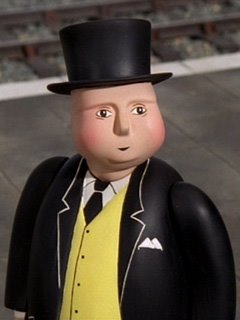
Perhaps Culver foresees a future for himself as Iowa’s own Sir Topham Hatt [pictured], Thomas’ railroad controller. (The resemblance is uncanny.) But unlike the railways on the fictional Isle of Sodor, Culver’s railroad plans will cost Iowa taxpayers some very real cash.

Spurring the current interest in rail travel is some $8 billion in federal “stimulus” funds slated to go toward high-speed and intercity passenger rail projects. Governors, at one time proud leaders of sovereign states, are fighting each other to snap up these scraps of borrowed money from beneath the federal table.

The purpose of these funds, according to Obama’s Transportation Secretary Ray Lahood, is “to coerce people out of their cars,” presumably lowering demand for those cars. This at a time when American automakers are being propped up with taxpayer money because their failure would have supposedly catastrophic effects on the U.S. economy. Does Obama’s left hand know what the right one is doing?

Another reason is the supposed environmental benefits of rail travel. For the money, however, other means of public transportation are better. Buses average 206.6 passenger-miles per gallon of fuel, while intercity rail (Amtrak) gets 67 passenger-miles per gallon. Buses put out 50 grams of CO2 per passenger-mile while intercity rail puts out 186 grams per passenger-mile. Buses also would not require costly upgrades to the road system.

But back to Culver. He recently signed an agreement with Illinois Governor Pat Quinn to coordinate efforts to create passenger rail service from Chicago to Iowa City and Chicago to Dubuque. The necessary track improvements for the Iowa City route alone (not counting station construction) are estimated to cost Iowa about $32.5 million.

But this is an official estimate, which history shows is usually artificially low in order to garner public support for a project (and ridership estimates are usually inflated). Research by Public Interest Institute shows that urban passenger rail projects have averaged about 40% higher than the projected cost. That would put the price about $45.5 million.

It’s unclear if the feds will give Iowa that much. Whatever wasn’t paid with federal funds would probably be financed with state bonds (debt). There would be even more ongoing costs to Iowa taxpayers. The rail service would be run by that model of efficiency, Amtrak. On the East Coast (where Amtrak “works”), for instance, Amtrack’s Boston to DC line LOSES $2.30 per passenger. Its Chicago to Detroit line loses $72 per passenger. States are expected to cover these loses in regional corridors.

The Iowa taxpayer would be adopting Amtrak and subsidizing its riders. According to Public Interest Institute, “the main patrons of high-speed trains will be the wealthy and downtown workers, such as bankers, lawyers, and government officials[…].” The working class will be paying for some affluent suburbanites to feel trendy and eco-friendly while spending their weekend in Chicago.

I have nothing against rail travel per se. If some smart entrepreneurs can figure out a way to provide affordable passenger rail service in Iowa, without hooking the taxpayer up to the milking-machine or putting my unborn grandchildren further in debt to the Chinese, I’d be all for it.

But in the mean time, if Governor Culver feels like joyriding on a train I suggest he head up to Boone Iowa, where he can ride on the Boone & Scenic Valley Railroad. A non-profit, this railroad is supported by voluntary contributions from Iowans, not taxation and public debt. And if he feels he absolutely must have his own railroad, for just a fraction of that $45.5 million I bet my son would sell him a Thomas & Friends Trackmaster set, slightly used.

Rebuild Iowa Wisely

As I noted previously, I just started reading the classic “Economics In One Lesson” by Henry Hazlitt. Although it was originally written in 1946, the subject matter seems to be torn from today’s headlines. Chief among these are the many “make-work” projects being advanced by the ruling Democrats.

Not to be outdone by President Obama’s national public works plan, our own Iowa Governor Chet Culver has trotted out his own $700 million infrastructure plan. “In an effort to stimulate economic growth during this recession, create good private sector jobs, and address unmet infrastructure needs, I propose the creation of the Rebuild Iowa Infrastructure Authority,” Culver said in his recent Condition of the State speech. “But when I say infrastructure, I’m not just talking about bridges and roads. I mean all infrastructure: rail, trails, public buildings, water and sewer treatment facilities, the utility grid, and telecommunications, too.”

After the 2008 floods and tornadoes, there is definitely no shortage of infrastructure that needs fixed. But what about the two primary goals, stimulating economic growth and creating jobs, that Culver listed even before “address[ing] unmet infrastructure needs?” Culver boasted that “for every $100 million spent on highway construction alone, more than 4,000 new jobs are created!” He predicts that if the legislature spends as much as he hopes, 28,000 jobs would be created.

Will any bill like this really “stimulate economic growth” and “create good private sector jobs?” Economist Hazlitt would say, “NO.”

In the chapter “Public Works Mean Taxes,” Hazlitt uses the erection of an otherwise unneeded bridge as his example of a typical government make-work project. He writes: “It is true that a particular group of bridgeworkers may receive more employment than otherwise. But the bridge has to be paid for out of taxes. For every dollar that is spent on the bridge a dollar will be taken away from taxpayers. If the bridge costs $10 million the taxpayers will lose $10 million. They will have that much taken away from them which they would otherwise have spent on the things they needed most.

“Therefore, for every public job created by the bridge project a private job has been destroyed somewhere else. We can see the men employed on the bridge. We can watch them at work. The employment argument of the government spenders becomes vivid, and probably for most people convincing. But there are other things that we do not see, because, alas, they have never been permitted to come into existence. They are the jobs destroyed by the $10 million taken from the taxpayers. All that has happened, at best, is that there has been a diversion of jobs because of the project. More bridge builders; fewer automobile workers, television technicians, clothing workers, farmers.”

In other words, if you need a bridge (or park or community building), then build it. But do so because you need it, not to “stimulate” the economy or create jobs. It will do neither.

The necessity of many of the projects covered in Culver’s plan is unquestionable. Iowa’s infrastructure took a pounding last year. But some of the projects should give taxpayers pause.

Mass transit projects such as “light rail” are often expensive boondoggles for governments that build them. (This fact was even lampooned in an episode of The Simpsons wherein an unscrupulous traveling salesman sells the gullible Springfielders on the idea of building a monorail.) I don’t know if Culver is referring to light rail when he mentions rail, but it wouldn’t surprise me. There’s been talk about it.

Even Iowa Public Radio would get some of Culver’s $700 million largesse, as would the governor‘s residence.

Culver pointed out that “unlike the federal government, [Iowa] can’t deficit spend. And, we’re not going to tax our way out of this, like California or New York.” Culver instead proposes to fund the $700 million by selling bonds. That means $700 million in state debt that will be need to be repaid over 20 years. So Culver does plan to “tax our way out of this,” although through delayed taxation rather than immediate taxation. Thanks, you Big Lug!

We have $620 million in “rainy day funds” and now is obviously a good time to use some of it. Governor Culver proposes taking $43 million from the fund: $20 million for property tax replacement, $10 million in “Jumpstart” assistance, $5 million in non-profit assistance, $5 million for individual unmet needs, $2 million for the Rebuild Iowa office and $1 million for skills training. Why not withdraw a little more and skip the bond debt?

I don’t doubt that Iowa needs to spend a lot of money to rebuild. I just hope that the Iowa legislature spends that money carefully and wisely.