
Book Review: "The FN FAL Battle Rifle"

When I received a signed copy of my brother Bob’s latest book “The FN FAL Battle Rifle,” a book about the Cold War rifle known as the “right arm of the Free World,” of course I was excited to read it.  Bob is a former active duty Cavalry Scout, Desert Storm vet, forestry worker, and still an avid shooter and gun collector living in Montana. Suffice it to say he has a passion for firearms and military history.

Since I’m not quite the firearms technician nor military historian that my brother is, part of me was a little worried I might find parts of a “biography” of a rifle a little dry. However Bob kept the book quite interesting and accessible to us laypersons while still providing plenty of detail for gun wonks.

For many American gunnies the Cold War was a face-off between the American M16 and the Soviet AK-47. However the 7.62x51mm NATO Fabrique Nationale (FN) Fusil Automatique Léger (FAL) eventually equipped over 90 Western nations around the world, earning it the aforementioned nickname. The history of the FAL is a history of every bushfire war that popped up during the Cold War. The FAL showed up in most of them, officially or not. The FAL’s storied history reaches a crescendo during the 1982 Falklands War where both sides (the British and the Argentinians) used the FAL against each other. Bob’s book chronicles the whole history.

First Bob walks us through the development of the FAL right after WW2. Besides the technical aspects of developing the new weapon there was the political quarreling behind adopting a new NATO standard rifle round. The book then provides a brief rundown of the adoption and modifications made by each of the major nations issuing the new FAL. There is a section running down the major accessories adopted for the FAL including magazines, optics, rifle grenades and bayonets.

In the next section Bob points out that although the FAL was (thankfully) never used for its intended role of repelling a Soviet invasion of Western Europe, “[i]t did, however, give excellent service in battle around the world in many smaller wars and numerous insurgencies.” Bob gives a brief history of the FAL’s major use in combat by the British army from the 1948 Malayan Emergency to the 1991 Persian Gulf War and by other nations in African and Latin American bush wars, the Arab-Israeli Wars, the Indo-Pakistani Wars, and Vietnam. The FAL still pops up in combat zones today.

The book then has a breakdown of the capabilities of the FAL’s 7.62x51mm NATO cartridge as well as an analysis of the strengths and weaknesses of the FAL system itself. Bob also compares and contrasts the FAL with its two a main contemporary rival battle rifles the German G3 and American M14. The book is chock full of historical photographs, graphs, as well as several original historical battlescene paintings created specially for the book by British artist Steve Noon.

I thoroughly enjoyed taking the stroll down Cold War “memory lane” that “The FN FAL Battle Rifle” provided. I think anyone with a bit of interest in weapons and/or military history will enjoy it as well. I recommend you check it out.
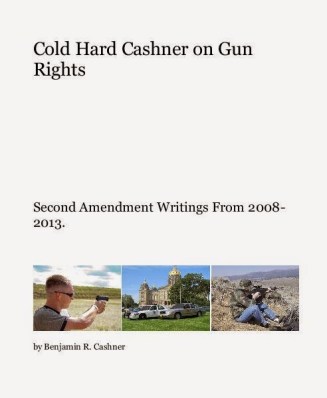
"Cold Hard Cashner on Gun Rights"

Please check out and buy my new book: “Cold Hard Cashner on Gun Rights: Second Amendment Writings From 2008-2013.”

http://www.blurb.com/b/5203508-cold-hard-cashner-on-gun-rights
 

“Cold Hard Cashner” has been called “the premiere small-town Iowa blog about Liberty.” This book collects the blog’s best posts dealing with Second Amendment issues since its inception in 2008 through 2013. In these pages you will read about the history and philosophy behind the Second Amendment, Iowa’s struggle to become a “shall-issue” state, gun training and selection, and the gun politics in the state.

About the author: Benjamin R. Cashner is a lifelong resident of Iowa where he lives with his wife and two children. He served as an infantryman in the Iowa Army National Guard from 1992 to 1998. Cashner is a member of the Iowa Libertarian Party and his columns have appeared in the “Cedar Rapids Gazette” and “Iowa City Press-Citizen.”

Buy the book HERE.

"Looking Backward" Book Review

Here are some thoughts on the book Looking Backward: 2162 – 2012, A View from a Future Libertarian Republic, by Iowa libertarian author Beth Cody. The review was written by Deborah D. Thornton who is a Research Analyst with Public Interest Institute in Mount Pleasant, Iowa.

Looking Backward: Potential, but Utopia?
By Deborah D. Thornton

The Libertarian movement, as evidenced by supporters of Congressman Ron Paul’s presidential bid, grew in strength during the 2012 Republican presidential primaries. According to the dictionary, a libertarian is one who “advocates for maximizing individual rights and minimizing the role of the state.”(1)

The Preamble of the Libertarian party platform makes the following statement:

We seek a world of liberty; a world in which all individuals are sovereign over their own lives, and no one is forced to sacrifice his or her values for the benefit of others. We believe that respect for individual rights is the essential precondition for a free and prosperous world, that force and fraud must be banished from human relationships, and that only through freedom can peace and prosperity be realized. Consequently, we defend each person’s right to engage in any activity that is peaceful and honest, and welcome the diversity that freedom brings. The world we seek to build is one where individuals are free to follow their own dreams in their own ways, without interference from government or any authoritarian power.
Inherent in this statement and definition is that society and government as we know them today must be radically changed in order to achieve a better world. The idea is that all would be perfect if we made these changes. We could have a utopian world.

The idea of utopian communities has been a part of the American culture since our very founding. In many ways utopia is what the Puritans were looking for in their quest. Other well-known examples include New Harmony in Indiana, Brook Farm, the Shakers, the Oneida community, and even the hard-working Germans who settled our own Amana Colonies in Iowa. More recent utopian groups include those such as the “Jesus People Movement” of the 1970s. Utopian movements have been formed around socialist, communist, anarchist, and religious themes.(2)So far, while some have succeeded for brief periods of time, all have ultimately failed.

In her newly published book, Looking Backward: 2162 – 2012, A View from a Future Libertarian Republic, small business owner and writer Beth Cody has crafted a fictional Libertarian world and explains the workings of this society. She uses the honored “accidental” time traveler approach to set the scene for exploring.

A professor from a campus much like those in Iowa accidentally falls into a 150-year coma, emerging in 2162. The United States of America as we know it has fallen apart under the weight of onerous debt and taxation, unsustainable social entitlement programs, overreaching government regulations, continuing wars, and general corruption.(3) The first states to leave were Texas and California. Then the rest crumbled. The most successful of the resulting countries is the “Free States of America,” formed around Libertarian principles. The area of the Free States includes Iowa and the states westward to Idaho and Nevada.(4) Most interesting is the idea that various areas of the U.S. have broken off and formed countries heavily influenced by our history.

Much of the environment our professor awakens to is similar to 2012. Cars and homes haven’t really changed that much – we still haven’t figured out how to teleport ourselves like in Star Trek! But the government structure of the time is radically different.

The Constitution of the Free States is strictly Libertarian. Most importantly it includes prohibition of federal and state government taxation. All government is funded by voluntary donations. The federal government can not raise money through debt. Government can not print money or regulate its printing. There is no national military, only voluntary militia. Government can not fund or provide education. Government employees can not be paid with public money. And most importantly, the federal government cannot make new laws restricting the individual freedom of individuals, businesses, or states.(5)

Cody then goes on to have our professor’s sponsor show him around to see how the
country
really works, and to explain why and how these ideas and systems are better than that
of the old United States.
Looking Backward is an interesting and easy read. It clearly lays out how a Libertarian government might work.

Movement towards many of the ideas and goals discussed is needed in our country
today. Many of the new “Tea Party” Conservatives in Congress and the Iowa Legislature are working towards and promoting these approaches. Smaller government, lower taxes, increased personal freedom, and reduced government regulation are issues which many voters and taxpayers support.

Unfortunately almost 50 percent of the voters and elected officials stand firmly on the other side – believing that bigger government is more effective and more social services programs are needed, along with ever higher taxes. The wealthy must be taxed more because it is “unfair” for them to be successful. Parents are unable to decide how to best educate their children. Families must be forced to have health-care insurance or pay higher taxes. Consumers are unable to decide how much soda to drink.

Though utopian societies have never been successful – and one would not want the
United States as a country to disintegrate – when considering the current government and
economic situation one can not help but wish Cody and those supporting Libertarian ideals good luck.

(Endnotes)

1 “Libertarian,” TheFreeDictionary.com, accessed on July 9, 2012.
2 “Utopian Communities,” Answers.com, accessed on July 9, 2012.
3 Beth Cody, Looking Backward: 2162 – 2012, A View from a Future Libertarian Republic, p. 50.
4 Ibid, p. 47.
5 Ibid, p. 52.

Reprinted by permission from INSTITUTE BRIEF, a publication of Public Interest Institute.

Glenn Beck’s "Common Sense"

There’s been a string of celebrity commentators whom I’ve enjoyed in other media, but I didn’t like their books. I enjoy listening to Rush Limbaugh on the radio, but I didn’t enjoy his book. I loved hearing Charlton Heston speak, but I didn’t love his book. Now I can add national radio and television host Glenn Beck to this list.

I like watching him on TV, but I didn’t like his book “Glenn Beck’s Common Sense: The Case Against an Out-of-Control Government, Inspired by Thomas Paine.” Since the previous book I read before Beck was John Locke’s “Two Treatises of Government,” anything not written in 17th Century English was refreshing. But as I think back about Beck’s “Common Sense” though, I can’t really recall any new ideas that I took away from it.

Where Beck shines is when he details what he calls “The Cancer of Progressivism.” Here Beck doesn’t just bash the Democrats. He shows how both political parties are steeped in the ideology of the progressives (who some might call liberals or statists). He includes some telling quotes from Republican President Teddy Roosevelt who believed that private property was “subject to the general right of the community to regulate its use to whatever degree the public welfare may require it,” and continues on to George W. Bush’s big government policies. Beck has strong political convictions and is not just a schill for the GOP, even if his opponents may try to paint him that way.

The book also contains a copy of Thomas Paine’s 1776 classic “Common Sense.” Since I had read Paine’s work many years ago and time is short, I didn’t reread it this time. As I recall, in it Paine spends a lot of time explaining why hereditary monarchy is not a good form of government. Although I hope every American will read Paine’s work at least once, to many modern readers it will seem like… well, common sense.

In general, if you’re looking for a primer on small government and constitutional thought, I would forgo “Glenn Beck’s Common Sense” and pick up a copy of “The Revolution: A Manifesto” by Dr. Ron Paul. I’ll continue to enjoy Beck where he excels: on TV and radio.

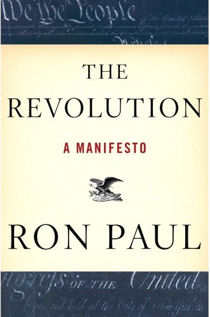
The Revolution: A Manifesto

Back in October I received a copy of Ron Paul’s book “The Revolution: A Manifesto.” I did something with it I had never done with a book before. No, not read it. I read it cover to cover twice in a row.

Usually books written in association with a presidential campaign aren’t very good. They tend to be just the written form of the meaningless sound bites that we expect from modern politics. Paul’s book is, unsurprisingly, different. Although Ron Paul sought the Republican nomination for president, philosophically he is a libertarian and has done more to advance that school of thought than any Libertarian Party candidate. The Revolution isn’t a campaign book at all, but a wide ranging dissertation on libertarian and paleo-conservative philosophy.

The first chapter is titled “The False Choices of American Politics.” Paul writes: “[E]very four years we are treated to the same tired, predictable routine: two candidates with few disagreements on fundamentals pretend that they represent dramatically different philosophies of government.” The false choice presented is, how should the government control something, not should the government control it. This chapter seemed particularly apropos after this election between statists Obama and McCain, and after a Republican president began nationalizing the banking industry like a Democrat on steroids.

Chapter 2 deals with “The Foreign Policy of the Founding Fathers.” Paul spends a good deal of time outlining the policy of “peace, commerce, and honest friendship with all nations, entangling alliances with none,” advocated by Thomas Jefferson and others. He chronicles how far we’ve strayed from that advice and how our intervention in other nations has made us a target for terrorists while draining our treasury.

The third chapter deals with the constitution and how much the federal government has slipped loose from its constraints. Paul again quotes Jefferson, who wrote in 1798, “Confidence is everywhere the parent of despotism. Free government is founded in jealousy, and not in confidence… In matters of Power, let no more be heard of confidence in man, but bind him down from mischief by the chains of the Constitution.” Paul urges us to “rally and recall our people to the Constitution, the rule of law, and our traditional American republic.”

Chapter 4 expounds upon “Economic Freedom.” He details his thoughts on government waste and spending (but I repeat myself), taxes, and regulation of private markets. In Chapter 5, “Civil Liberties and Personal Freedom,” he deals with privacy rights and other civil protections that have been buffeted by the “wars” on terror and drugs. Writes Paul: “Freedom means not only that our economic activity ought to be free and voluntary, but that government should stay out of our personal affairs as well. […] Economic freedom and personal liberty are not divisible.” This flies in the face of conservatives and liberals that want one but not the other, conservatives wanting only the former and liberals wanting only the latter.

The sixth chapter deals with Paul’s true passion: “Money: The Forbidden Issue in American Politics.” Here Paul chronicles America’s monetary policy and how it creates inflation, encourages debt and government spending, and causes the economic “bubbles” that seem to be bursting everywhere lately. Chief among Paul’s concerns is the Federal Reserve, which orchestrates all of the above. To remedy our problems, Paul advises abolishing the Federal Reserve and returning the dollar to the gold standard.

In the final chapter, “The Revolution,” Paul explains what can be done to peacefully implement the points he raised in the previous chapters.

If you’re at all interested in understanding libertarian ideas, you should read “The Revolution: A Manifesto.” It touches on just about every subject of importance and is an easy, enjoyable read. It’s available at the Campaign For Liberty Store online, amazon.com and anywhere else books are sold.