Iowans Walking To Beat Alzheimer’s Disease

September will once again be the time for the Alzheimer’s Association annual Memory Walk to cure Alzheimer’s Disease.

Alzheimer’s Disease is a degenerative disease that attacks the brain. It is always fatal and there is no cure. According to the Alzheimer’s Association, the nation’s leading group battling the disease, at least 5.3 million Americans are currently living with Alzheimer’s. These 5.3 million people all have families dealing with the disease too, including mine.

That’s why I’m participating in the 2009 Alzheimer’s Association Cedar Rapids Iowa Memory Walk (September 26th). I hope that you can sponsor me with a tax-deductible donation to the Association. I know that times are hard, but every dollar you can contribute helps. To donate online, please CLICK HERE. (Or below the graphic to the far right.)

If you would like to participate in or volunteer to help at a Memory Walk in your area, click here for a list of events in Iowa.

Together we can beat Alzheimer’s.

The opinions expressed on this site are those of the author and do not necessarily represent the views of any group or organization.

Iowa Getting Railroaded?

My three-year-old boy loves his Thomas the Tank Engine train set. I think that all kids (or at least all the boys) go through “the train stage,” but they grow out of it. Those who don’t outgrow it go into politics.

Iowa Governor Chet Culver, for instance, has been riding around in his own special choo-choo to promote expanded passenger rail service in Iowa. (Republican blogger Krusy Konservative points out that Iowa Interstate Railroad [IAIS] is letting Culver use their train and Culver’s I-Jobs program is funding two railroad bridges for IAIS. Quid pro quo?)

Perhaps Culver foresees a future for himself as Iowa’s own Sir Topham Hatt [pictured], Thomas’ railroad controller. (The resemblance is uncanny.) But unlike the railways on the fictional Isle of Sodor, Culver’s railroad plans will cost Iowa taxpayers some very real cash.

Spurring the current interest in rail travel is some $8 billion in federal “stimulus” funds slated to go toward high-speed and intercity passenger rail projects. Governors, at one time proud leaders of sovereign states, are fighting each other to snap up these scraps of borrowed money from beneath the federal table.

The purpose of these funds, according to Obama’s Transportation Secretary Ray Lahood, is “to coerce people out of their cars,” presumably lowering demand for those cars. This at a time when American automakers are being propped up with taxpayer money because their failure would have supposedly catastrophic effects on the U.S. economy. Does Obama’s left hand know what the right one is doing?

Another reason is the supposed environmental benefits of rail travel. For the money, however, other means of public transportation are better. Buses average 206.6 passenger-miles per gallon of fuel, while intercity rail (Amtrak) gets 67 passenger-miles per gallon. Buses put out 50 grams of CO2 per passenger-mile while intercity rail puts out 186 grams per passenger-mile. Buses also would not require costly upgrades to the road system.

But back to Culver. He recently signed an agreement with Illinois Governor Pat Quinn to coordinate efforts to create passenger rail service from Chicago to Iowa City and Chicago to Dubuque. The necessary track improvements for the Iowa City route alone (not counting station construction) are estimated to cost Iowa about $32.5 million.

But this is an official estimate, which history shows is usually artificially low in order to garner public support for a project (and ridership estimates are usually inflated). Research by Public Interest Institute shows that urban passenger rail projects have averaged about 40% higher than the projected cost. That would put the price about $45.5 million.

It’s unclear if the feds will give Iowa that much. Whatever wasn’t paid with federal funds would probably be financed with state bonds (debt). There would be even more ongoing costs to Iowa taxpayers. The rail service would be run by that model of efficiency, Amtrak. On the East Coast (where Amtrak “works”), for instance, Amtrack’s Boston to DC line LOSES $2.30 per passenger. Its Chicago to Detroit line loses $72 per passenger. States are expected to cover these loses in regional corridors.

The Iowa taxpayer would be adopting Amtrak and subsidizing its riders. According to Public Interest Institute, “the main patrons of high-speed trains will be the wealthy and downtown workers, such as bankers, lawyers, and government officials[…].” The working class will be paying for some affluent suburbanites to feel trendy and eco-friendly while spending their weekend in Chicago.

I have nothing against rail travel per se. If some smart entrepreneurs can figure out a way to provide affordable passenger rail service in Iowa, without hooking the taxpayer up to the milking-machine or putting my unborn grandchildren further in debt to the Chinese, I’d be all for it.

But in the mean time, if Governor Culver feels like joyriding on a train I suggest he head up to Boone Iowa, where he can ride on the Boone & Scenic Valley Railroad. A non-profit, this railroad is supported by voluntary contributions from Iowans, not taxation and public debt. And if he feels he absolutely must have his own railroad, for just a fraction of that $45.5 million I bet my son would sell him a Thomas & Friends Trackmaster set, slightly used.

Privatize Honey Creek Resort

We libertarians are sometimes criticized as having all these “big ideas” about limited government and personal freedom but lacking small, practical steps to implement them. Here’s one idea that I think fits the bill: Privatize Iowa’s Honey Creek Resort State Park.

Billed as Iowa’s first “destination park,” Honey Creek Resort opened for business last September. The luxury resort, located on Iowa’s Rathun Lake, was built and is owned by the Iowa Dept. of Natural Resources. The resort boasts 105 spacious rooms in its “great lodge,” 28 resort cabins, a pirate-themed indoor water park, an 18-hole golf course, 50-boat slips, boat launch, fishing pier, conference center, RV park, and a full-service restaurant and lounge. Whew!

The resort park has about 138 employees, making it one of Appanoose Countys largest employers, impacting the economy of southern Iowa. This is of course why the state government built the place, for the economic impact.

But what is this impact? Economist Henry Hazlitt teaches: “The art of economics consists in looking not merely at the immediate but at the longer effects of any act or policy; it consists in tracing the consequences of that policy not merely for one group but for all groups.” We need to look beyond 138 employed persons in southern Iowa and any immediate tax revenues of the resort.

What is the resort’s impact on other similar businesses in the area? A quick Google search identified 10 hotels, 4 golf courses, 3 RV parks and 4 private campgrounds near Moravia Iowa (where the resort was built). The state has created a tax-payer subsidized business to compete directly with them.

This impact stretches much further since the resort obviously hopes to draw tourists from all over the state as well as from out of state. A day a family stays at the resort is a day that they don’t stay in a bed and breakfast in Dubuque or a day they don’t spend shopping at Coral Ridge Mall or enjoying Arnold’s Park or Adventureland Park, making those enterprises less profitable. The state has not “created” 138 jobs and a new revenue stream, it has merely borrowed them from private businesses throughout the state.

This is only the direct impact. More jobs and money will be sucked from elsewhere in the state via taxes. The state of Iowa has pumped atleast $8 million directly into the project. In 2008, Senator Chuck Grassley requested an additional $7.1 million in federal funds for projects around Rathbun Lake. In true government fashion, delays and cost overruns were frequent. Construction of the golf course alone went 150% over budget.

The project also racked up about $33 million in public revenue bonds to pay for construction. These will have to be paid back. Early projections from 2007 (before the economy tanked) showed that the resort should be showing a small profit by the third year of operation (2011). Since the resort will make the bond payments out of it’s net income, every year that the resort doesn’t break even the Iowa taxpayer will have to make the bond payments.

All this tax money is perhaps diverted from more needful government projects at a time when the state is having difficulty paying the bills. But the money was originally diverted from its rightful owners: the people of Iowa. Every dollar taken from us to fund frivolous projects is a dollar not spent or invested in our own communities to create jobs and build dreams.

So when we see the “massive mosaic fireplace” of Honey Creek’s “great lodge,” before we marvel at its grandeur, let us take Hazlitt’s advice and use our mind’s eye to see “the possibilities that have never been allowed to come into existence. [Let us] see the unbuilt homes, the unmade cars and washing machines, the unmade dresses and coats, perhaps the ungrown and unsold foodstuffs. […] What has happened is merely that one thing has been created instead of others.”

Honey Creek Resort is already built. Iowa should sell it to private investors. Let them assume the debt and compete against Iowa’s other businesses on equal footing, without the coercive and confiscatory power of government tipping the scales in the resort’s favor.

"Iowa" Gun Ban Group Folds

According to a Radio Iowa report, Iowans for the Prevention of Gun Violence (IPGV), a group dedicated to incrementally banning gun-ownership in Iowa, has disbanded due to lack of funds. The article states that the group was founded in response to the 1991 shootings by deranged student Gang Lu on the campus of the University of Iowa (a gun-free zone, I might point out).

While IPGV might have started out as a grassroots campaign, it quickly turned into nothing more than a surrogate for the large anti-gun Joyce Foundation out of Chicago (on the board of which President Obama served at the time).

According to a 2005 article by lawyer/author David Hardy, the Joyce Foundation dumped $250,000 into IPGV in 2002 and again in 2004. After he checked IPGV’s tax records (which are open to the public, since IPGV was a tax-exempt “charity”), Hardy concluded that “it would appear that the ‘grassroots’ group’s entire contribution income and budget consists of the Joyce money.” That’s right, in that time period apparently not a single Iowan contributed a penny to this supposed group of “concerned” Iowans. IPGV has also received funds from the Joyce Foundation during other years and from Freedom States Alliance, which is also largely funded by the Joyce Foundation.

Poor fiscal management might have helped to hasten IPGV’s fall. According to analysis at the LonelyMachines blog, in one particular year 67% of IPGV’s funding was gobbled up paying themselves salaries while only 3% went toward the group’s stated mission. No wonder that not too many Iowans opened their wallets up for these clowns and no wonder that the Joyce Foundation finally slapped IPGV off the teat.

I recall that after 9-11 gun control groups decided to target .50-caliber rifles for elimination. “It can shoot down airliners!” they warned in a tizzy. Well, you could theoretically bring down an airliner tossing a well-aimed bar of soap, but it would be a million-to-one shot. Anyway, IPGV jumped on the bandwagon as usual.

I read a news article in the “Cedar Rapids Gazette” where John Johnson, then Executive Director of IPGV, was trumpeting the supposed evils of these .50-cals. I looked online and quickly found who must have been handing Johnson his talking points: Tom Diaz from the anti-gun Violence Policy Center (which is largely funded by guess who… the Joyce Foundation). Johnson didn’t just use these talking points as a starting point, he mindlessly parroted the words almost verbatim. A couple examples:

  • Diaz: “It is indeed almost impossible to exaggerate the lethality of these weapons of war.” Johnson: “It is almost impossible to exaggerate the lethality of the .50-caliber sniper rifle.”
  • Diaz: “Translate that into civilian terms and you have the perfect weapon for assassination and terrorism[.]” Johnson: “[B]ut in civilian terms, you have a perfect weapon for assassination and terrorism.”

I shot off a letter to the “Gazette” pointing all this out and which I concluded, “It’s easy to see who is controlling IPGV’s agenda, and it’s not the people of Iowa.” In a stroke of good luck they published my letter three days before Johnson had one published in which he used those very talking points, hopefully eroding his credibility. It was fun for this David to sling a stone at a (then well-funded) Goliath.

In the end, however, IPGV probably wasn’t brought down by the efforts of gun owners like myself so much as it was by it’s own waste, greed and inefficiency. But like the mighty Soviet Empire, as long as it topples who cares why?

It should be noted that while IPGV couldn’t find many actual Iowans to support their cause, pro-gun freedom groups like Iowa Carry (which relies primarily on dues and contributions from living, breathing Iowans) seem to be surviving and growing.

So on behalf of myself, Iowa’s gun owners, and every other Iowan who wouldn’t open their wallet to IPGV, let me say: “Good riddance!” I think I’ll celebrate IPGV’s demise with a trip to the shooting range.

Beth Cody on Gov’t-Run Health Care

Wednesday’s edition of the Iowa City Press-Citizen had a good column by libertarian writer Beth Cody called “Let’s focus on fixing the sick part of our health care system,” which is in response to the increasing call for government-run health care. Cody, a small business owner and writer, assures readers that government “universal coverage” will be “universally disappointing.”

In her column, Cody points out that there really isn’t a problem with health care per se, most people are happy with the actual care they receive. (Since I just spent two and half days in the hospital with my wife having a new baby, I agree wholeheartedly. The staff and facility at St. Luke’s birthing center in Cedar Rapids were first rate.) Cody says the real problem is with the cost and complexity of the insurance system that has grown up around health care.

Among the flaws of the current insurance regime, Cody points out:

  1. “Insurance policies are expensive because competition is restricted — individuals must buy policies in their own state.”
  2. “Each state has long lists of mandated coverages for things consumers often don’t want or need, which makes insurance so expensive that many must go without coverage entirely.”
  3. “Tax policy encourages reliance on employer-provided insurance, leading employees to stay in bad job situations merely to keep their insurance.”

Since these three main forces driving up health care costs are created by the government itself, is it likely that the government will be able to reduce health care prices? I cannot, for the life of me, understand the faith that many people have that the government can do so, when every other program administered by the federal government is either a wasteful disgrace or teetering on insolvency or both.

Cody lists some of the other side-effects of government health plans, including waiting lists, doctor shortages, lower survival rates, and discrimination against elderly, minority and rural patients. She recommends reading the Cato Institute’s policy analysis “Health Care in a Free Society” for more examples. (I would also recommend a shorter Cato article “Obama Doesn’t Have the Only Prescription for Healthcare Reform.”)

So what can be done to reform the health insurance industry? Cody recommends four mostly market-based reforms:

  1. “Allow people to purchase insurance from any state — this will lead to more competition and much lower rates.”
  2. “Repeal corporate deductibility of premiums and replace it with individual tax credits. This will sever the unhealthy relationship between employment and insurance, empower individuals and lead to more individual plan competition and lower rates.”
  3. “Allow insurers to charge less to policyholders who practice healthy habits — this is mostly illegal now, incredibly.”
  4. “Reform medical malpractice laws, which will make health care itself less expensive.”

These all certainly make sense and would be helpful in making health insurance less expensive, but it would be nice to see some reforms that lessen or eliminate the need for health insurance altogether.

Food is as much a necessity as health care, yet we don’t have some elaborate, overly-complicated, often senseless system to pay for it. Imagine having to pay a $25 co-payment every time you made a trip to the grocery store, whether buying ramen noodles or veal chops. Broccoli might be “covered” while cauliflower is not. It would be utter nonsense, yet we think it makes sense for health care? So long as health care consumers rely on a third party to pay the bill, prices will continue to be out of whack with reality.

If, like food shoppers, health care consumers knew exactly what price they were paying and had to pay out of their own pockets, competition would soon drive health care prices down to the lowest sustainable level. Tax exempt “health savings accounts” are one small step in that direction. Abolishing the income tax, which has so perverted market incentives in health care (as well as everywhere else) would be even better. Well, I can dream.

Barring “radical” reform like that, Beth Cody is certainly right, a market-based health insurance industry would be infinitely better than any government-run program. Unfortunatly, that doesn’t appear to be the way the political winds are blowing.

Declaration of Independence: The Reason for the Season

Most of the time growing up, like a lot of people, I thought that the Fourth of July was about fireworks and barbecues. I knew it was “America’s birthday,” but I didn’t really understand how that birth came about or how it was unique. It was only after I ended my “formal” education that I began to read a lot about the founding of our country and the importance of the Declaration of Independence.

When I attended the Fourth of July parade and festivities in my birth town of Independence, Iowa last year, I was pleasantly surprised to hear the Declaration being read aloud in its entirety over loudspeakers to kick off the celebration. Perhaps the Declaration hasn’t been entirely forgotten after all.

The Declaration is revolutionary in the truest sense of the word. Thirteen political subdivisions that thought they weren’t getting a fair deal from their own government, the existing government that our founders all had been born into, declared to the world that they were free of that government. When you think about it, it’s extraordinary.

As I read the declaration today, particularly the list of specific grievances against the British crown, I’m struck by how they resemble some of our own grievances with our various governments today:

“He has erected a multitude of New Offices, and sent hither swarms of Officers to harrass our people, and eat out their substance.” Yep. Sounds like the countless alphabet soup federal agencies regulating every aspect of our existence and taking our money.

“He has affected to render the Military independent of and superior to the Civil power.” Seems like a liberal critique of President Bush, with his military tribunals.

“He has combined with others to subject us to a jurisdiction foreign to our constitution, and unacknowledged by our laws; giving his Assent to their Acts of pretended Legislation[.]” Two words: United Nations. There are a host of other sovereignty-destroying organizations that many of our own elected officials are working to subjugate us to.

“For imposing Taxes on us without our Consent[.]” Our children are being passed a suffocating level of debt (which will have to be paid by them through extensive taxation) by politicians they couldn’t vote for or against.

Anyway, I won’t analyze it all into the ground. I hope that you’ll take a few moments to read the Declaration of Independence with fresh eyes and think about what it means. It is, in effect, America’s mission statement. [You can also listen to an audio version here.]

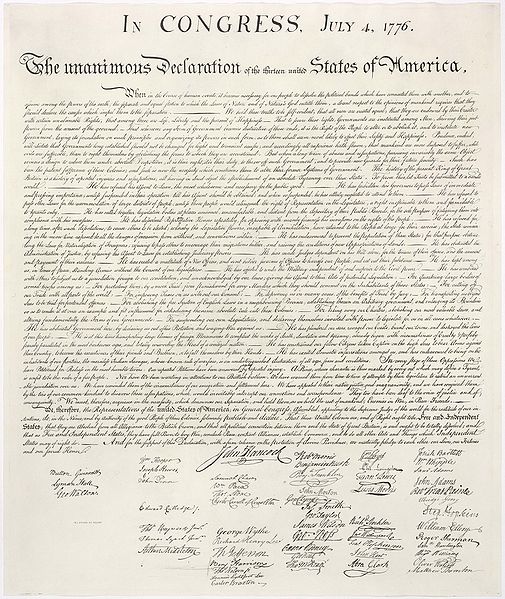
IN CONGRESS, July 4, 1776.

The unanimous Declaration of the thirteen united States of America,

When in the Course of human events, it becomes necessary for one people to dissolve the political bands which have connected them with another, and to assume among the powers of the earth, the separate and equal station to which the Laws of Nature and of Nature’s God entitle them, a decent respect to the opinions of mankind requires that they should declare the causes which impel them to the separation.

We hold these truths to be self-evident, that all men are created equal, that they are endowed by their Creator with certain unalienable Rights, that among these are Life, Liberty and the pursuit of Happiness.–That to secure these rights, Governments are instituted among Men, deriving their just powers from the consent of the governed, –That whenever any Form of Government becomes destructive of these ends, it is the Right of the People to alter or to abolish it, and to institute new Government, laying its foundation on such principles and organizing its powers in such form, as to them shall seem most likely to effect their Safety and Happiness. Prudence, indeed, will dictate that Governments long established should not be changed for light and transient causes; and accordingly all experience hath shewn, that mankind are more disposed to suffer, while evils are sufferable, than to right themselves by abolishing the forms to which they are accustomed. But when a long train of abuses and usurpations, pursuing invariably the same Object evinces a design to reduce them under absolute Despotism, it is their right, it is their duty, to throw off such Government, and to provide new Guards for their future security.–Such has been the patient sufferance of these Colonies; and such is now the necessity which constrains them to alter their former Systems of Government. The history of the present King of Great Britain is a history of repeated injuries and usurpations, all having in direct object the establishment of an absolute Tyranny over these States. To prove this, let Facts be submitted to a candid world.

He has refused his Assent to Laws, the most wholesome and necessary for the public good.
He has forbidden his Governors to pass Laws of immediate and pressing importance, unless suspended in their operation till his Assent should be obtained; and when so suspended, he has utterly neglected to attend to them.
He has refused to pass other Laws for the accommodation of large districts of people, unless those people would relinquish the right of Representation in the Legislature, a right inestimable to them and formidable to tyrants only.
He has called together legislative bodies at places unusual, uncomfortable, and distant from the depository of their public Records, for the sole purpose of fatiguing them into compliance with his measures.
He has dissolved Representative Houses repeatedly, for opposing with manly firmness his invasions on the rights of the people.
He has refused for a long time, after such dissolutions, to cause others to be elected; whereby the Legislative powers, incapable of Annihilation, have returned to the People at large for their exercise; the State remaining in the mean time exposed to all the dangers of invasion from without, and convulsions within.
He has endeavoured to prevent the population of these States; for that purpose obstructing the Laws for Naturalization of Foreigners; refusing to pass others to encourage their migrations hither, and raising the conditions of new Appropriations of Lands.
He has obstructed the Administration of Justice, by refusing his Assent to Laws for establishing Judiciary powers.
He has made Judges dependent on his Will alone, for the tenure of their offices, and the amount and payment of their salaries.
He has erected a multitude of New Offices, and sent hither swarms of Officers to harrass our people, and eat out their substance.
He has kept among us, in times of peace, Standing Armies without the Consent of our legislatures.
He has affected to render the Military independent of and superior to the Civil power.
He has combined with others to subject us to a jurisdiction foreign to our constitution, and unacknowledged by our laws; giving his Assent to their Acts of pretended Legislation:
For Quartering large bodies of armed troops among us:
For protecting them, by a mock Trial, from punishment for any Murders which they should commit on the Inhabitants of these States:
For cutting off our Trade with all parts of the world:For imposing Taxes on us without our Consent:
For depriving us in many cases, of the benefits of Trial by Jury:
For transporting us beyond Seas to be tried for pretended offences
For abolishing the free System of English Laws in a neighbouring Province, establishing therein an Arbitrary government, and enlarging its Boundaries so as to render it at once an example and fit instrument for introducing the same absolute rule into these Colonies:
For taking away our Charters, abolishing our most valuable Laws, and altering fundamentally the Forms of our Governments:
For suspending our own Legislatures, and declaring themselves invested with power to legislate for us in all cases whatsoever.
He has abdicated Government here, by declaring us out of his Protection and waging War against us.
He has plundered our seas, ravaged our Coasts, burnt our towns, and destroyed the lives of our people.
He is at this time transporting large Armies of foreign Mercenaries to compleat the works of death, desolation and tyranny, already begun with circumstances of Cruelty & perfidy scarcely paralleled in the most barbarous ages, and totally unworthy the Head of a civilized nation.
He has constrained our fellow Citizens taken Captive on the high Seas to bear Arms against their Country, to become the executioners of their friends and Brethren, or to fall themselves by their Hands.
He has excited domestic insurrections amongst us, and has endeavoured to bring on the inhabitants of our frontiers, the merciless Indian Savages, whose known rule of warfare, is an undistinguished destruction of all ages, sexes and conditions.

In every stage of these Oppressions We have Petitioned for Redress in the most humble terms: Our repeated Petitions have been answered only by repeated injury. A Prince whose character is thus marked by every act which may define a Tyrant, is unfit to be the ruler of a free people.

Nor have We been wanting in attentions to our Brittish brethren. We have warned them from time to time of attempts by their legislature to extend an unwarrantable jurisdiction over us. We have reminded them of the circumstances of our emigration and settlement here. We have appealed to their native justice and magnanimity, and we have conjured them by the ties of our common kindred to disavow these usurpations, which, would inevitably interrupt our connections and correspondence. They too have been deaf to the voice of justice and of consanguinity. We must, therefore, acquiesce in the necessity, which denounces our Separation, and hold them, as we hold the rest of mankind, Enemies in War, in Peace Friends.

We, therefore, the Representatives of the united States of America, in General Congress, Assembled, appealing to the Supreme Judge of the world for the rectitude of our intentions, do, in the Name, and by Authority of the good People of these Colonies, solemnly publish and declare, That these United Colonies are, and of Right ought to be Free and Independent States; that they are Absolved from all Allegiance to the British Crown, and that all political connection between them and the State of Great Britain, is and ought to be totally dissolved; and that as Free and Independent States, they have full Power to levy War, conclude Peace, contract Alliances, establish Commerce, and to do all other Acts and Things which Independent States may of right do. And for the support of this Declaration, with a firm reliance on the protection of divine Providence, we mutually pledge to each other our Lives, our Fortunes and our sacred Honor.

Georgia: Button Gwinnett, Lyman Hall, George Walton
North Carolina: William Hooper, Joseph Hewes, John Penn
South Carolina: Edward Rutledge, Thomas Heyward, Jr., Thomas Lynch, Jr., Arthur Middleton
Massachusetts: John Hancock
Maryland: Samuel Chase, William Paca, Thomas Stone, Charles Carroll of Carrollton
Virginia: George Wythe, Richard Henry Lee, Thomas Jefferson, Benjamin Harrison, Thomas Nelson, Jr., Francis Lightfoot Lee, Carter Braxton
Pennsylvania: Robert Morris, Benjamin Rush, Benjamin Franklin, John Morton, George Clymer, James Smith, George Taylor, James Wilson, George Ross
Delaware: Caesar Rodney, George Read, Thomas McKean
New York: William Floyd, Philip Livingston, Francis Lewis, Lewis Morris
New Jersey: Richard Stockton, John Witherspoon, Francis Hopkinson, John Hart, Abraham Clark
New Hampshire: Josiah Bartlett, William Whipple
Massachusetts: Samuel Adams, John Adams, Robert Treat Paine, Elbridge Gerry
Rhode Island: Stephen Hopkins, William Ellery
Connecticut: Roger Sherman, Samuel Huntington, William Williams, Oliver Wolcott
New Hampshire: Matthew Thornton

Armed Mariners Bill Introduced In U.S. House

In November of 2008 (before the merchant vessel Maersk Alabama was captured by pirates), I suggested that the Federal Government could aid in arming ship crews. I stated that while shipping companies certainly had the right to arm their crews themselves, many foreign ports were hostile to the idea of armed civilians. I suggested that sanctioning of certain armed sailors by the American government might ease the fears of some squeamish governments and provide legal cover for armed seaman.

In a similar vein, U.S. Representative Frank LoBiondo (R-NJ) has recently introduced H.R. 2984, the “United States Mariner and Vessel Protection Act of 2009.” The stated purpose of the bill is “to assist in the defense of United States-flag vessels against piracy and to ensure the traditional right of self-defense of those vessels against piracy.”

Rep. LoBiondo, who is on the U.S. House of Representatives Coast Guard and Maritime Transportation subcommittee, said of his bill, “Our merchant marine fleet is increasingly under attack from unlawful individuals and rogue groups that seek to disrupt commerce, seize U.S. and foreign crews, and instill fear on international waters. It is only appropriate that our fleets be legally allowed to defend themselves from these violent encounters. This common-sense legislation is a necessary step in empowering U.S.-flagged vessels to protect their crews and cargo.”

The bill would direct the appropriate U.S. Secretary to “issue regulations establishing standards and circumstances under which an individual is authorized to use force (including lethal force) against an individual in the defense of a vessel against piracy.”

It would also limit the liability of ship owners, operators, and individuals for damages arising during the defense of a vessel (except in cases of gross negligence or willful misconduct). To achieve this automatic limited liability when using firearms, a mariner would have to have “completed training certified by the Coast Guard for use of firearms aboard vessels.” This would help calm the fears of shipping companies that are reluctant to arm their crews for fear of future lawsuits.

The bill would also allow the U.S. Coast Guard to deploy “maritime safety and security team[s] on a temporary basis, […] to deter, protect against, and rapidly respond to acts of piracy against vessels […] in international waters.”

Perhaps most importantly, the bill would authorize the appropriate U.S. Secretary to “work through the International Maritime Organization to establish agreements to promote coordinated action among flag and port states to deter, protect against, and rapidly respond to acts of piracy against the vessels of, and in the waters under the jurisdiction of, those nations, and to ensure limitations on liability similar to those established by […] this Act.” [Emphasis added.] In other words, the U.S. government would try to win legal protections for armed crews even from foreign governments.

I believe this law would be authorized by the U.S. Constitution under Article 1, Section 8, which gives Congress power “To define and punish Piracies and Felonies committed on the high Seas,” and “To provide for organizing, arming, and disciplining, the Militia,” and “To regulate Commerce with foreign Nations[.]”

So long as it doesn’t become the ONLY way that ship owners are allowed to arm their crews, I think this bill is a good bill that would help reduce piracy against U.S. merchant vessels.

Cap & Tax Won’t Save The Earth

Today the U.S. House of Representatives passed the “American Clean Energy and Security Act,” known as a “cap and trade” system. It now goes to the Senate where it’s fate is unclear. Opponents charge that the bill is too costly and will hurt the faltering economy, while doing little to improve the environment. Here is a quick video from the Heritage Foundation dealing with subject.

This Land Is Your Land, But Now It’s OUR Land

Eminent domain abuse in Iowa?

The fact that Iowa passed a law affording property owners additional protections, in response to the landmark Kelo decision by the U.S. Supreme Court, may be of little comfort to about two-dozen Iowa families who may soon be forced off their own land.

The high court’s ruling in Kelo v. City of New London was handed down June 23, 2005. In it’s decision the court ruled that local governments could take land from one private property owner, just to give it to another, who may generate more tax revenue with the property. The court ruled that it was permissible under the “takings clause” of the Fifth Amendment.

That clause reads, “nor shall private property be taken for public use, without just compensation.” Before the Kelo decision, “public use” was generally understood to mean something open for the use of the general public, such as roads or schools. After Kelo, local governments could take private land from one owner (a farmer for instance) and give it to another (a real estate developer perhaps). The decision caused considerable public backlash across the country.

Here in Iowa, the Legislature responded by passing an anti-Kelo law in 2006 which tightened the state’s laws protecting landowners. Then-governor Tom Vilsack vetoed the bill, but the Legislature overrode his veto by wide margins. (After sticking his thumb in the eye of Iowa’s farmers and property owners on his way out of office, Vilsack now serves as Obama’s Secretary of Agriculture.) Three years later, Iowa’s eminent domain law may face it’s first real test.

Recently the Clarke County Reservoir Commission voted to condemn farmland in order to build a new 900-acre reservoir north of Osceola. Osceola City Administrator Bill Kelly said that the area’s current reservoir has about 7 percent capacity remaining. When that’s completely tapped, it may hamper efforts to develop a new hotel and upscale subdivision that the town wants. The reservoir would also have a 300-foot beach, boat ramp and campsites, which supporters hope would help draw tourists to the area.

It sounds like a nice idea, but Clarke County has the same dilemma that Harvey Corman’s character did in “Blazing Saddles” when he said, “Unfortunately there is one thing standing between me and that property: the rightful owners.” About two-dozen rightful owners actually.

The landowners (many of whom live on the soon-to-be-submerged land) and their friends don’t plan on going down without a fight. Opponents of the lake allege that supporters have exaggerated the area’s water needs. Either way, the project puts the needs of future development over the welfare of current tax-paying property owners.

Representative Jodi Tymeson, a Winterset Republican and reservoir opponent, points out that many members of the Clarke County Reservoir Commission are unelected representatives of local developers and a local water association, who stand to gain from the project. “Iowans understand eminent domain for real public uses, but private property ownership is just basic to our individual liberties,” said Tymeson.

The project sidesteps Iowa’s anti-Kelo law since it does not take land and give it directly to private developers. Instead it takes the land and uses it for the direct benefit of those developers, at the expense of the rightful owners. “This is a deliberate attempt to get around our law,” said Rep. Jeff Kaufmann, R-Wilton, who helped pass the 2006 law.

The county government has deeper pockets than the rural residents that it seeks to dispossess, leaving Kaufmann hoping that an attorney might provide pro bono legal services for the group. If this lake project proceeds, opponents fear that it may encourage the use of eminent domain for other development and recreation projects. “I’m not sure anyone in Iowa is safe,” Representative Tymeson said.

This project may not be as an egregious case of eminent domain abuse as that which is now enshrined by the Kelo decision, but that doesn’t mean it’s fair.

Clean Sweep!

All 5 of Iowa’s U.S. Representatives Co-Sponsor Ron Paul’s “Audit the Fed” Bill.

On June 11, U.S. Representative Bruce Braley became the final member of Iowa’s U.S. House delegation to co-sponsor HR 1207, the “Federal Reserve Transparency Act of 2009.″ Iowa’s three Democrat and two Republican representatives have all now co-sponsored this important legislation.

The bill merely calls for the Comptroller General (America’s chief financial inspector and head of the Government Accountability Office [GAO]) to conduct an audit of the Federal Reserve System by the end of 2010 and report the findings to Congress.

The Federal Reserve (or “Fed”) is America’s central banking system. It is a a quasi-public and quasi-private organization (an unholy union of government and private interests). It was signed in 1913 by President Woodrow Wilson, who supposedly later lamented, “I am a most unhappy man. I have unwittingly ruined my country. […] The growth of the nation, therefore, and all our activities are in the hands of a few men. […] No longer a government by free opinion, no longer a government by conviction and the vote of the majority, but a government by the opinion and duress of a small group of dominant men.”

According to its website, the Federal Reserve’s duties fall into four general areas:

  1. Conducting the nation’s monetary policy by influencing the monetary and credit conditions in the economy in pursuit of maximum employment, stable prices, and moderate long-term interest rates.
  2. Supervising and regulating banking institutions to ensure the safety and soundness of the nation’s banking and financial system and to protect the credit rights of consumers.
  3. Maintaining the stability of the financial system and containing systemic risk that may arise in financial markets.
  4. Providing financial services to depository institutions, the U.S. government, and foreign official institutions, including playing a major role in operating the nation’s payments system.

You would think that an institution with so much responsibility to and power in the U.S. economy would be run openly and transparently. Not so. To understand why the audit of the Fed is necessary, here are the words of the bill’s author Congressman Ron Paul, when he arose to introduce the bill to Congress:

I rise to introduce the Federal Reserve Transparency Act. Throughout its nearly 100-year history, the Federal Reserve has presided over the near-complete destruction of the United States dollar. Since 1913 the dollar has lost over 95% of its purchasing power, aided and abetted by the Federal Reserve’s loose monetary policy. How long will we as a Congress stand idly by while hard-working Americans see their savings eaten away by inflation? Only big-spending politicians and politically favored bankers benefit from inflation. […]

Since its inception, the Federal Reserve has always operated in the shadows, without sufficient scrutiny or oversight of its operations. […] The Federal Reserve has, on the one hand, many of the privileges of government agencies, while retaining benefits of private organizations, such as being insulated from Freedom of Information Act requests.

The Federal Reserve can enter into agreements with foreign central banks and foreign governments, and the GAO is prohibited from auditing or even seeing these agreements. Why should a government-established agency, whose police force has federal law enforcement powers, and whose notes have legal tender status in this country, be allowed to enter into agreements with foreign powers and foreign banking institutions with no oversight? […]

More importantly, the Fed’s funding facilities and its agreements with the Treasury should be reviewed. The Treasury’s supplementary financing accounts that fund Fed facilities allow the Treasury to funnel money to Wall Street without GAO or Congressional oversight. […]

The Federal Reserve Transparency Act would eliminate restrictions on GAO audits of the Federal Reserve and open Fed operations to enhanced scrutiny. We hear officials constantly lauding the benefits of transparency and especially bemoaning the opacity of the Fed, its monetary policy, and its funding facilities. By opening all Fed operations to a GAO audit and calling for such an audit to be completed by the end of 2010, the Federal Reserve Transparency Act would achieve much-needed transparency of the Federal Reserve. I urge my colleagues to support this bill.”

And support it they have. HR 1207 currently has 223 co-sponsors in the House of Representatives, Republicans and Democrats alike. That is over half of all representatives. With that much support, it would appear likely that House leadership will allow the bill to be debated and voted on.

Attention now turns to the Senate where the bill’s companion bill, S.604 (Federal Reserve Sunshine Act) has already been introduced. The Fed intends to hire a veteran lobbyist to urge Congress to vote against the audit. The people, therefore, need to urge them to vote FOR the bill. Contact information for Iowa’s two U.S. Senators is below. Ask them to co-sponsor S.604.

Sen. Charles Grassley (R): Website Contact Page or Mail to 135 Hart Senate Office Building, District of Columbia 20510-1501 D.C. Office Phone: (202) 224-3744 Des Moines Office Phone: (515) 288-1145

Sen. Tom Harkin (D): Website Contact Page or Mail to 731 Hart Senate Office Building,District of Columbia 20510-1502 D.C. Office Phone: (202) 224-3254 Des Moines Office Phone: (515) 284-4574